
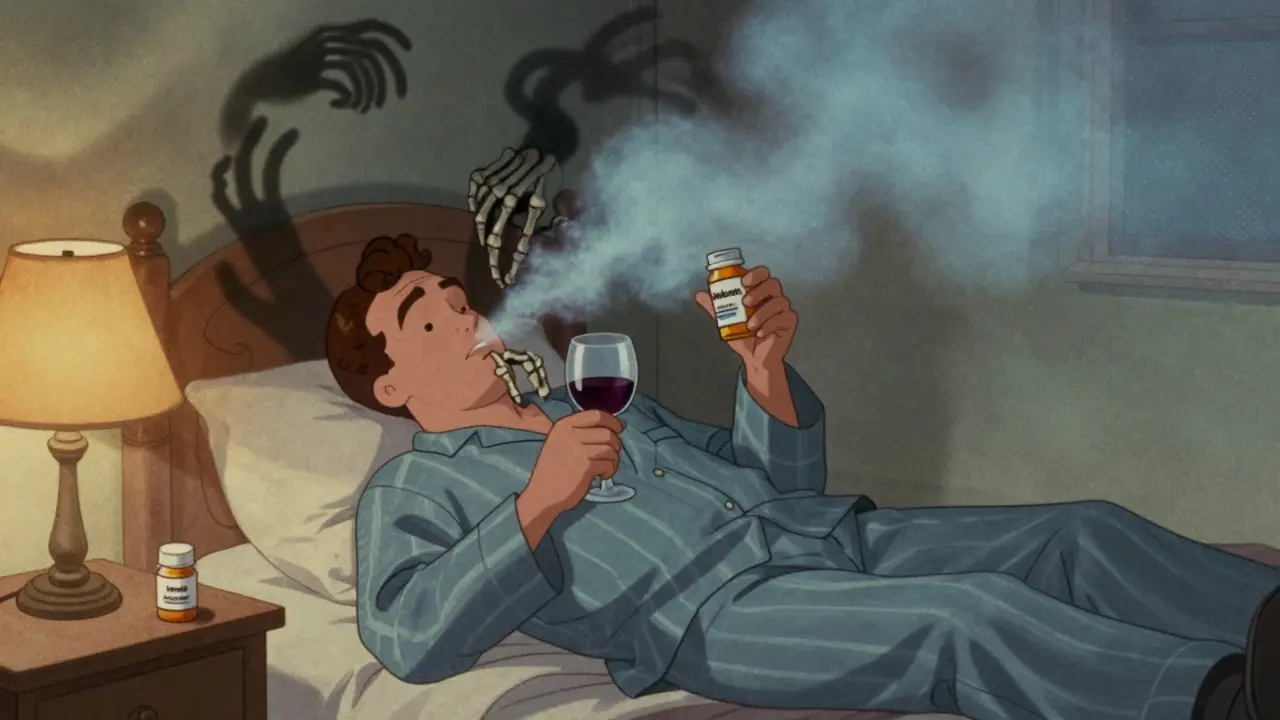
Alcohol and Sleep Medications: The Hidden Danger of Combined Sedation
It’s 11 p.m. You’ve had a long day. A glass of wine helps you unwind. You pop your sleep pill-maybe Ambien, maybe an OTC sleep aid-and lie down, expecting a deep, restful night. But what you don’t realize is that you’re not just taking two things to help you sleep. You’re mixing two powerful depressants that can slow your breathing to dangerous levels, leave you with no memory of the night, or even stop your heart. This isn’t a myth. It’s a medical emergency waiting to happen.
Why Alcohol and Sleep Pills Don’t Mix
Alcohol and prescription sleep medications both work on the same part of your brain: the GABA receptors. These receptors calm your nervous system. When you take just one, it helps you relax. When you take both, they don’t just add up-they multiply. This is called synergistic sedation. The result? Your brain gets so depressed it can’t keep your breathing steady or wake you up if you stop breathing.
The FDA has been clear since 2022: no amount of alcohol is safe with prescription sleep aids. Even one drink-a single beer or a small glass of wine-can be enough to push your body into a dangerous state. Clinical studies show that when alcohol is mixed with zolpidem (Ambien), the drug stays in your system more than twice as long. That means you’re not just sleepy-you’re impaired for hours longer than expected.
The Most Dangerous Sleep Medications
Not all sleep pills carry the same risk. The biggest dangers come from three types:
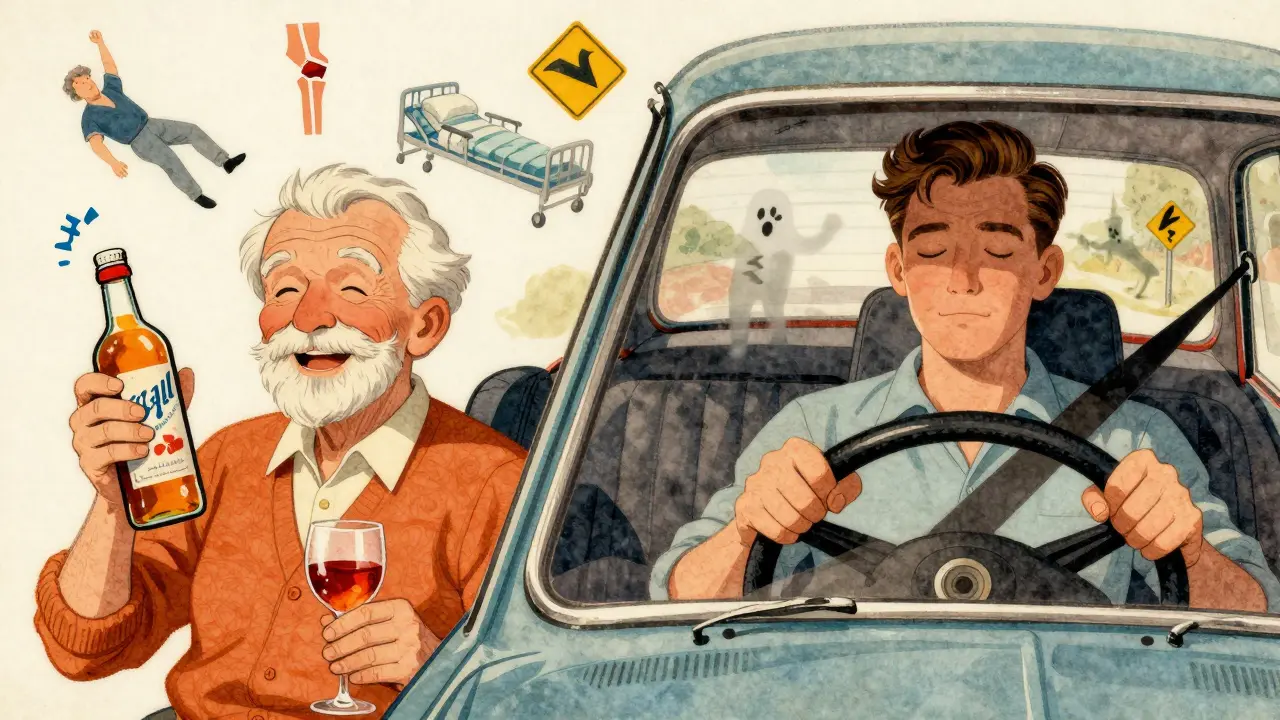
- Z-drugs (like Ambien, Lunesta, and Sonata): These are the most dangerous when mixed with alcohol. Ambien alone can cause sleepwalking or sleep-driving. With alcohol, those risks jump by 15 times. A 2023 study found that 2.4% of people who took Ambien with even a small amount of alcohol experienced complex sleep behaviors-like driving while asleep-with no memory of it afterward.
- Benzodiazepines (like Ativan, Klonopin, Restoril): These were once the go-to sleep meds. They’re still prescribed, but they’re just as risky. Mixing them with alcohol can drop your oxygen levels below 85%, a level that can cause brain damage over time.
- OTC sleep aids (like ZzzQuil and Unisom): These contain diphenhydramine or doxylamine, antihistamines that make you drowsy. They’re sold as "natural" or "gentle," but they’re not safe with alcohol. For adults over 65, combining these with even one drink increases fall risk by 300%. Emergency room visits for hip fractures from this combo have nearly quadrupled since 2018.
Here’s what the numbers say:
| Medication Type | Increased Sedation with Alcohol | Key Risk | Emergency Visits (2022) |
|---|---|---|---|
| Zolpidem (Ambien) | 2.7x greater impairment than alcohol alone | Sleep-driving, memory loss | 63% of all cases |
| Eszopiclone (Lunesta) | Respiratory rate drops to 9.3 breaths/min | Low oxygen, confusion | 22% of all cases |
| Diphenhydramine (ZzzQuil) | 300% higher fall risk in seniors | Delirium, hospitalization | 41% of OTC-related visits |
| Melatonin | Minimal interaction | Next-day drowsiness | Not reported |
Who’s Most at Risk?
It’s not just older adults. While people over 65 face the highest risk of falls and confusion, the biggest spike in emergency visits is among adults aged 35 to 54. Why? This group is more likely to take sleep meds regularly, drink socially, and underestimate the danger. A 2021 autopsy study found that 83% of fatal Ambien-alcohol interactions happened at blood alcohol levels below the legal driving limit of 0.08%. That means someone could have had just one drink-and still died.
Older adults are especially vulnerable because their bodies process alcohol and medications slower. Liver function declines with age, so both substances stick around longer. One drink can have the same effect as two or three in a younger person. That’s why the American Geriatrics Society now says: avoid alcohol completely if you’re over 65 and taking any sleep aid.
What About Melatonin?
If you’re looking for a safer alternative, melatonin is the only sleep supplement with minimal interaction risk. It doesn’t act on GABA receptors like alcohol and prescription pills do. That means it won’t slow your breathing. However, it still increases next-day drowsiness by 35% when combined with alcohol. So while it’s not deadly, it’s not risk-free. If you’re using melatonin, stick to one dose and avoid alcohol if you need to drive or operate machinery the next day.
Real Stories, Real Consequences
Reddit threads, patient forums, and FDA reports are full of terrifying stories. One user, u/SleepWalker99, wrote: "Woke up 2 miles from home with no memory of driving there after taking half an Ambien with two glasses of wine." That’s not an isolated case. The FDA received over 1,800 consumer reports in 2021 about alcohol-sleep med interactions. Nearly two-thirds of those people said they had no memory of what happened.
On Drugs.com, Ambien has a 1.8/5 safety rating when combined with alcohol. The most common complaint? "Extreme drowsiness lasting 12+ hours." For Lunesta, it’s "confusion and memory loss." And for OTC sleep aids, seniors are reporting hospitalizations after just one drink.

What Should You Do?
Here’s the simple truth: never mix alcohol with any prescription sleep medication. Not even one drink. Not even on weekends. Not even "just this once."
Follow these steps to stay safe:
- Read the label. All FDA-approved sleep medications now carry a black box warning: "Do not consume alcohol while taking this medication." If you don’t see it, ask your pharmacist.
- Wait at least 6 hours. If you’ve had alcohol, wait at least 6 hours before taking a Z-drug like Ambien. For benzodiazepines, wait 12 hours. Your body needs time to clear the alcohol.
- Ask your doctor. If you drink regularly, your doctor may need to reconsider your sleep treatment. There are non-drug options like CBT-I (Cognitive Behavioral Therapy for Insomnia) that work better long-term and have zero interaction risks.
- Don’t trust OTC labels. "Natural" doesn’t mean safe. ZzzQuil and Unisom are just as dangerous as prescription pills when mixed with alcohol.
- Use melatonin cautiously. It’s the safest option, but still avoid alcohol if you need to be alert the next day.
The Bigger Picture
Over 58 million Z-drug prescriptions were filled in the U.S. in 2022. That’s more than ever before. And yet, 68% of patients say they weren’t properly warned about alcohol risks when they got their prescription. That’s a failure in patient education-and it’s costing lives.
There’s hope, though. New sleep medications like Dayvigo (lemborexant) are being developed to avoid GABA pathways entirely. These drugs target orexin receptors, which regulate wakefulness, not sedation. Early data shows they have far less interaction with alcohol. In clinical trials, Dayvigo’s half-life only increased by 15% with alcohol-compared to 150-200% for Ambien.
The NIH has launched a $4.7 million study to find genetic markers that predict who’s most at risk for fatal interactions. That could one day lead to personalized warnings based on your DNA.
For now, though, the message is simple: if you’re taking a sleep pill, leave the alcohol on the shelf. Your brain, your breathing, and your life depend on it.
Can I have one glass of wine with Ambien if I wait a few hours?
No. Even one drink can dangerously amplify Ambien’s effects. Alcohol stays in your system longer than you think, and it doesn’t matter if you wait a few hours-the interaction still happens. The FDA and medical experts agree: no amount is safe. The risk of sleep-driving, respiratory depression, or memory loss is too high.
Is it safe to take melatonin with alcohol?
Melatonin has minimal interaction with alcohol and doesn’t cause dangerous sedation. However, combining them can make you more drowsy the next day-by about 35%. If you’re planning to drive, work, or operate machinery, avoid alcohol even with melatonin. It’s not deadly, but it’s still not ideal.
Why are older adults more at risk?
As we age, our liver processes alcohol and medications slower. This means both substances stay in the body longer, increasing sedation and fall risk. People over 65 also have weaker balance and slower reflexes. Mixing alcohol with sleep meds increases their chance of falling by 300%, leading to fractures, hospitalizations, and even death.
What should I do if I’ve already mixed alcohol and sleep meds?
If you’ve taken them together and feel extremely drowsy, confused, or have trouble breathing, call 911 immediately. Don’t wait. If you’re not having symptoms but are worried, contact your doctor or pharmacist. Never try to "sleep it off"-this isn’t a normal hangover. It’s a medical emergency waiting to happen.
Are there alternatives to sleep medications?
Yes. Cognitive Behavioral Therapy for Insomnia (CBT-I) is the gold standard treatment recommended by the American Academy of Sleep Medicine. It’s as effective as medication, has no side effects, and works long-term. Other options include sleep hygiene improvements-like keeping a consistent schedule, avoiding screens before bed, and reducing caffeine. Talk to your doctor about non-drug treatments, especially if you drink alcohol.



14 Comments
Mike Rengifo
December 19, 2025 at 03:02
Been there. Had one glass of wine with Ambien after a rough week. Woke up on the floor next to my cat with no idea how I got there. Didn’t break anything, but my dignity? Gone. Now I just drink chamomile tea and stare at the ceiling until I pass out. Worth it.
Sajith Shams
December 19, 2025 at 11:33
Let me tell you something about American medicine. You think this is about safety? No. It’s about liability. The FDA doesn’t care if you die-they care if your family sues them. That’s why they slap black box warnings on everything. Meanwhile, real solutions like sleep restriction therapy? Ignored. This isn’t a medical issue-it’s a corporate one.
Kinnaird Lynsey
December 21, 2025 at 01:28
So… one glass of wine with melatonin is basically just a fancy nightcap? 😏 I’ll take that over a chemical takedown any day. Still, I don’t blame people for mixing things-when you’re exhausted and the world won’t shut up, you do what you gotta do. Just… maybe don’t drive afterward.
Mark Able
December 23, 2025 at 00:01
Y’all are acting like this is news. I’ve been telling my cousins for years not to mix Ambien and tequila. One of them drove into a ditch in 2019. No charges. No jail. Just a $500 ticket and a lifetime of shame. People don’t listen until it’s too late.
Erica Vest
December 24, 2025 at 12:45
Important clarification: melatonin’s interaction with alcohol isn’t just about next-day drowsiness-it’s about disrupted circadian signaling. Alcohol suppresses melatonin production in the pineal gland, so even if you take it, your body isn’t getting the signal it needs. You’re not just sleepy-you’re rhythmically confused. That’s why you feel off for days.
Marsha Jentzsch
December 26, 2025 at 01:04
HOW MANY PEOPLE HAVE DIED BECAUSE OF THIS??!! I SWEAR IF I SEE ONE MORE PERSON POST "JUST ONE DRINK" ON REDDIT I’M GOING TO SCREAM!! I’M A NURSE. I’VE SEEN THE BODIES. I’VE SEEN THE FAMILIES. YOU THINK YOU’RE BEING COOL? YOU’RE BEING A STATISTIC.
Matt Davies
December 27, 2025 at 00:40
It’s like putting a feather duster on a jet engine and calling it a "gentle breeze." Alcohol and sleep meds don’t just add-they detonate. I used to think "natural" meant safe. Now I know it just means the FDA hasn’t gotten around to suing the company yet. Melatonin’s the only chill one in the room.
Ashley Bliss
December 27, 2025 at 18:33
It’s not just the alcohol. It’s the loneliness. The quiet desperation of lying awake at 2 a.m. wondering if you’ll ever feel whole again. So you reach for the wine. The pill. The silence. We don’t do this because we’re stupid-we do it because we’re tired. And nobody told us how heavy that tiredness really is.
Dev Sawner
December 29, 2025 at 16:57
The data presented is statistically significant but methodologically flawed. The 2.7x impairment metric is derived from subjective self-reports and lacks controlled polysomnography. Furthermore, the 2023 study cited on sleep-driving has a sample size of n=127, which is insufficient for population-level extrapolation. The FDA’s stance, while prudent, is not evidence-based-it is precautionary.
jessica .
December 31, 2025 at 07:00
Who’s really behind this? Big Pharma. They make billions off sleep meds. They know alcohol makes you dependent. They know you’ll keep buying. They just don’t want you to know it. That’s why they say "no alcohol"-not because it’s dangerous, but because they need you to think you need their pills. Wake up.
Ryan van Leent
January 2, 2026 at 00:12
So you're telling me I can't have a beer after my zzzquil? That's it I'm done. I'm just gonna sleep on the couch. My dog's got better sleep hygiene than me anyway
Moses Odumbe
January 2, 2026 at 12:20
Bro I took Ambien + whiskey once and woke up eating cold pizza at 4am wearing my socks on my hands 😅 I thought I was in a dream. Then I Googled it and nearly had a heart attack. Melatonin now. No regrets. 🙏🌙
Anna Sedervay
January 3, 2026 at 03:06
One must question the epistemological foundations of this discourse. The very notion of "safe" is a social construct, contingent upon regulatory paradigms that prioritize economic stability over individual autonomy. The GABAergic synergy, while clinically observable, is pathologized to maintain pharmaceutical hegemony. One might argue that the true danger lies not in the pharmacological interaction, but in the societal suppression of hedonistic self-medication.
Chris Davidson
January 4, 2026 at 16:26
Just don't do it. Simple. No excuses. No "just one". If you're taking a sleep med you're already in the danger zone. Add alcohol and you're playing Russian roulette with your brainstem. Stop being clever. Stay alive.