
How to Protect Your Privacy When Disposing of Medications
Throwing away old pills might seem like a simple chore, but if you don’t handle the bottles right, you’re putting your personal information at risk. Prescription labels hold more than just your name and dosage-they include your doctor’s name, pharmacy details, diagnosis codes, and sometimes even your birth date. All of that is enough for someone to steal your identity, forge prescriptions, or even get access to your insurance. The good news? Protecting your privacy when disposing of medications isn’t hard. You just need to know the right steps.
Why Prescription Labels Are a Privacy Risk
You might think, “It’s just an empty bottle.” But that’s exactly what thieves think too. A 2021 study in the Journal of the American Pharmacists Association found that 42% of prescription bottles tossed in residential trash still had readable personal info. That’s not just a nuisance-it’s a legal issue. Under HIPAA, healthcare providers and pharmacies are required to protect your Protected Health Information (PHI), but once that bottle leaves their hands, the responsibility shifts to you. PHI on a pill bottle includes your full name, address, phone number, Rx number, prescribing doctor, and sometimes even the condition being treated-like “for diabetes” or “for anxiety.” Identity thieves use this data to file fake insurance claims, get controlled substances under your name, or sell your info on the dark web. One woman in Texas lost $1,200 to fraud after someone found her oxycodone bottle in the trash and used her details to refill the prescription. That’s not rare. It’s happening more often.What the Law Says About Disposal
The Health Insurance Portability and Accountability Act (HIPAA) doesn’t just apply to hospitals and clinics-it applies to you too. The HHS Office for Civil Rights has made it clear: improper disposal of PHI on prescription containers is one of the top 10 privacy risks in healthcare today. While the law doesn’t fine individuals for tossing out a bottle with their name still on it, it does hold pharmacies and providers accountable for giving you clear instructions. And if you’re a caregiver or managing meds for an elderly parent, you’re legally responsible for protecting their data too. The FDA, DEA, and EPA all agree: privacy protection is part of safe disposal. The DEA’s National Prescription Drug Take Back Day has collected over 9.5 million pounds of medications since 2010-not just to keep them out of waterways, but to prevent misuse. And in 2023, the HHS issued updated guidance reminding everyone that “reasonable safeguards” include making personal info unreadable before tossing anything.The Best Way to Dispose: Take-Back Programs
If you want the highest level of privacy protection, use a drug take-back program. These are run by law enforcement, pharmacies, or local governments. The DEA hosts two National Prescription Drug Take Back Days each year-most recently in April 2024-with over 6,000 drop-off sites across the U.S. You don’t need to show ID. You don’t need to explain why you’re dropping off meds. You just hand over the bottle, and they destroy everything-meds and labels-securely. Most chain pharmacies like Walgreens, CVS, and Rite Aid now offer year-round drop-off bins. These are locked, monitored, and compliant with DEA security standards. In a 2024 Pharmacy Times poll, 89% of people who used these programs said they felt “very confident” their privacy was protected. That’s compared to just 32% who used at-home methods. Mail-back programs are another great option. Companies like Walgreens and DisposeRx sell prepaid envelopes for $2.99 to $6.99. You put your meds and empty bottles inside, seal it, and drop it in the mailbox. The envelope is designed so the label can’t be read from the outside, and the contents are destroyed at a licensed facility. No one sees your name. No one touches your bottle. It’s private, convenient, and effective.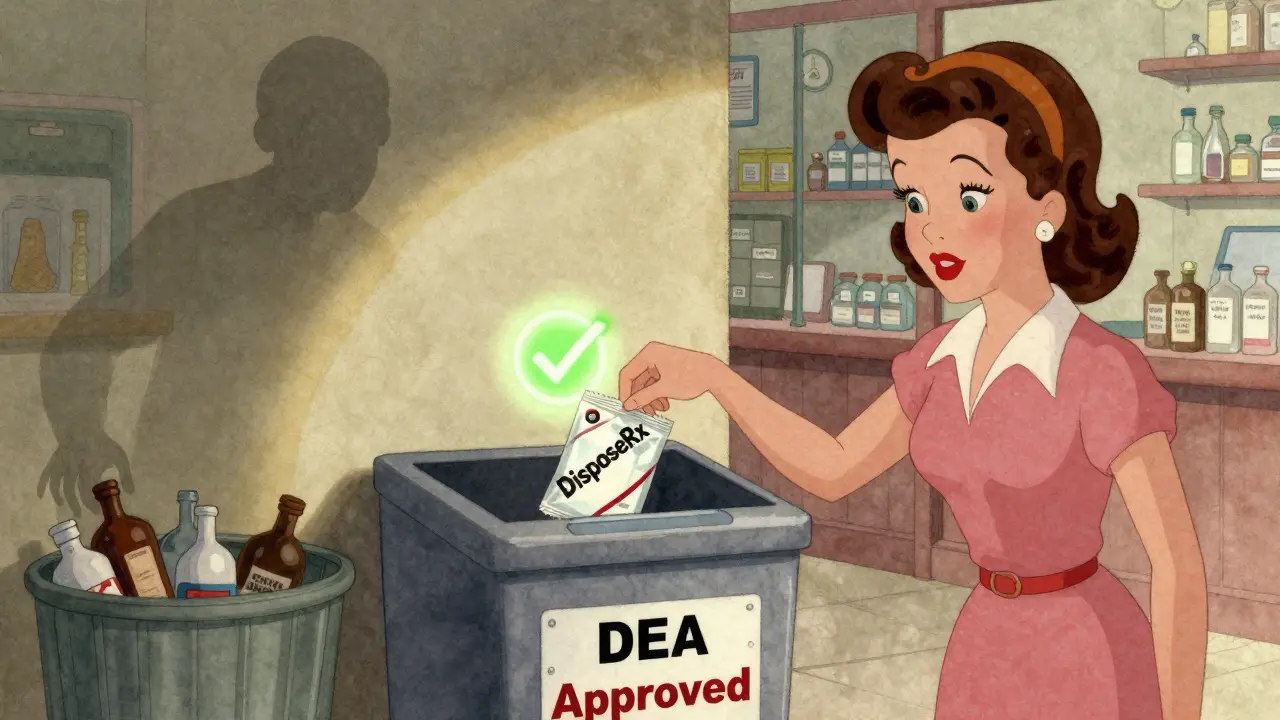
At-Home Disposal: How to Do It Right
Not everyone has easy access to a take-back site. If you’re stuck disposing at home, here’s the FDA’s official 5-step method, updated in October 2022:- Take meds out of the original bottle. Don’t just toss the bottle. Empty the pills into a sealable bag or container.
- Mix them with something unpleasant. Used coffee grounds, kitty litter, or dirt work best. This makes the pills unappealing and harder to recover.
- Put the mixture in a sealed container. A plastic tub with a lid or a zip-top bag works. This prevents spills and keeps pets or kids from digging through trash.
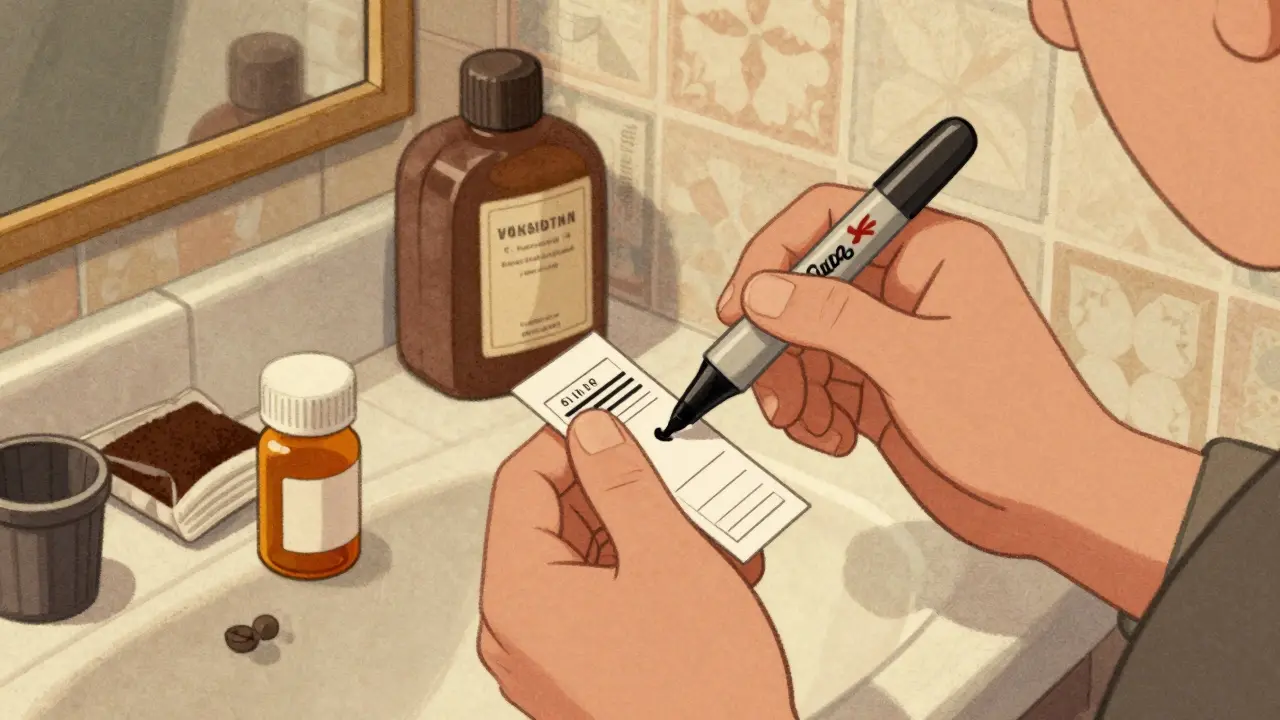
- Destroy the label. This is the most critical step. Use a permanent marker (like a Sharpie Industrial) to black out your name, address, Rx number, and diagnosis. If you don’t have a marker, cover the label with duct tape or soak the bottle in hot water and peel the label off. Scratching with a key or sandpaper works too.
- Throw both in the trash. Don’t recycle the bottle unless your local program accepts it-and even then, make sure the label is gone.
Pro tip: A 2023 University of Michigan study found that 47% of people struggle to remove labels from plastic bottles. If you’re having trouble, soak the bottle in warm soapy water for 10 minutes. The label should peel off easily. Then scrub the residue with baking soda and a sponge.
What Not to Do
There are a few common mistakes that put your privacy at risk:- Don’t flush meds unless they’re on the FDA Flush List. Only 15 medications, like fentanyl patches and certain opioids, should go down the toilet. Flushing others harms the environment and doesn’t protect your privacy.
- Don’t just throw the bottle in the recycling. Recycling centers don’t check labels. Someone could pull it out and access your info.
- Don’t assume “empty” means safe. Even if you think the bottle is empty, there’s often residue inside. Always mix with an undesirable substance.
- Don’t rely on memory. If you’re juggling multiple meds, write down which ones you’ve disposed of. A simple note on your phone helps avoid confusion.
Tools That Make It Easier
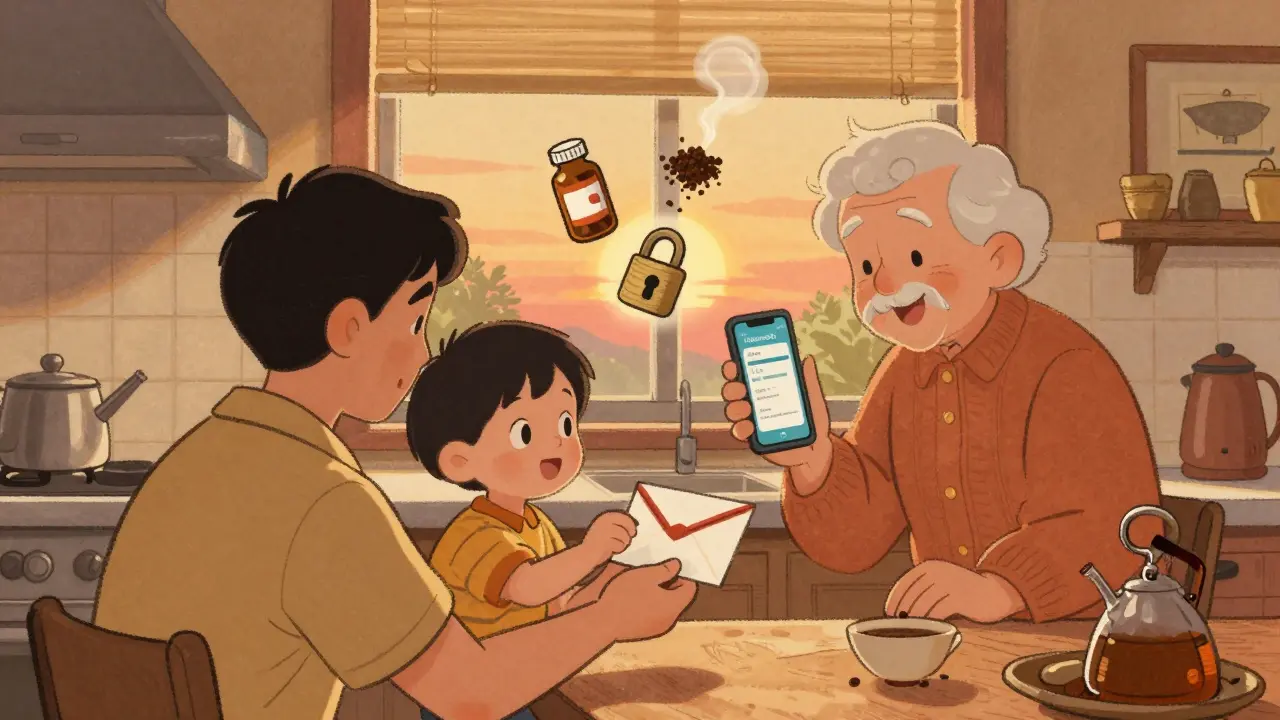
There are products designed to simplify privacy protection:- DisposeRx pouches (around $1.50-$3.00 each) contain activated carbon that neutralizes meds while you shake them. You drop the bottle inside, seal it, and toss it. The pouch destroys the medication and the label becomes unreadable. Many users call it the “set it and forget it” solution.
- Sharpie Industrial markers are designed to resist smudging on plastic. A pack costs about $5 and lasts for years.
- Free apps like DisposeRx’s let you scan your pill bottle and tell you if it’s on the FDA Flush List. No more guessing.
These tools aren’t required, but they cut down the time and confusion. A 2024 Yelp review from a user in Arizona said: “The pouch lets me destroy both the medication AND the personal information in one step-finally a simple privacy solution.”
What About the Environment?
Privacy isn’t the only concern. The EPA estimates 3.2 million pounds of pharmaceuticals end up in U.S. water systems every year. Flushing meds or dumping them in landfills contributes to this. Take-back programs and mail-back envelopes are the most environmentally friendly options because they ensure controlled destruction. Deactivation pouches like DisposeRx also prevent chemicals from leaching into soil or groundwater. The market for pharmaceutical waste management is growing fast-projected to hit $3.12 billion by 2030. Why? Because people are waking up to the dual risks: privacy and pollution. More pharmacies are adding take-back bins. More states are funding disposal programs. And more companies are building products that solve both problems at once.What You Can Do Today
You don’t need to wait for a take-back day or buy special tools to start protecting your privacy. Here’s your quick action plan:- Check your medicine cabinet. Gather all expired, unused, or unwanted pills.
- Find your nearest take-back location using the DEA’s website or ask your pharmacist.
- If you can’t get there, grab a Sharpie and a bag of coffee grounds.
- Empty the bottles. Scrub off the labels. Mix the pills with the grounds. Seal it. Trash it.
- Repeat every 3-6 months. Don’t wait until you have a closet full of old meds.
Privacy protection doesn’t have to be complicated. It just has to be consistent. The same way you lock your doors and guard your Social Security number, treat your prescription bottles like sensitive documents. Because they are.
Can I recycle empty pill bottles after removing the label?
It depends on your local recycling rules. Many curbside programs don’t accept pill bottles because they’re made of mixed plastics. Even if they do, you must remove the label completely-no smudges, no tape. If you’re unsure, check with your city’s waste department. When in doubt, trash it. The privacy risk isn’t worth the recycling.
What if I’m caring for an elderly parent who can’t scratch off labels?
You’re responsible for their PHI under HIPAA. Use a DisposeRx pouch or mail-back envelope-those require no label removal. If you’re doing it manually, soak the bottles in warm water to loosen labels, then use a scrub brush. Write down each medication you dispose of so you don’t miss any. Many pharmacies offer free disposal kits for caregivers-ask your pharmacist.
Is it safe to just throw away pills without mixing them with anything?
No. The FDA says you must mix medications with an unappealing substance like coffee grounds or kitty litter. Otherwise, someone-like a child, pet, or thief-could dig them out of the trash and use them. Mixing also prevents the pills from being easily recovered and reused. It’s not just about privacy-it’s about safety.
How do I know if a medication should be flushed?
Only 15 medications are on the FDA’s Flush List as of May 2024. These include fentanyl patches, oxycodone, and certain painkillers that are extremely dangerous if accidentally ingested. You can find the full list on the FDA’s website. If your medication isn’t on it, don’t flush it. Use a take-back program or mix it with coffee grounds instead.
Are there free disposal options?
Yes. DEA Take Back Days are free and happen twice a year. Most pharmacies offer free drop-off bins year-round. Some cities have permanent collection sites at police stations or public works facilities. You can also call your local pharmacy-they’ll tell you where to go. You don’t need to pay to dispose of meds safely.



14 Comments
Caitlin Foster
December 27, 2025 at 22:40
OMG YES. I just threw away a bottle last week and didn't think twice-now I'm horrified. Sharpie + coffee grounds is my new ritual. 🙌
Kylie Robson
December 28, 2025 at 00:54
The HIPAA implications here are non-trivial. Prescription labels constitute Protected Health Information (PHI) under 45 CFR 160.103, and failure to de-identify them prior to disposal may constitute a breach of administrative safeguards under §164.308(a)(4). This isn't just common sense-it's regulatory compliance.
Olivia Goolsby
December 29, 2025 at 00:36
You think this is bad? Wait until you find out the DEA is using these take-back programs to build databases on who’s taking what. They’re tracking your meds, your doctor, your zip code-everything. It’s not about privacy, it’s about control. And don’t even get me started on the ‘DisposeRx pouches’-those are probably bugged. 🕵️♀️
Todd Scott
December 29, 2025 at 16:47
In Nigeria, we don’t have take-back programs, but we do have a cultural practice of repurposing pill bottles for storing spices or small tools. The labels? We burn them. It’s not just about privacy-it’s about dignity. Once a bottle held your medicine, it shouldn’t hold your identity. That’s why I always scrub them clean with vinegar and salt. Simple. Effective. Respectful.
Will Neitzer
December 31, 2025 at 12:25
I appreciate the thoroughness of this guide. However, I would like to respectfully suggest that the FDA’s 5-step method be supplemented with a sixth: document your disposal process. Maintaining a digital log-timestamped and encrypted-of which medications were disposed of, how, and when, provides an audit trail that may be useful in the event of identity theft or liability disputes. This aligns with best practices in data governance.
Andrew Gurung
January 1, 2026 at 03:33
Let’s be real-most people don’t care. They just toss the bottle in the recycling like it’s a yogurt cup. And then they wonder why their insurance got billed for 200 oxycodone pills they never took. 🤦♂️ This isn’t just negligence. It’s a national character flaw.
Chris Garcia
January 1, 2026 at 19:37
In my community in Lagos, we’ve started organizing monthly ‘Med Bottle Cleanups’-neighbors bring their empty bottles, we soak the labels off together, and then we turn the clean plastic into planters. It’s become a ritual. We sing while we scrub. It’s healing. And yes, we use baking soda. Always baking soda.
Elizabeth Ganak
January 2, 2026 at 10:29
i just use a lighter to burn the label. works like a charm. no more sticky goo. no more worry. easy peasy. 😊
Nicola George
January 4, 2026 at 00:06
Oh sweet mercy, someone finally said it. I’ve been telling my sister for years to scrub those labels. She still leaves them on. ‘It’s just a bottle,’ she says. Honey. It’s your diagnosis. Your doctor. Your life. 🙄
Alex Lopez
January 5, 2026 at 06:26
I used to think the coffee grounds thing was overkill-until my neighbor’s dog got into the trash and threw up for three days. Turns out, he ate a whole bottle of gabapentin. So now? I use DisposeRx pouches. $3.50. Peace of mind. Worth every penny. 🤝
Nikki Thames
January 5, 2026 at 19:24
I find it disturbing that society has normalized the casual disposal of medical records in the form of prescription bottles. This is not trash-it is forensic evidence of your health history. And yet, we treat it like old pizza boxes. We have lost all sense of bodily sovereignty. This is not a lifestyle tip. This is a moral crisis.
Miriam Piro
January 6, 2026 at 20:28
They’re watching us. The labels aren’t just for identity thieves-they’re for the algorithm. Every pill you take, every condition you have, every pharmacy you visit-it’s all feeding into a predictive model that determines your insurance rates, your job prospects, even your credit score. They’re not just collecting data. They’re building your digital ghost. And you’re handing it to them in a plastic bottle. 💀
Janice Holmes
January 7, 2026 at 18:16
I tried the Sharpie method. The ink smudged. I tried the boiling method. The label came off but the adhesive remained like a greasy scar. Then I bought the DisposeRx pouch. One shake. One seal. One less thing to worry about. Honestly? It’s the only thing that made me feel like I wasn’t a dumbass for not knowing this sooner. 🙏
James Bowers
January 9, 2026 at 15:42
The assertion that ‘the responsibility shifts to you’ is legally misleading. Under HIPAA, the covered entity retains liability for PHI until it is rendered unreadable, indecipherable, and unreconstructable. Merely removing a label does not meet this standard. The burden is not yours-it is the pharmacy’s. They should be providing de-identification tools with every prescription. This is a systemic failure, not a personal one.