
How to Read FDA Safety Communications for Your Medications
Every year, the FDA sends out dozens of safety notices about medications you or someone you care about might be taking. These aren’t ads. They’re not warnings from your pharmacy. These are official updates from the U.S. Food and Drug Administration about real, newly discovered risks tied to your prescription drugs. If you’ve ever seen a letter in the mail or an email saying something like, “Important safety update about your medication,” you’ve seen one of these. But what do they actually mean? And how do you know if you need to take action-or just pay attention?
What FDA Safety Communications Actually Are
The FDA doesn’t just approve drugs and walk away. Once a medication is on the market, it’s watched closely. Thousands of people take it. New side effects show up. Interactions with other drugs emerge. Sometimes, a rare but serious problem only becomes clear after years of use. That’s where FDA Drug Safety Communications are official notices issued by the U.S. Food and Drug Administration to inform the public and healthcare providers about new safety information about approved medications come in.
These aren’t rumors. They’re based on real data-reports from doctors, patient registries, clinical trials, and even voluntary reports from people like you. Since 2007, the FDA has had stronger legal power to track drugs after they’re sold. That’s when the number of these updates started climbing. Today, they issue 50 to 70 major safety notices every year.
Not all of them are the same. Some are short alerts about urgent risks. Others are full labeling changes that rewrite how doctors should prescribe the drug. Some affect every medicine in a class-like all opioids. Others target just one brand. The key is knowing how to read them so you don’t miss what matters.
How to Spot the Most Important Parts
These documents are written for doctors first, but they include clear sections for patients too. If you’re not a clinician, here’s where to look:
- What Safety Concern Is FDA Announcing? This is the headline. It tells you in plain language what the issue is. For example: “FDA is updating labels to warn that sudden stopping of opioid painkillers can cause serious withdrawal.”
- For Patients section. This is your part. It tells you what to do. It might say: “Don’t stop your medicine without talking to your doctor.” Or: “Call your provider if you feel dizzy or have chest pain.”
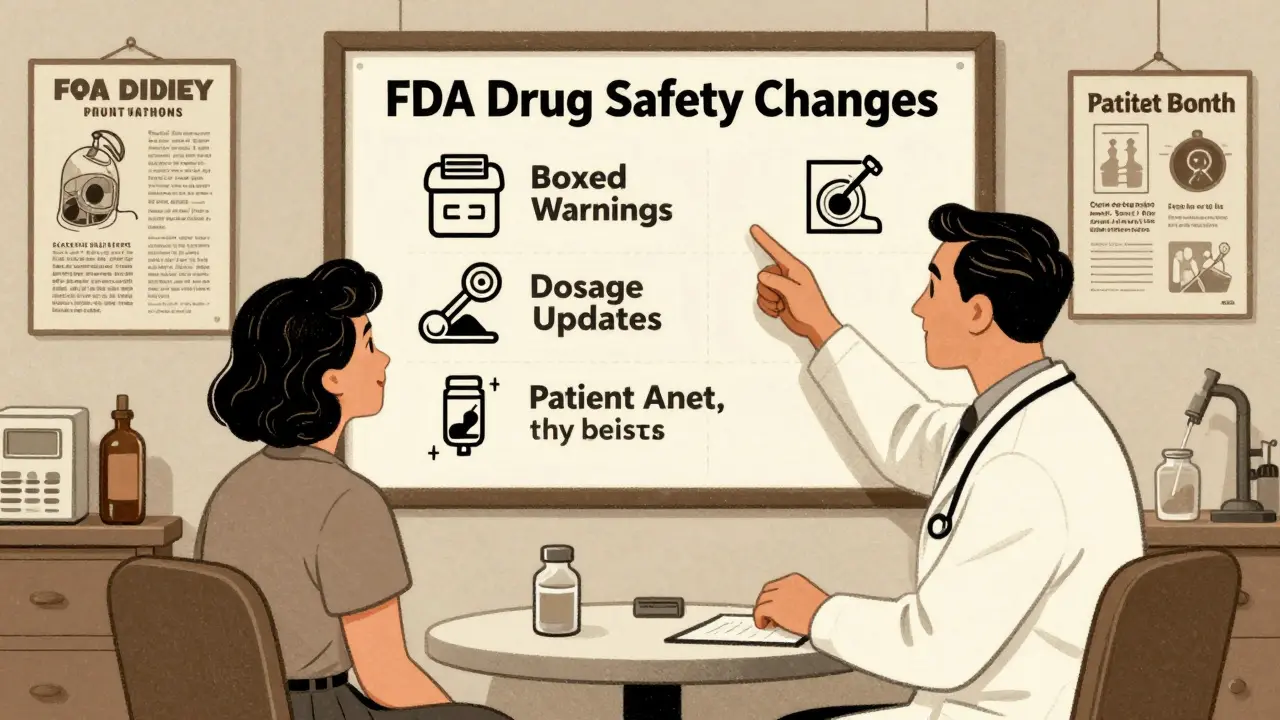
- Boxed Warning is the FDA’s highest-level alert. It’s called that because it used to appear in a box on the drug’s label. If you see this mentioned, it means the risk is serious-possibly life-threatening. Changes here are urgent.
- Highlights of Prescribing Information summarizes what changed in the official prescribing guide. Look for bold text (new info) and strikethrough (removed info). This helps you see exactly what’s different.
One example: In July 2025, the FDA updated safety info for all opioid painkillers. The old label said: “Do not abruptly discontinue.” The new version says: “Do not rapidly reduce or abruptly discontinue.” That small change matters. It means doctors now have to plan a slower, safer way to stop the drug-not just turn it off.
What the FDA Says About Your Medication
Every communication includes references to specific sections of the drug’s official prescribing information. These are numbered like “2.x” or “5.x.” That’s not random. It points to exact parts of the doctor’s manual: Section 2 is Dosage and Administration. Section 5 is Warnings and Precautions. If the FDA changes Section 5, it’s about risks. If it changes Section 2, it’s about how much to take or how often.
For patients, the real takeaway is often in the Medication Guide a printed handout that comes with your prescription, required by the FDA to explain risks, uses, and instructions in simple language. By law, this guide must be written at an 8th-grade reading level. It should answer: What is this drug for? What are the biggest risks? How do I take it? What should I avoid?
But here’s the catch: Many patients don’t read it. A 2023 survey found that only 37% of patients reviewed their Medication Guide every time they got a refill. That’s a problem. Side effects can change. New warnings appear. The guide you got last year might not reflect today’s risks.
What to Do When You See a Safety Notice
Don’t panic. Don’t stop your medicine on your own. Here’s what to do instead:
- Find the full notice on the FDA’s website: fda.gov/drugs/drug-safety-and-availability. Search by drug name.
- Look for the “For Patients” section. It will tell you if you need to act now, call your doctor, or just stay aware.
- Check if it’s a Boxed Warning. If yes, this is serious. Talk to your provider within a week.
- Read the Medication Guide that came with your prescription. Compare it to the FDA notice. If they don’t match, ask why.
- Don’t rely on your pharmacist alone. They may not see every notice. Your doctor needs to know too.
Some changes are about dosing. Others are about who shouldn’t take the drug. For example, a 2022 safety notice for the cancer drug Copiktra told patients: “Talk to your doctor about the risks and benefits of continuing treatment.” That’s not a stop order. It’s a prompt to have a conversation.
How to Stay Updated Without Overwhelming Yourself
You don’t need to check the FDA website every day. Here’s how to make it easier:
- Sign up for FDA email alerts. Go to the FDA’s Drug Safety page and choose alerts for your specific drug or drug class (like “antibiotics” or “diabetes meds”). You’ll get one email when something changes.
- Ask your doctor or pharmacist if they get FDA updates. Many do. Ask them: “Will you let me know if there’s a safety update for my medicine?”
- Keep your Medication Guides in one place. Review them every time you refill. Highlight anything new.
- Use the FDA’s plain-language summaries. Since 2023, the FDA has started releasing simplified versions of major alerts in English and Spanish. These are designed for people without medical training.
Some people worry that safety notices come too late. Studies show it can take over four years for the FDA to act on early warning signs. But the system is improving. The 2022 Food and Drug Omnibus Reform Act now requires the FDA to issue safety notices within 30 days of finalizing changes-down from 60.
Common Mistakes People Make
Many patients misunderstand these notices. Here’s what to avoid:
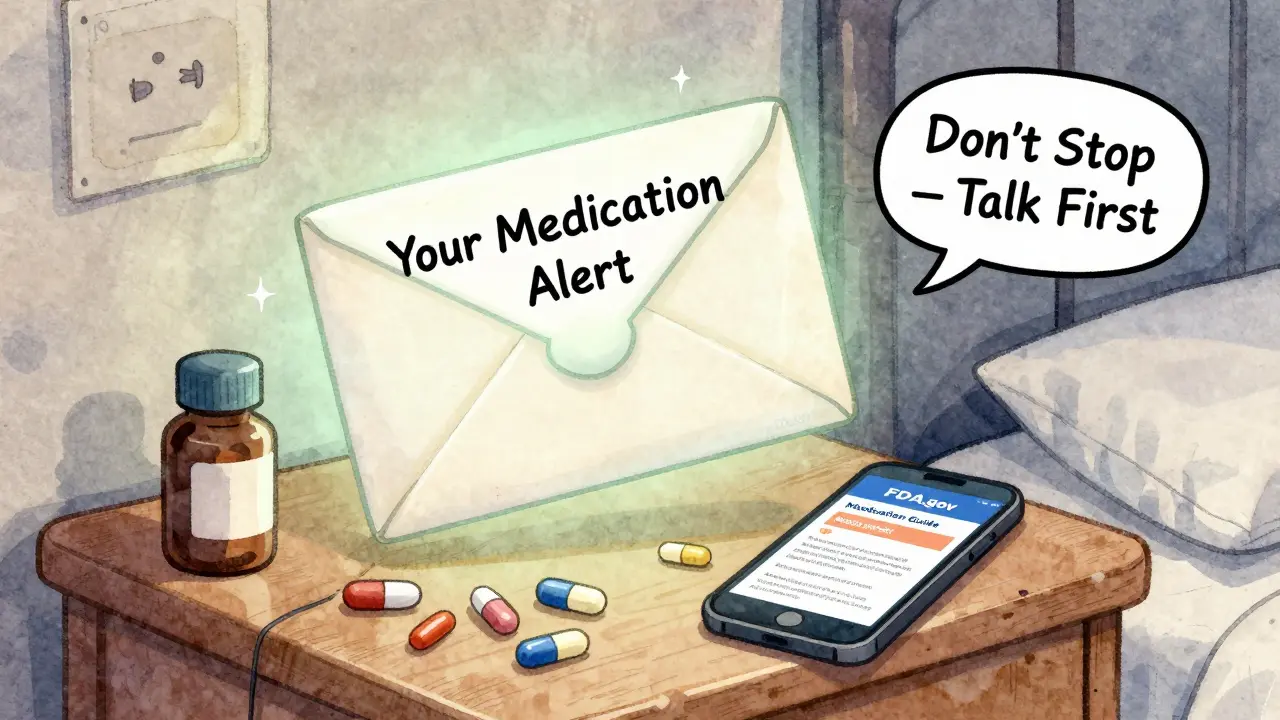
- Stopping your medicine without talking to your doctor. Even if the notice says “serious risk,” stopping suddenly can be dangerous. Many drugs need to be tapered.
- Assuming all alerts are emergencies. Not every update means you’re in danger. Some are just reminders or minor tweaks.
- Ignoring the “For Patients” section. It’s there for a reason. It’s written to help you, not confuse you.
- Thinking your pharmacy’s warning is enough. Pharmacists give you general advice. The FDA notice is the source. Always check both.
One patient told her doctor she stopped her blood pressure medication after reading a safety alert. She ended up in the ER with a stroke. The alert didn’t say to stop. It said to monitor for a rare side effect. She misread it.
What’s Changing Soon
The FDA is working on making these notices easier to understand. By 2025, they plan to deliver personalized safety alerts directly through patient portals used by hospitals and clinics. That means you might get a message in your MyChart or Epic account saying, “Your medication, Lisinopril, has a new safety update.”
They’re also testing visual aids-charts, icons, and simple graphics-to help explain risks. Right now, only 54% of patients fully understand these notices. The goal is to get that up to 75% by 2027.
For now, the best tool you have is awareness. Know that these notices exist. Know where to find them. And know that your doctor is your partner in understanding them.


10 Comments
Ashley Paashuis
February 20, 2026 at 17:25
The FDA’s safety communications are one of those quiet lifelines in healthcare that most people never think about until something goes wrong. I’ve been reading them for years now, ever since my mom had that reaction to her blood thinner. It’s not glamorous, but knowing how to parse those bullet points has saved us from panic more than once. The ‘For Patients’ section? That’s the golden ticket. It’s written in plain language for a reason - because people deserve to understand what’s in their medicine without a medical degree.
And yes, I keep every Medication Guide in a folder labeled ‘Drugs & Dangers.’ It’s weird, I know. But when your doctor changes your prescription and doesn’t mention the new warning? You’re glad you have it.
Also, signing up for FDA email alerts was the best decision I ever made. One email a year, maybe two. Worth it.
Oana Iordachescu
February 21, 2026 at 16:48
Let me just say this: the FDA is not your friend. They wait YEARS before acting - four years on average, as the article admits. And when they finally do? They bury the real danger in bureaucratic language. The ‘Boxed Warning’? That’s just the tip of the iceberg. Behind every notice is a trail of dead patients, lawsuits, and corporate lobbying. You think they care about your health? They care about liability. Read the fine print - the ‘voluntary reports from people like you’? Those get ignored unless there are hundreds. And don’t get me started on how they classify ‘rare’ side effects… 1 in 10,000? That’s 30,000 Americans. That’s not rare. That’s negligence. :(
PS: Always cross-reference with PubMed. The FDA’s data is outdated before it’s published.
Davis teo
February 23, 2026 at 01:55
Okay, I just read this whole thing and I’m crying. Like, full-on ugly tears. I thought I was just paranoid for double-checking my meds every time I got a refill. Turns out I’m just… smart? I’ve been keeping a spreadsheet. Drug name. Date received. FDA alert status. Notes from doctor. I even color-coded it. Red = stop immediately. Yellow = call within 72 hours. Green = chill. My partner thinks I’m a lunatic. My pharmacist calls me ‘the Medication Whisperer.’
And last month? I caught a change in my thyroid med that my doctor hadn’t even seen yet. I printed the FDA notice, walked into his office, and said, ‘Explain this.’ He apologized. We changed the dosage. I didn’t die. We all lived.
Also, I have a shrine to the FDA’s plain-language summaries. It’s in my bathroom. I read it while I pee. It’s therapeutic.
Michaela Jorstad
February 23, 2026 at 15:14
I just want to say: thank you. For writing this. For caring enough to explain it clearly. So many people are terrified of their prescriptions - not because they’re dangerous, but because they’re confusing. And confusion kills. I’m a nurse, and I’ve seen too many patients stop their meds because they misread a pharmacy label. Or worse - they didn’t read anything at all.
The Medication Guide isn’t optional. It’s your legal right. And if your pharmacy doesn’t give it to you? Ask again. And again. And if they still refuse? Call the FDA. They’ll listen.
Also - keep the guides. Store them. Date them. Highlight changes. You’ll thank yourself later.
And if you’re reading this and you’re scared? You’re not alone. We’re all just trying to stay alive.
Danielle Gerrish
February 24, 2026 at 15:53
Okay, so I read this article and I’m now officially obsessed. Like, I’ve spent the last three hours deep-diving into FDA safety notices for every drug I’ve ever taken - even the one I stopped in 2018. I found a 2021 update for my old anxiety med that said, ‘May increase risk of suicidal ideation in patients under 25.’ I was 23 when I took it. I didn’t know. I didn’t even remember taking it. I thought I was just ‘feeling off’ that winter. Now I’m wondering if that’s why I dropped out of college. Was it the drug? Or was it me? Am I broken? Is my brain forever changed? Did they know? Did they care? Why didn’t someone tell me?
I’m not okay. I need to talk to someone. My therapist says I’m having a ‘health anxiety spiral.’ I think she’s wrong. I think I’m awake.
Also - I just emailed the FDA. I asked them to send me a handwritten apology. I’m waiting.
Also also - I’m not taking any more pills. Ever. I’m going full herbal. Turmeric. Ashwagandha. Moon water. I’m reborn.
Liam Crean
February 25, 2026 at 13:20
This was actually really helpful. I didn’t know about the ‘For Patients’ section. I always skimmed past it thinking it was fluff. Turns out it’s the only part that matters. I checked my blood pressure med - Lisinopril - and there was a 2024 update about avoiding NSAIDs. I’d been taking ibuprofen for headaches. I stopped. Called my doctor. He said, ‘Good catch.’
I don’t usually care about this stuff. But now I do. I’ve signed up for the alerts. I printed my Medication Guide. I’m not a freak. I’m just… informed.
Thanks for making it feel doable.
madison winter
February 27, 2026 at 12:21
So… we’re supposed to trust the FDA? After the opioid crisis? After Vioxx? After the whole thalidomide thing? This is just PR. They don’t act until the lawsuits pile up. The 30-day rule? That’s after a year of internal review. The ‘plain language’ summaries? Written by interns. The ‘For Patients’ section? A footnote. The real danger is in Section 8 - Contraindications - which nobody reads because it’s in 8-point font. And don’t get me started on how they classify ‘serious’ side effects. If you’re hospitalized? That’s serious. If you die? That’s ‘rare.’
Also, I’m pretty sure my antidepressant caused my cat’s death. I didn’t read the guide. I’m not proud.
Jeremy Williams
March 1, 2026 at 05:22
As a former public health officer in the U.S. and current resident of Japan, I find this article both timely and culturally revealing. In the U.S., the FDA operates with a quasi-legal authority that is rarely matched elsewhere. In Japan, the PMDA (Pharmaceuticals and Medical Devices Agency) issues similar notices, but they are distributed through primary care clinics - not email. And in the U.K., the MHRA embeds updates directly into the electronic prescribing system. Here, we rely on patients to self-educate. That’s not a feature - it’s a flaw.
Also, the Medication Guide? It’s legally mandated, but often printed on paper so thin it disintegrates in a rainstorm. I’ve seen patients lose theirs. I’ve seen them forget. I’ve seen them die because they didn’t know.
Ellen Spiers
March 1, 2026 at 17:07
The FDA’s safety communication framework is a textbook case of institutional inertia masked as transparency. The 50–70 annual notices are statistically negligible against the >5,000 drugs on the market. The ‘Boxed Warning’ is a performative artifact - a legal shield, not a clinical imperative. The ‘For Patients’ section? A compliance checkbox. The Medication Guide? An 8th-grade reading level is insufficient when the underlying pharmacology involves CYP450 polymorphisms, P-glycoprotein efflux, and QTc prolongation. You cannot distill pharmacokinetics into bullet points without losing critical nuance. This is not patient empowerment - it’s patient distraction.
Furthermore, the claim that ‘side effects can change’ is misleading. Side effects are inherent to the pharmacophore. What changes is the epidemiological detection threshold - which is why the FDA’s 30-day notice window is a Pyrrhic victory. The real issue is post-marketing surveillance infrastructure. And it’s underfunded. By design.
Marie Crick
March 3, 2026 at 11:13
You’re all wrong.