
How to Replace Lost or Stolen Medications While Abroad
Traveling abroad can be exciting, but losing your medications-whether from theft, a lost bag, or a spilled bottle-can turn a dream trip into a medical emergency. You can’t just walk into a pharmacy abroad and ask for your prescription. Rules vary wildly from country to country, and many places won’t fill a foreign prescription at all. Worse, some medications you rely on daily, like insulin or antidepressants, simply aren’t available without proper documentation. The good news? With the right steps, you can get back on track fast. Here’s how.
Start with Your Travel Insurance
If you have travel insurance, call the 24/7 assistance line immediately. Companies like Allianz, MedAire, and UHC SafeTrip have teams that specialize in this exact problem. They don’t just give you a list of pharmacies-they actively coordinate with local doctors, verify your prescription history, and arrange for you to see a physician who can legally prescribe what you need. According to UHC SafeTrip’s 2023 data, travelers who use their assistance service get their medications within 24 hours 78% of the time. Those who try to figure it out alone? Only 42% succeed. Insurance isn’t just for emergencies-it’s your lifeline for medication.Get Your Doctor Involved
Your prescribing doctor is your best ally. Even if you’re overseas, most U.S. physicians can fax, email, or electronically send a copy of your prescription to a local provider. But here’s the catch: if you don’t have a copy of your original prescription, or your doctor can’t be reached (37% of U.S. doctors report being unreachable for same-day emergencies), you’re already behind. That’s why carrying a printed copy-and a digital backup-is non-negotiable. If you’re on controlled substances like Adderall, OxyContin, or Ritalin, the rules get stricter. U.S. federal law doesn’t allow refills of Schedule II drugs without a new prescription, even if you’re just a few days short. And abroad? Many countries won’t touch them at all.Carry a Doctor’s Letter
The U.S. Department of State recommends every traveler carry a letter from their doctor. It should list your medical conditions, all medications (by generic name), dosages, and the reason you need them. Why? Because 92% of international travel medicine specialists say this letter is the single most helpful document when replacing meds abroad. It cuts through language barriers and bureaucratic red tape. A 2023 study in the Journal of Travel Medicine found travelers with this letter replaced their meds 3.7 times faster than those without. Don’t skip this step. Print it. Keep it in your wallet. Take a photo of it on your phone.Know What’s Allowed-And What’s Not
Medications that are legal in the U.S. might be banned or strictly controlled elsewhere. Pseudoephedrine (in cold medicines) is illegal in Thailand. Codeine is sold over the counter in the UK but requires a prescription in the U.S. In some countries, even common antibiotics like amoxicillin are kept behind the counter. The International Pharmaceutical Federation found that 89% of countries won’t fill a prescription from outside their borders. That means you’ll likely need to see a local doctor anyway. And if you’re on insulin, psychiatric meds, or blood pressure drugs? Most international physicians (76%, according to the American Medical Association) require an in-person visit before prescribing anything unfamiliar. Don’t assume your U.S. prescription works anywhere-it doesn’t.
Use Original Containers
Always keep your meds in their original pharmacy bottles. The label should show your name, the drug name, dosage, and your doctor’s info. Why? Because 63% of countries require this for customs verification. If you’re caught with unlabeled pills, you could face delays, confiscation, or even legal trouble. Even if you’re just carrying a week’s supply, don’t transfer pills to pill organizers before travel. Keep the originals. If you need to split doses, bring a small, labeled container as a backup-not your primary.Check Local Pharmacy Rules
In Western Europe, replacing meds is often straightforward. The EU has standardized pharmaceutical regulations under Directive 2001/83/EC. Travelers report an 82% success rate in getting replacements within 24 hours. But in Southeast Asia? That number drops to 54%. Why? Because regulations are patchy, pharmacies are less likely to trust foreign prescriptions, and counterfeit drugs are common. The World Health Organization estimates 500,000 deaths a year come from fake medications-especially in parts of Africa and Southeast Asia. Never buy meds from street vendors or unlicensed clinics. Even if the packaging looks right, it could be dangerous. Stick to hospital-affiliated pharmacies or major chains.Use Digital Tools (But Don’t Rely on Them)
Apps like Medisafe (used by over 5 million people) let you store digital copies of prescriptions and set refill reminders. Some use blockchain for verification. But here’s the reality: only 17% of countries accept digital prescriptions as legal documentation. So while these tools are great backups, they’re not replacements for paper copies. Use them to organize your meds, not to prove you need them.What If You’re Without Insurance?
If you’re uninsured, replacement costs vary. In Western Europe, expect to pay $75-$150 for common prescriptions. In Southeast Asia, it’s $40-$90. In Latin America, it’s $120-$200. You’ll need to pay out of pocket and submit receipts later if you have any kind of health plan back home. Your best bet? Contact the nearest U.S. embassy or consulate. They can’t give you meds, but they can help you find a reputable local doctor or clinic. Don’t wait until you’re sick to find this info-research it before you leave.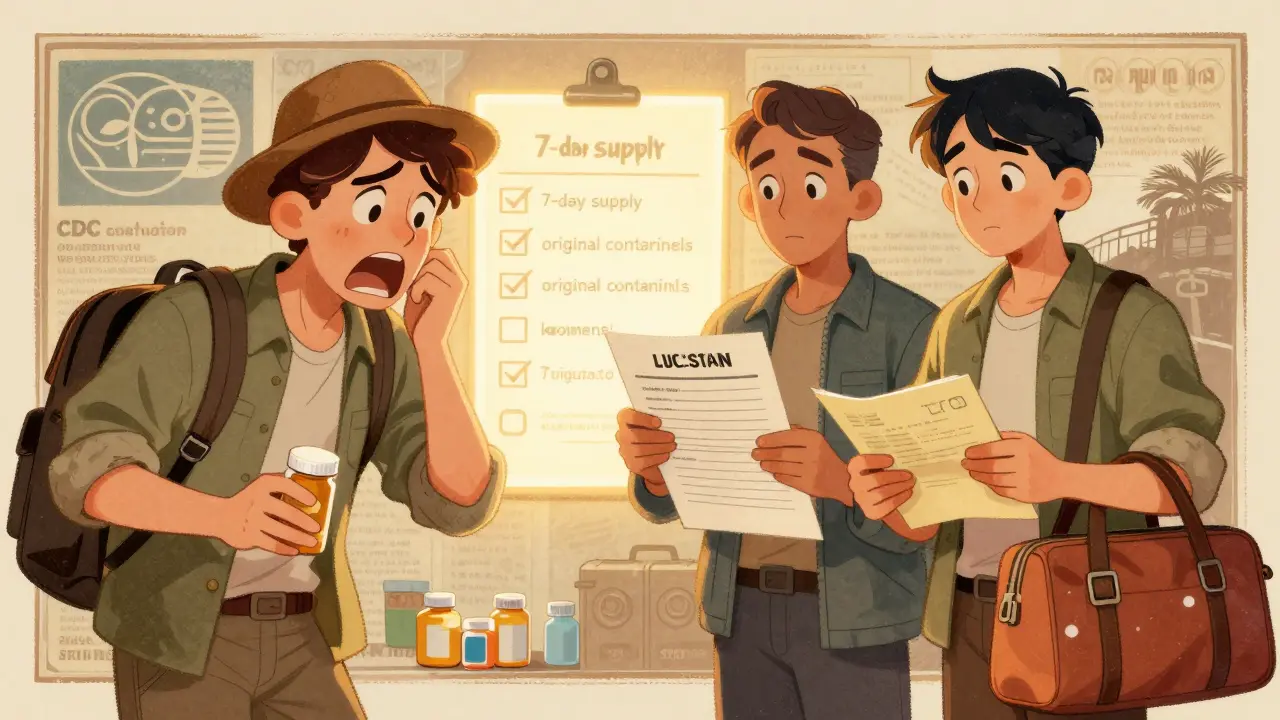
Prevention Is Better Than Replacement
The CDC’s 2024 Yellow Book says 31% of medication-related travel emergencies could be avoided with simple prep. Here’s how:- Carry at least a 7-day supply in your carry-on. IATA reports 1 in 150 checked bags are mishandled.
- Bring extra refills if your trip is longer than your prescription allows.
- For temperature-sensitive meds (like insulin), pack a cooling pack. 41% of travelers report efficacy issues due to heat exposure.
- Research your destination’s drug laws before you go. Some countries ban common U.S. medications.
- If you’re on multiple meds, keep a printed list with names, doses, and why you take them.




12 Comments
Nandini Wagh
February 25, 2026 at 21:24
So let me get this straight - we’re supposed to trust a stranger in Bangkok with our insulin because a pharmacy sign says 'official'? Lol. I’ve seen those 'pharmacies' - they sell 'Vitamin X' that’s just powdered sugar and glitter. And don’t even get me started on the 'doctor' who spoke three words of English and handed me a pill that looked like a tiny Lego brick. 🤡
Holley T
February 27, 2026 at 06:56
I appreciate the thoroughness of this guide, but it completely ignores the fact that the entire global pharmaceutical system is built on a foundation of corporate greed and regulatory capture. The reason you can’t get your prescription filled abroad isn’t because of 'bureaucratic red tape' - it’s because Big Pharma doesn’t want you to have access to cheaper alternatives. Why do you think they lobby so hard to keep drug prices high? The system is rigged. And yes, I’ve been to six countries in the last year - I know what I’m talking about. I’ve seen the price differences firsthand - $300 for insulin in the U.S., $12 in India. The moral outrage here is real.
Ashley Johnson
February 28, 2026 at 05:11
I don’t trust any of this. I read somewhere that the WHO and the CDC are in cahoots with the pharmaceutical companies to make people dependent on meds they don’t even need. That letter from your doctor? It’s probably tagged with a microchip. And those digital apps? They’re tracking your every pill. I know a guy whose sister’s blood pressure med was replaced with a placebo - and now she’s in a coma. They’re testing something. They’re testing something. They’re testing something. I’m not paranoid - I’m prepared.
Lillian Knezek
March 1, 2026 at 08:59
I just lost my anxiety meds in Prague and I’m crying right now 😭😭😭 I’m not gonna make it through the night without them I swear to god I’m gonna jump off a bridge if I don’t get them back I’ve been on them for 8 years and I’m basically a different person without them I need help someone please help me 😭😭😭
Maranda Najar
March 3, 2026 at 00:58
I am absolutely appalled by the casualness with which this article treats the sanctity of one’s pharmaceutical regimen. To suggest that one might 'just' visit a local physician as though they were popping into a Starbucks for a latte is not merely naive - it is a profound dereliction of moral responsibility. Imagine, if you will, the trembling hand of the diabetic, the hollow eyes of the depressed, the fragile equilibrium of the epileptic - all left to the mercy of a foreign healthcare system that views them not as human beings, but as revenue streams. This is not travel advice. This is a eulogy for the dignity of patient autonomy.
Dominic Punch
March 4, 2026 at 11:12
You’re overcomplicating this. If you’re traveling and rely on meds, you’ve got three things: 1) a printed copy of your prescription, 2) a doctor’s letter, 3) your original bottles. That’s it. No apps. No drama. No conspiracy theories. I’ve done this in 17 countries. In Thailand, I walked into a hospital pharmacy with my docs, showed the label, and got my meds in 20 minutes. No fuss. No panic. Just preparation. Stop overthinking. Just do the work before you leave.
Matthew Brooker
March 5, 2026 at 08:46
I’ve been on insulin for 15 years and I’ve replaced it in 5 countries and honestly the hardest part isn’t the paperwork it’s the fear that you’re gonna wake up one day and your body just won’t work anymore if you miss a dose so yeah carry the letter carry the bottles carry the extra and if you’re lucky enough to have insurance use it because that’s what it’s there for not to save money but to save your life
Emily Wolff
March 6, 2026 at 04:15
The only thing worse than losing your meds is reading this article. It’s like someone wrote a manual for the terminally unprepared. You don’t need a 2000-word essay. You need a doctor’s letter. A backup prescription. And common sense.
Lou Suito
March 8, 2026 at 00:43
I’m sorry but I have to say - the entire premise is flawed. You say 'don’t rely on digital tools' - but blockchain-based verification is already live in Switzerland and Germany. And you say 'U.S. law won’t refill Schedule II' - but that’s outdated. The DEA has granted emergency telehealth exceptions since 2022 under the SUPPORT Act. And you say 'carrying originals' - but what about the 40% of travelers who get their meds confiscated at customs because the bottle has a U.S. label? The real solution is a global digital prescription registry - not paper scraps and prayers.
Joseph Cantu
March 8, 2026 at 11:33
This whole thing is a scam. The government doesn’t want you to travel with your meds because they know if you get healthy abroad, you might start asking questions about why your insurance costs $1200/month. I know a guy who got his antidepressants in Mexico - and when he came home, his doctor said 'you’re not supposed to be here.' He was blacklisted. They’re watching. They’re always watching. And that 'doctor’s letter'? It’s a tracking device. I’ve seen the blueprints.
Jacob Carthy
March 9, 2026 at 13:30
Why are we even talking about this? If you’re dumb enough to lose your meds while traveling then you deserve to suffer. America is the greatest country on earth and if you can’t handle basic responsibility then go live in a cave. I’ve been to 12 countries and I never lost a pill because I’m not an idiot. Carry your meds. Don’t be a liability.
Lisandra Lautert
March 9, 2026 at 16:27
I lost my thyroid meds in Bali. I cried for three days. I called my mom. I screamed into a pillow. I Googled 'can you die from missing levothyroxine for 48 hours' and the answer was yes. Then I walked into a hospital, showed them my bottle, and they gave me a new one. I didn’t need insurance. I didn’t need a letter. I just needed to be brave. And now I’m alive. So you can too.