
Federal Food, Drug, and Cosmetic Act: How It Built the Legal Foundation for Generic Drugs
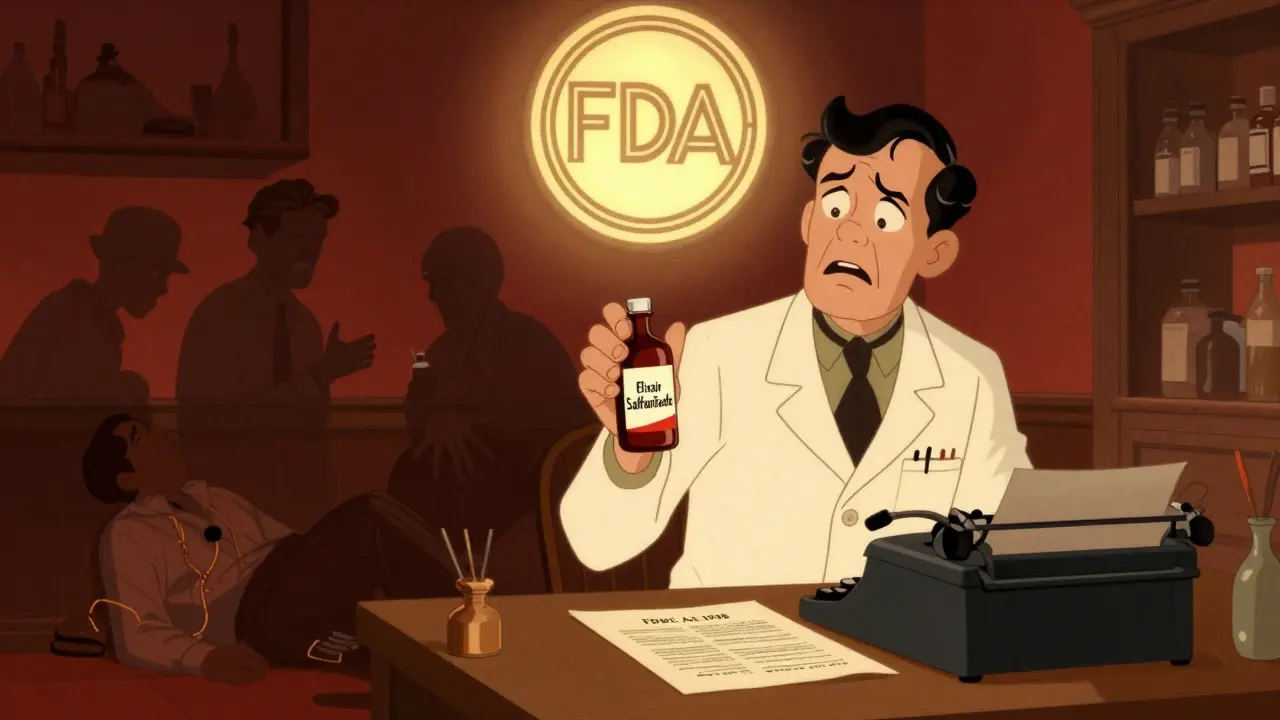
The FD&C Act didn’t start out as a law for generic drugs. When it was signed in 1938, its goal was simple: stop another tragedy like the elixir sulfanilamide disaster, where over 100 people died because a drug company used a toxic solvent and didn’t test it first. Back then, companies could sell any drug they wanted-no safety data, no proof it worked. The FD&C Act changed that. It gave the FDA the power to say no before a drug hit the market. But it didn’t say anything about generics. That came decades later.
Why Generic Drugs Didn’t Exist Before 1984
Before the Hatch-Waxman Amendments, if you wanted to make a copy of a brand-name drug, you had to do everything the original company did. That meant running full clinical trials-testing on thousands of patients-to prove your version was safe and effective. Even though the brand drug had already been approved, the FDA required you to start from scratch. It wasn’t just expensive. It was practically impossible for most companies. The result? In 1984, only 19% of prescriptions filled in the U.S. were for generics. And those generics made up just 3% of total drug spending. The system was designed to protect innovation, but it also protected monopolies.
The Hatch-Waxman Amendments: The Game Changer
In 1984, Congress passed the Drug Price Competition and Patent Term Restoration Act. Everyone calls it Hatch-Waxman after the two lawmakers who pushed it through: Senator Orrin Hatch and Representative Henry Waxman. This wasn’t just a tweak. It rewrote the rules.
Hatch-Waxman created Section 505(j) of the FD&C Act. That’s the part that lets generic drugmakers file an Abbreviated New Drug Application, or ANDA. The word "abbreviated" is key. You don’t need to prove safety and effectiveness again. You just need to show your drug is the same as the brand-name version in four ways: same active ingredient, same strength, same dosage form (pill, injection, etc.), and same way it’s taken (oral, topical, etc.).
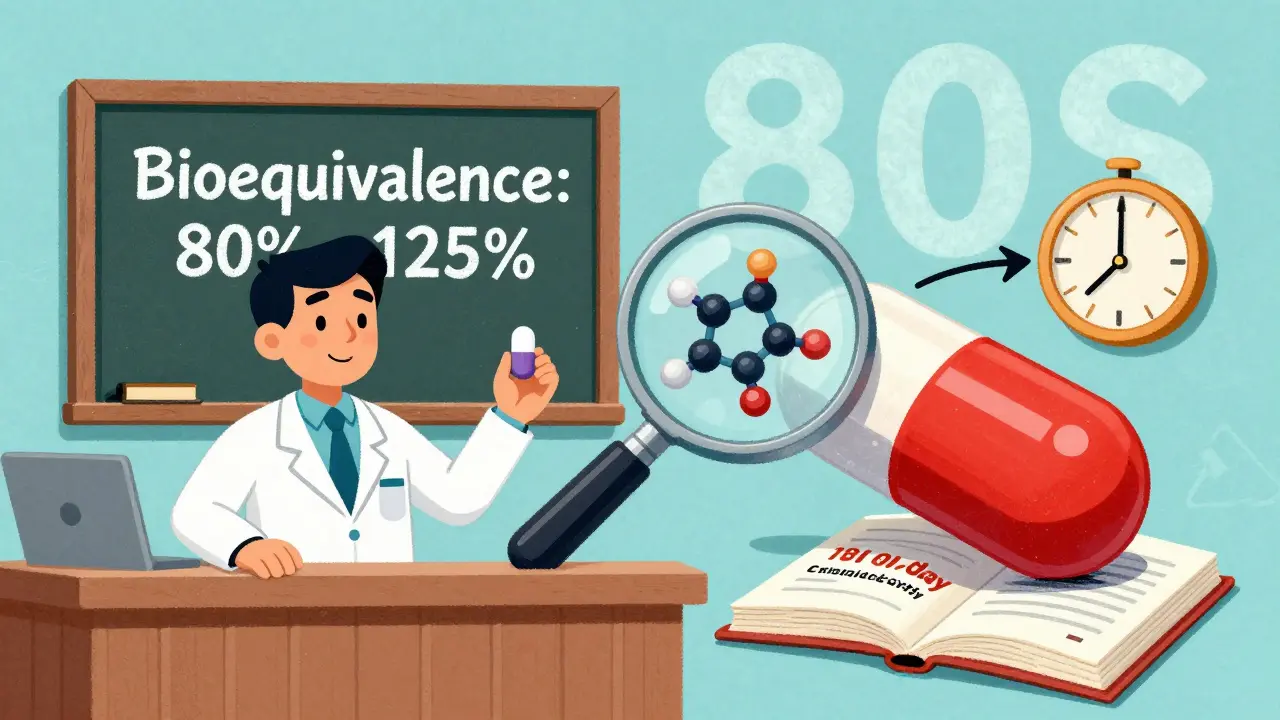
The real magic? Bioequivalence. You don’t test on patients for effectiveness. Instead, you test blood levels. If your generic delivers the same amount of drug into the bloodstream as the brand-within 80% to 125% of the original-you’re approved. That’s it. No more years of clinical trials. No more millions in costs. Suddenly, making generics became doable.
How the System Encourages Competition
Hatch-Waxman didn’t just make generics easier to make. It gave the first company to file an ANDA a powerful incentive: 180 days of exclusive rights to sell their version. No other generic could enter the market during that time. That’s a huge financial reward. It’s why generic companies invest millions to challenge brand-name patents. If they win, they get the market to themselves for half a year-before anyone else can jump in.
There’s another layer: the Orange Book. The FDA publishes this list of all approved drugs and their patent information. Generic companies have to check it. If the brand has a patent, the generic maker must certify whether they think it’s invalid, expired, or won’t be infringed. That’s where patent battles start. And that’s exactly what Congress wanted-competition through legal challenge, not just waiting for patents to expire.
Patent Extensions and the Flip Side
Hatch-Waxman also gave brand-name companies something back: patent term restoration. If a drug took five years to get approved by the FDA, the company could get up to five extra years on its patent to make up for lost time. But there’s a cap: total patent life can’t go beyond 14 years after the drug hits the market. That’s meant to balance innovation with access.
But it hasn’t always worked that way. Some brand companies use "evergreening"-filing new patents on minor changes like a new pill coating or a slightly different dose-to delay generics. Others file citizen petitions with the FDA, asking for delays under the guise of safety concerns. These tactics aren’t illegal, but they’ve stretched exclusivity far beyond what Hatch-Waxman intended.
How the System Works Today
Today, 90% of prescriptions in the U.S. are for generic drugs. Yet they make up only 17% of total drug spending. That’s a $2.2 trillion savings for consumers over the last decade, according to the Federal Trade Commission. The FDA approves about 95% of ANDAs within 10 months now. In the 1990s, it took over three years.
That speed comes from GDUFA-the Generic Drug User Fee Amendments. Since 2012, generic companies pay fees to the FDA, and in return, the agency commits to review timelines. It’s a win-win: faster approvals, more generics, lower prices.
But challenges remain. Complex drugs-like inhalers, injectables, and biologics-are harder to copy. The science is tougher. The FDA has only approved a handful of biosimilars for complex injectables, and even fewer generics for inhalers. Patent thickets around these drugs have reduced generic entry by 42% compared to simple pills.
Compliance and Enforcement
Making a generic isn’t just about science. It’s about compliance. Every facility that makes generic drugs must follow current Good Manufacturing Practices (cGMP). The FDA inspects these plants regularly. In 2022, they issued 47 warning letters to generic manufacturers. The top two issues? Poor quality control and data integrity problems-like falsified test results or missing records.
Violations can cost up to $1.1 million per incident. And if the FDA finds intentional fraud, criminal charges can follow. That’s why big generic companies invest heavily in quality systems. A single bad batch can shut down an entire plant for months.
What’s Next for Generic Drugs?
The FDA’s 2023-2027 plan says one of its top goals is modernizing the approval process for complex generics. Draft guidance for nasal sprays and eye drops is expected in mid-2024. The CREATES Act of 2019 helps by forcing brand companies to sell samples to generic makers-something some brands refused to do, blocking competition.
The Congressional Budget Office estimates that if current policies hold, the U.S. will save $158 billion on federal drug spending between 2023 and 2032. That’s all thanks to the FD&C Act’s foundation, built on safety, then expanded by Hatch-Waxman to include access.
Without the FD&C Act, we wouldn’t have a single generic drug approved in the U.S. Without Hatch-Waxman, most of those generics would still be too expensive to make. Together, they created a system that saves lives-not just by making drugs available, but by making them affordable.
What is the FD&C Act and why does it matter for generic drugs?
The Federal Food, Drug, and Cosmetic Act (FD&C Act) is the 1938 law that gave the FDA authority to regulate drug safety. While it didn’t originally cover generics, it became the legal base for them after the 1984 Hatch-Waxman Amendments added Section 505(j), which created the Abbreviated New Drug Application (ANDA) pathway. This lets generic makers prove their drugs are equivalent to brand-name versions without repeating clinical trials.
What is an ANDA and how is it different from an NDA?
An ANDA (Abbreviated New Drug Application) is the filing generic drugmakers use to get approval. Unlike an NDA (New Drug Application), which requires full clinical data to prove safety and effectiveness, an ANDA only needs to show bioequivalence-meaning the generic delivers the same amount of drug into the body as the brand. That cuts development time and cost by over 90%.
How does bioequivalence testing work for generics?
Bioequivalence is proven through pharmacokinetic studies in healthy volunteers. Blood samples are taken over time to measure how much of the drug enters the bloodstream (AUC) and how fast it peaks (Cmax). The generic’s values must fall within 80% to 125% of the brand’s. If they do, the FDA considers them therapeutically equivalent-no need for more patient trials.
Why do some generic drugs take longer to reach the market?
Patent challenges, complex drug formulations, and brand-name tactics like "product hopping" or delaying sample access can slow down generics. The CREATES Act helps by requiring brand companies to provide samples. But for drugs like inhalers or injectables, scientific complexity and patent thickets still block entry for years-even after patents expire.
What’s the Orange Book and why is it important?
The Orange Book is the FDA’s official list of approved drug products with therapeutic equivalence ratings. It shows which drugs are brand-name, which generics are approved, and what patents are listed. Generic makers must review it to know which patents they need to challenge before filing an ANDA. It’s the roadmap for legal and regulatory competition.
Are generic drugs as safe and effective as brand-name drugs?
Yes. The FDA requires generics to meet the same strict standards as brand-name drugs. They use the same active ingredients, work the same way in the body, and are made in inspected facilities. The only differences are in inactive ingredients like fillers or dyes-none of which affect safety or effectiveness. Over 90% of U.S. prescriptions are generics because they’re proven to work.




10 Comments
Stacy Thomes
January 23, 2026 at 03:18
This is the kind of law that actually saves lives-and money. I used to pay $400 for my blood pressure med, now I pay $4. No joke. My grandma takes five generics and she’s still kicking at 89. Thank you, Hatch-Waxman.
Dawson Taylor
January 23, 2026 at 15:50
The FD&C Act was a quiet revolution. Not flashy, not dramatic-but it turned pharmaceutical chaos into something resembling a system. Sometimes the most important laws are the ones no one talks about.
Sallie Jane Barnes
January 25, 2026 at 07:00
It’s fascinating how such a foundational piece of legislation-designed purely to prevent another tragedy-ended up enabling the most cost-effective healthcare innovation in modern history. The intent was safety, but the unintended consequence? Access. That’s the beauty of well-crafted policy.
I’ve worked in regulatory affairs for 18 years, and I still get chills when I see an ANDA approved on time. It’s not just paperwork-it’s someone’s ability to afford their insulin.
The Orange Book? It’s the legal chessboard. Every patent certification is a move. Every citizen petition, a delay tactic. And the 180-day exclusivity? That’s the checkmate reward.
People think generics are ‘inferior.’ They’re not. They’re identical. The only difference is the price tag-and the fact that someone else paid for the R&D.
And yes, the FDA inspections are brutal. I’ve seen plants shut down over a single missing log. It’s not bureaucracy-it’s accountability. One bad batch can kill. And it has.
Complex drugs are the new frontier. Inhalers, injectables, biosimilars-they’re not just harder to make. They’re harder to regulate. The science is evolving faster than the law.
But we’re getting there. GDUFA changed everything. Faster reviews. More transparency. More generics. More savings. The system’s still imperfect-but it’s working.
If you think generics are a threat to innovation, you’re missing the point. They’re the counterbalance. Without them, innovation becomes a luxury. And medicine should never be a luxury.
Kerry Evans
January 27, 2026 at 03:34
Let’s be real-most generic manufacturers cut corners. I’ve seen the reports. Falsified data. Dirty labs. The FDA’s ‘95% approval rate’ is a lie. They approve because they’re understaffed, not because everything’s clean.
And don’t get me started on those ‘bioequivalence’ studies. Healthy volunteers? 20 people? That’s not science. That’s a guess. Real efficacy? You need real patients. But no-let’s just trust the blood levels.
And don’t even mention ‘patent challenges.’ That’s just legal bullying disguised as competition. Big Pharma gets squeezed, sure-but so do patients who end up with bad generics.
Laura Rice
January 27, 2026 at 10:27
Y’all need to know this: generics are NOT the same as brand drugs… like, at all. I had a cousin who took a generic for seizures and she had a full-on seizure in the middle of a grocery store. The brand kept her stable for 10 years. The generic? Total nightmare.
And don’t tell me ‘it’s the same active ingredient’-what about the fillers? The dyes? The coating? Those matter! People get allergic to stuff in generics all the time. No one talks about it.
Also, why is it that every time a new generic comes out, the brand price goes UP? That’s not capitalism. That’s fraud.
I’m not anti-generic. I’m anti-lazy regulation. And I’m anti-pharma lobbyists pretending this is about ‘affordability’ when it’s really about profit.
Andrew Smirnykh
January 28, 2026 at 00:43
Interesting how the U.S. system balances innovation and access so differently than Europe or India. In India, generics are everywhere and dirt cheap-but quality control is spotty. In Europe, they have centralized pricing and slower approvals. Here? We’ve got speed, competition, and a lot of legal drama.
It’s messy. But it works.
dana torgersen
January 29, 2026 at 10:33
ok so like… the fd&c act? it was like… a thing? right? and then hatch-waxman? that was like… the big one? i mean, i dont really get how bioequivalence works but like… if your blood levels are in the 80-125% range? is that… safe? what if you’re sensitive? what if you’re a child? what if you’re elderly? like… are we just… trusting math? and not… people? also why is the orange book called that? is it a fruit? i think i need to go re-read this 17 times
charley lopez
January 29, 2026 at 20:51
From a regulatory science standpoint, the ANDA pathway represents a paradigm shift in pharmacokinetic modeling and statistical equivalence testing. The 80–125% confidence interval for Cmax and AUC0–t is grounded in the ICH E9 guidelines and validated through population pharmacokinetic modeling across multiple cohorts.
However, the increasing complexity of drug delivery systems-particularly transdermal, inhaled, and injectable formulations-exposes limitations in current bioequivalence models, which assume linear pharmacokinetics and homogeneous absorption profiles.
The GDUFA framework, while improving throughput, has not adequately addressed the technical challenges of complex generics. The 2023 FDA draft guidance on nasal sprays represents a necessary, albeit incremental, step toward harmonizing in vitro-in vivo correlation (IVIVC) for non-oral routes.
Vanessa Barber
January 30, 2026 at 10:45
Wait, so you’re saying this whole system was designed to save money, not save lives? That’s not what I thought. I thought it was about safety. Turns out it’s just capitalism with a lab coat.
Susannah Green
February 1, 2026 at 10:44
Just a heads-up: if you’re on a generic and feel weird-like dizzy, nauseous, or just ‘off’-don’t just assume it’s ‘in your head.’ Switch back to brand for a week and see. If you feel better? Talk to your doctor. It’s not common, but it happens. And your pharmacist can help you check if the generic is on the FDA’s ‘not equivalent’ list.
Also-yes, the Orange Book is a real book. It’s online. And yes, it’s orange. I’ve seen it. It’s not a metaphor. It’s just… orange.