

Pharmacist Counseling Scripts: Training Materials for Generic Patient Talks
When a patient walks up to the pharmacy counter with a new prescription, the pharmacist doesn’t just hand over the bottle. They have a responsibility-legally, ethically, and clinically-to make sure that patient understands what they’re taking, why, and how to stay safe. But in a busy pharmacy, with 20+ patients waiting and a clock ticking, how do you deliver clear, consistent, and meaningful counseling every time? That’s where pharmacist counseling scripts come in.
Why Scripts Are Not Optional Anymore
Back in 1990, the U.S. government passed OBRA '90, a law that changed how pharmacies operate. It didn’t just tweak paperwork-it made patient counseling a requirement for Medicaid reimbursement. Suddenly, pharmacists couldn’t just say, “Here’s your medicine, call if you have questions.” They had to actually talk to patients. And not just once. Every time a new prescription was filled, they had to explain the basics: what the drug is for, how to take it, what side effects to watch for. That’s when standardized scripts started appearing. Not because pharmacists wanted to sound robotic, but because without structure, important details got missed. One pharmacist might spend five minutes explaining everything. Another might rush through it in 30 seconds. The result? Patients forgot half of what they heard. Medications went unused. Hospital visits spiked. The data showed it: medication non-adherence costs the U.S. system over $312 billion a year. Scripts weren’t about control-they were about saving lives.The Core of Every Script: Three Questions That Matter
You don’t need a 20-page manual to start. The most effective scripts, especially for beginners, follow a simple, proven model from the Indian Health Service. It’s built around three questions:- What do you already know about this medication?
- How should you take it?
- What problems might you run into?
What You Must Cover: The OBRA '90 Essentials
Even if you’re using a custom script, there are seven things federal law says you have to hit:- The name and description of the drug
- The dosage form (pill, liquid, injection)
- The route of administration (by mouth, inhaler, patch)
- The dosage amount and frequency
- How long the patient should take it
- Special instructions (take with food, avoid sunlight, shake well)
- Common and severe side effects
When Scripts Go Wrong: The Robot Trap
Here’s the biggest mistake pharmacists make: reading the script word-for-word like a news anchor. “I’m prescribing you lisinopril. It’s an ACE inhibitor used to treat hypertension. The usual dose is 10 mg once daily. Common side effects include dry cough, dizziness, and hyperkalemia.” That’s not counseling. That’s a lecture. And patients tune out. Dr. Daniel Holdford’s 2006 research found that scripts are meant to be a framework-not a script. Think of them like a recipe. You don’t follow it exactly every time. You adjust for what’s in your kitchen. Same here. If a patient says, “I take this with coffee,” you don’t interrupt with the script. You say, “Oh, interesting. Some people do. But caffeine can make your blood pressure spike right after you take it. Have you noticed your heart racing?” The best pharmacists use the script to stay on track, then shift into conversation mode. They ask open-ended questions. They pause. They listen. And they use the teach-back method: “Can you tell me in your own words how you’ll take this pill?” If they can’t, you re-explain-not with more jargon, but with simpler language. “So, you swallow this one time a day, like brushing your teeth in the morning.”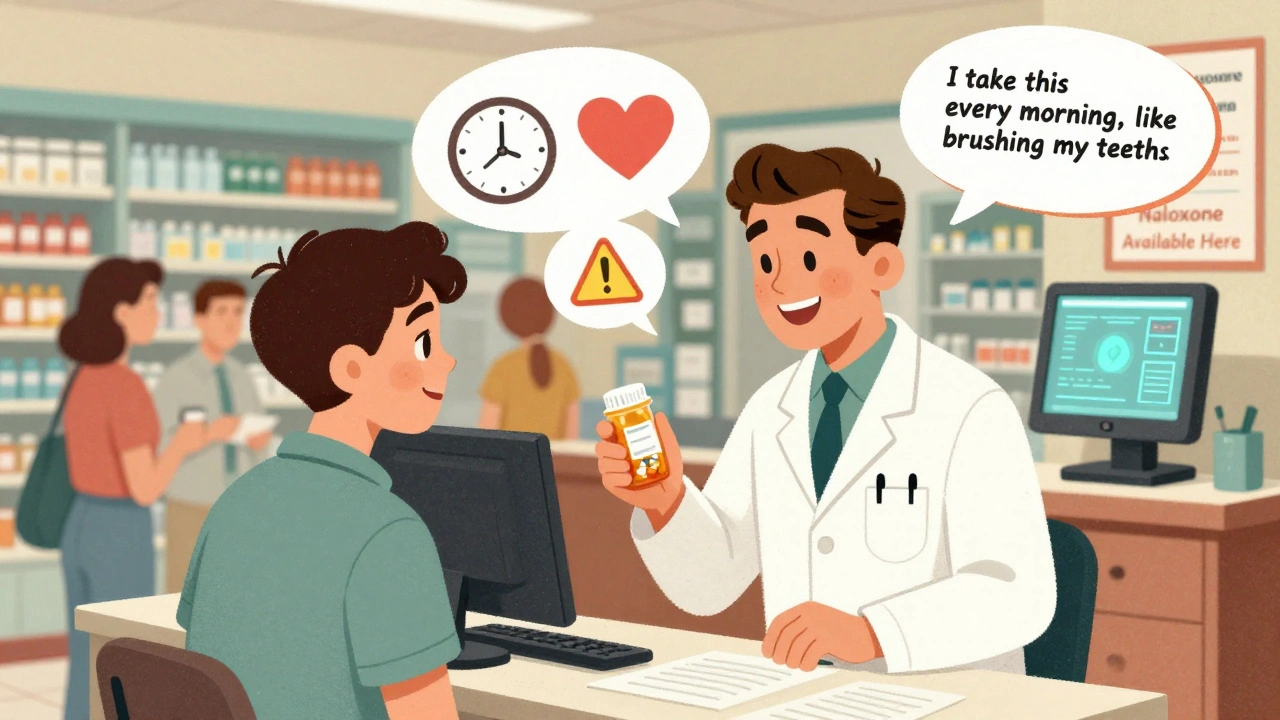
Special Cases Need Special Scripts
Not all medications are created equal. A script for antibiotics won’t work for insulin. Or opioids. For controlled substances-especially opioids-there are now mandatory counseling elements. The RXCE 2023 guidelines require pharmacists to cover:- Proper storage (away from kids, in a locked cabinet)
- Safe disposal (don’t flush it-use a take-back program)
- Naloxone availability (do they know how to use it? Do they have it?)
Documentation: It’s Not Just Paperwork
You can’t counsel without recording. And no, scribbling “counseling provided” on a sticky note doesn’t cut it. ASHP guidelines say you must document two things:- That counseling was offered and accepted-or refused
- Your assessment of the patient’s understanding
Overcoming Real-World Barriers
Time is tight. The average counseling session in a chain pharmacy is just 2.1 minutes. Language is a barrier. One in five patients speaks a language other than English at home. And not all pharmacies have interpreters on hand. Solutions exist. Many pharmacies now use pre-printed, multilingual handouts covering 150+ languages through services like Language Access Network. Others use telephonic interpreters-just a button press away. For patients who aren’t there (like family picking up meds), you send a clear, written summary with the prescription. And if they’re in a nursing home? Phone counseling counts, as long as you document it properly. HIPAA is non-negotiable. Never discuss a patient’s meds in line. Never leave printed materials visible. And never assume a caregiver knows what’s being given. Ask. Confirm. Document.
How to Learn This Skill
No one is born a great counselor. It’s learned. Pharmacy schools now train students using simulated patients. They practice scripts, get feedback, and redo it. It takes 8 to 12 weeks of supervised practice before a new pharmacist stops reading scripts and starts having conversations. If you’re already working, here’s how to improve:- Start with the three-question framework
- Record yourself counseling (with permission) and listen back
- Ask patients: “What’s one thing you’ll remember about this medicine?”
- Use the teach-back method every single time
- Track your documentation accuracy-aim for 100%
The Future: Smarter, Not Harder
The next wave of counseling tools won’t be static scripts. They’ll be dynamic. Pilot programs at CVS and Walgreens are testing AI-assisted systems that listen to patient responses and adjust the script in real time. If a patient says, “I’m worried about weight gain,” the system prompts the pharmacist: “Ask about diet changes and suggest a low-calorie alternative.” These tools aren’t replacing pharmacists. They’re helping them focus on what matters: connection, not compliance. And the push is growing. In 2023, 43 states introduced bills to expand pharmacists’ counseling authority. CMS is preparing a 2025 rule that will require proof of patient comprehension for Medicare Part D-meaning pharmacists will have to show they didn’t just talk, but that the patient actually understood. This isn’t about paperwork. It’s about outcomes. Better adherence. Fewer ER visits. Lower costs. Healthier people.Final Thought: Scripts Are Tools, Not Traps
Pharmacist counseling scripts aren’t about making you sound like a robot. They’re about making sure no patient walks away confused. They’re about giving you a safety net so you don’t forget the critical stuff when you’re tired, rushed, or overwhelmed. Use them. Master them. Then, let them go. The best pharmacists don’t follow scripts-they use them as a foundation to build trust. And that’s what turns a transaction into care.Are pharmacist counseling scripts mandatory by law?
Yes, under OBRA '90, pharmacists must offer counseling for new Medicaid prescriptions. Many states go further and require actual counseling-not just an offer. Failure to comply can result in lost reimbursement, fines, or disciplinary action. Even in states with weaker rules, professional standards from ASHP and the American Pharmacists Association require it.
Can I use the same script for every patient?
No. Scripts are templates, not scripts to read verbatim. A 70-year-old with diabetes needs different details than a 25-year-old on birth control. A patient with low health literacy needs simpler language and visual aids. The best scripts are flexible-they guide you to cover the essentials, then adapt based on the person in front of you.
What’s the teach-back method, and why does it matter?
The teach-back method asks patients to explain back in their own words what they’ve been told. Instead of asking, “Do you understand?” you say, “Can you tell me how you’ll take this pill?” This reveals misunderstandings you might miss. Studies show it cuts medication errors by up to 40%. It’s the single most effective tool for ensuring real comprehension-not just nodding along.
How do I handle patients who refuse counseling?
You still have to document it. Say, “I’ve offered counseling on how to take this medication safely. You’ve declined. Is there anything specific you’d like to know right now?” Even if they say no, offer a printed handout. Document their refusal and your offer. This protects you legally and gives them a resource to refer to later.
Do I need different scripts for different medications?
Yes. A script for antibiotics covers duration and completing the course. A script for insulin covers injection technique, storage, and hypoglycemia. Opioids require counseling on naloxone and safe disposal. Anticoagulants need INR monitoring and dietary warnings. Generic scripts won’t cover these. Use specialized templates for high-risk or complex drugs.
How can I fit counseling into a busy day?
Use efficiency tricks: Prepare printed materials in advance. Use the three-question framework to stay focused. Train technicians to handle routine questions (like refill instructions) so you can focus on new meds. Use EHR checkboxes to speed up documentation. Most importantly, don’t try to do it all at once. Make counseling part of your workflow, not an extra task.
Pharmacist counseling isn’t about checking boxes. It’s about making sure the person leaving your pharmacy doesn’t just have a prescription-they have confidence, clarity, and control over their health.


11 Comments
gladys morante
December 4, 2025 at 01:43
My grandma took 17 pills a day and never understood half of them. The pharmacist just handed over the bag like it was a drive-thru burger. No one talks to you anymore. It’s sad.
Melania Dellavega
December 5, 2025 at 11:58
This is one of those topics that should be taught in high school. Not just to future pharmacists, but to everyone. We treat medicine like magic beans-take it, don’t ask why, hope it works. But it’s not magic. It’s science. And people deserve to understand it. The three-question framework? That’s not just efficient-it’s humane. It turns a transaction into a conversation. And that’s where healing actually begins.
Shawna B
December 6, 2025 at 00:57
teach back works. i tried it with my dad. he said he knew how to take his blood pressure pill. turned out he thought he only needed it when he felt dizzy. big mistake.
Jerry Ray
December 6, 2025 at 21:58
Scripts? Please. You’re treating patients like robots who need a canned response. Real medicine isn’t about checklists. It’s about intuition. I’ve seen pharmacists read from a script while the patient’s eyes glazed over. That’s not counseling. That’s performance art. The real solution? Hire fewer people and give the ones you have more time. Not more forms.
David Ross
December 8, 2025 at 16:42
OBRA '90? That was a federal overreach. Who gave the government the right to dictate how pharmacists speak to patients? This is America. Not a bureaucratic simulation. And now we’re being forced into robotic speech patterns because some bureaucrat in D.C. thinks patients can’t think for themselves? Pathetic. And don’t get me started on the paperwork. I’ve seen pharmacists cry over documentation errors. This isn’t healthcare-it’s compliance theater.
Sophia Lyateva
December 9, 2025 at 19:56
ai is listening to patients now? lol. they’re not just watching you-they’re recording everything. i heard a pharmacist got fired because the system flagged her for saying 'it's just a pill' to a diabetic. next thing you know, they’ll be tracking your tone of voice and giving you a 'compassion score'. this is how they control us. you think this is about safety? no. it’s about control.
AARON HERNANDEZ ZAVALA
December 10, 2025 at 10:22
I’ve worked in three different states and seen everything from zero documentation to insane paperwork. The truth? Most pharmacists want to help. They’re just drowning. The real issue isn’t the script-it’s the system. We need more staff, better pay, and less pressure. Scripts can help, but they won’t fix a broken workplace. Let’s stop blaming the tool and fix the machine.
Lyn James
December 12, 2025 at 02:48
Let’s be honest-most patients don’t deserve detailed counseling. They don’t take their meds. They don’t read labels. They blame the doctor when they get sick. Why should pharmacists waste their time on people who treat their health like a suggestion? I’ve seen the same person refill their opioid script every 27 days, then show up angry because they’re still in pain. Counseling won’t fix laziness. Accountability will. And we’re not teaching accountability-we’re teaching dependency.
Craig Ballantyne
December 13, 2025 at 23:16
The three-question model is empirically validated and aligns with the WHO’s communication framework for adherence interventions. However, its efficacy is contingent upon contextual fidelity-particularly in resource-constrained environments where cognitive load exceeds baseline thresholds. Without integration into EHR-driven decision support systems, the script remains a heuristic, not a clinical intervention. The real innovation lies in dynamic adaptation via natural language processing, not static templates.
Robert Asel
December 14, 2025 at 10:06
It is imperative to note that the American Society of Health-System Pharmacists (ASHP) has established formal guidelines delineating the minimum competencies required for pharmaceutical counseling. Failure to adhere to these standards constitutes a breach of professional ethics and may result in licensure review. Furthermore, the teach-back method, while widely promoted, lacks standardized operationalization across institutions, leading to inter-practitioner variability that undermines reproducibility. A unified national protocol is not merely advisable-it is obligatory.
Sakthi s
December 15, 2025 at 06:55
Good stuff. Simple, real, works. I’ve used the three questions in India with patients who don’t speak English. Pictures, gestures, repetition. No script needed-just care.