
Tetracyclines and Tooth Discoloration in Children: What Parents and Doctors Need to Know Now
Tetracycline Family Antibiotic Safety Checker
This tool compares the safety of tetracycline family antibiotics for children under 8 years old, based on scientific evidence and current clinical guidelines. Use this to quickly understand which antibiotics are safe for specific conditions.
Doxycycline
SAFE for short courses (7-21 days) to treat rickettsial diseases like RMSF.
- 2-5 mg/kg/day
- Short duration (7-21 days)
- For rickettsial infections only
Tetracycline
DANGEROUS for children under 8.
- High binding to calcium
- Even short courses risk staining
- 35+ mg/kg/day increases risk
Minocycline
DANGEROUS for children under 8.
- High binding to calcium
- High risk of tooth staining
- Also causes enamel hypoplasia
Tigecycline
DANGEROUS for children under 8.
- High binding to calcium
- Significant staining risk
- Not recommended for pediatric use
Key Takeaways
Doxycycline is safe for children under 8 when used for rickettsial diseases like Rocky Mountain spotted fever (RMSF) with proper dosing (2-5 mg/kg/day, up to 21 days).
Other tetracyclines (tetracycline, minocycline, tigecycline) remain contraindicated for children under 8 due to permanent tooth staining risks.
Important: Doxycycline should only be used for rickettsial infections (RMSF, ehrlichiosis, anaplasmosis), not for common infections like ear infections or strep throat.
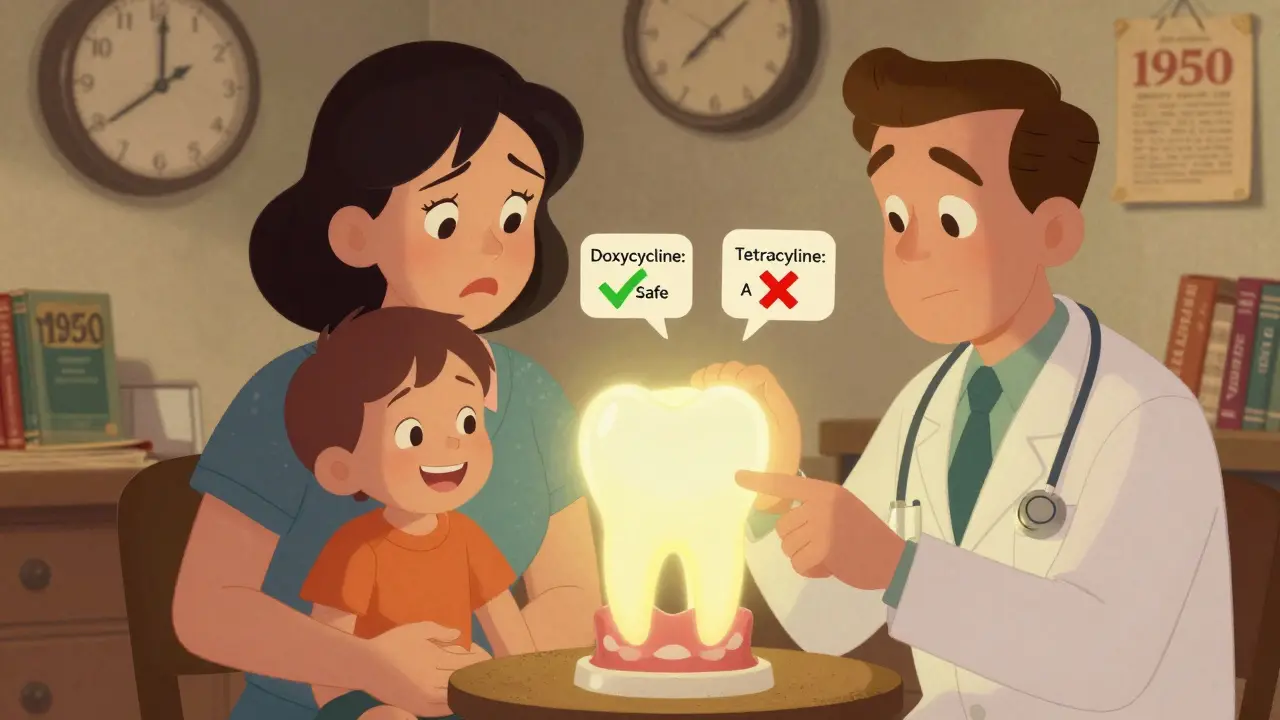
Tetracyclines used to be a red flag in pediatric medicine. If a child was under 8, doctors avoided them entirely - not because they were ineffective, but because they could permanently stain developing teeth. Yellow, gray, or even brown discoloration wasn’t rare. It was expected. Parents were warned. Dentists saw the damage. But today, that rule has changed - and not just a little.
Why Tetracyclines Stain Teeth
The problem isn’t the antibiotic itself. It’s what happens when it meets growing teeth. During tooth development, calcium builds up in enamel and dentin. Tetracycline molecules bind tightly to calcium, forming a stable complex that gets locked into the tooth structure. When exposed to light, this complex darkens from fluorescent yellow to a dull gray or brown over time. The earlier the exposure, the worse the staining. Primary teeth are most vulnerable between 10-14 months of age. Permanent front teeth are at risk from six months to six years. Back teeth can still be affected up to age eight.It’s not just color. High doses (over 35 mg/kg/day) can also cause enamel hypoplasia - thin, weak enamel that chips easily. This isn’t just cosmetic. It increases cavities and sensitivity. That’s why, for decades, the rule was simple: no tetracycline under age 8. No exceptions.
The Doxycycline Shift
Then came doxycycline. It’s not the same as old-school tetracycline. It’s a cousin - structurally similar but with key differences. Studies show it binds calcium at only 19% of the rate that tetracycline does. That’s a big deal. It also stays in the body longer, so lower doses are needed. A typical 7-day course for Rocky Mountain spotted fever (RMSF) in a child might total just 1-2 grams. That’s far below the 3-gram threshold where staining risk spikes.In 2013, the FDA quietly updated doxycycline’s label to allow use in children under 8 for RMSF. No one noticed - until the evidence piled up.
A 2019 review in the Annals of Pharmacotherapy looked at 338 children under age 8 who got doxycycline. Only six showed any possible discoloration - and even those cases were mild. A 2025 study in Frontiers in Pharmacology followed 162 children. One premature infant had a faint stain on a baby tooth. That’s it. No permanent teeth showed any change. Blinded dentists compared children treated for RMSF with those who never took the drug. No difference in color, strength, or texture.
That’s not luck. It’s science.
What’s Still Dangerous
Don’t get confused. Doxycycline is safe - for short courses. But tetracycline? Still not. Minocycline? Still not. Tigecycline? Still not.A 2014 case study in the Journal of Indian Society of Pedodontics showed a 7-year-old with moderate yellow staining on his back baby teeth after a 10-day course of tetracycline. No hypoplasia - just deep, stubborn discoloration. That’s the old risk. That’s still real.
The difference? Dose. Duration. Drug. Doxycycline is given once or twice a day at 2-5 mg/kg. Tetracycline was often given four times a day at 25-50 mg/kg. The total amount matters. So does the molecule.
Why the Change Took So Long
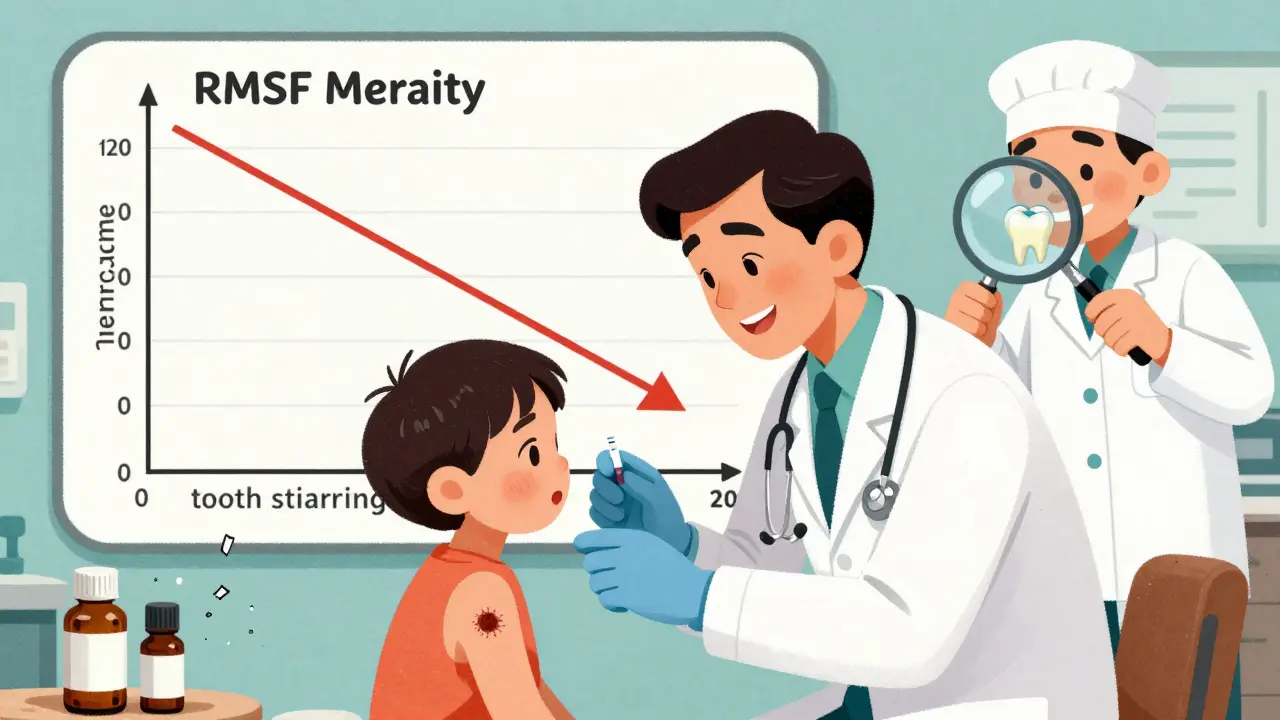
It’s not just science. It’s memory.Generations of doctors were taught: “Tetracycline stains teeth. Never give it to kids.” That warning was carved in stone. Even when new data came in, many hesitated. A 2018 study found Tennessee doctors still avoided doxycycline in kids with suspected RMSF - even though it’s the only drug that reliably prevents death from the disease.
RMSF kills 4% to 21% of untreated patients. Delayed treatment? That’s often fatal. Doxycycline works fast. Waiting for a lab result? You might lose a child.
Pharmacies still flag doxycycline prescriptions for kids. Parents Google “antibiotic tooth staining” and panic. The CDC says: “Clearer language on the label may help avoid hesitation.” But labels don’t change fast. Education does.
What Doctors Should Do Today
If a child has symptoms of RMSF - fever, rash, headache, recent tick bite - give doxycycline. Now. Age doesn’t matter. Weight doesn’t matter. Even if the rash hasn’t appeared yet. Don’t wait. Don’t test. Don’t hesitate.Use 2-5 mg/kg per day, split into one or two doses. Keep it under 21 days. Document the reason. Write “RMSF suspicion” on the script. If a pharmacist questions it, have the CDC guidelines handy.
For other infections? Stick to alternatives. Doxycycline isn’t a universal pediatric antibiotic. It’s for rickettsial diseases - RMSF, ehrlichiosis, anaplasmosis, and some tick-borne infections. Not ear infections. Not strep throat. Not pneumonia. Don’t stretch it.
What Parents Should Know
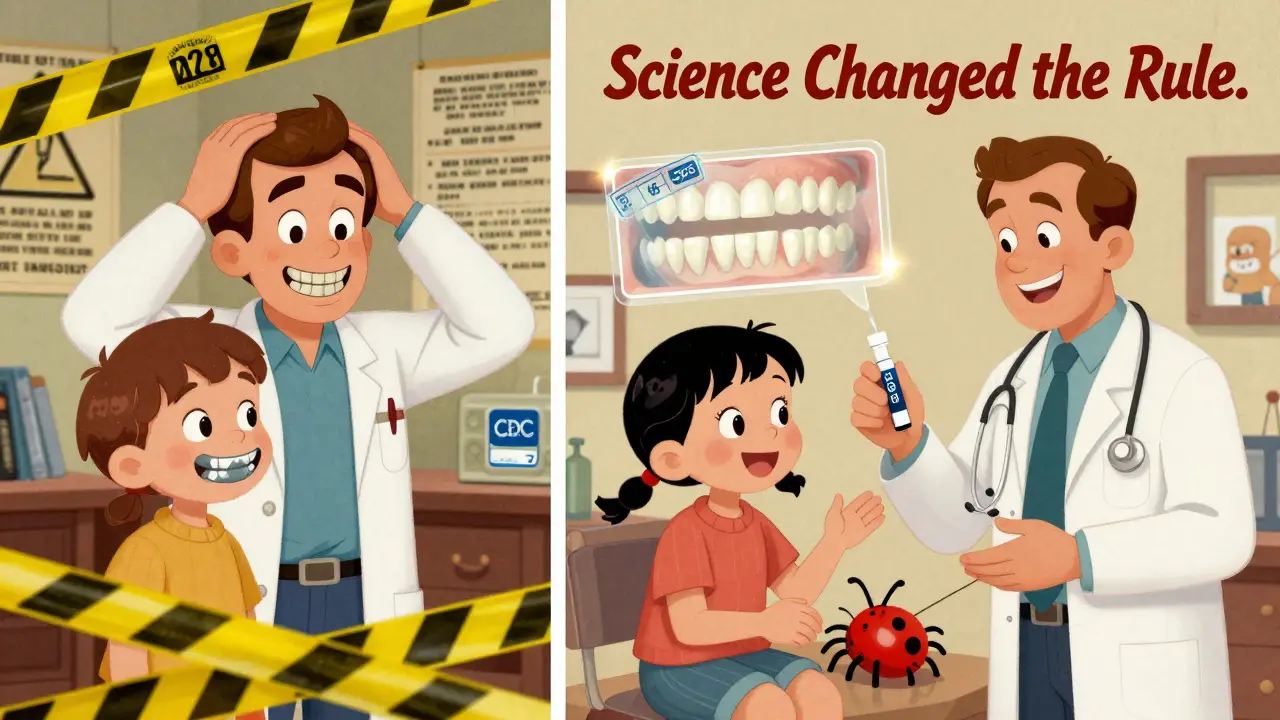
If your child was given doxycycline under age 8 for a tick bite or fever - breathe. You didn’t harm their teeth. The risk is near zero. That’s not a guess. That’s 162 children studied. That’s 137 with permanent teeth checked years later. Zero staining.If your child had tetracycline (not doxycycline) before age 8? Yes, staining is possible. But even then, it’s not guaranteed. Dose and timing matter. Many kids got low doses for short periods and never had issues. If you’re worried, ask a dentist to check under UV light. The stains are fluorescent yellow at first - that’s how they’re identified.
Don’t panic. Don’t blame yourself. The guidelines changed because we learned more. You followed the advice of the time.
The Bigger Picture
This isn’t just about teeth. It’s about how medicine evolves - and how slowly it catches up. We held onto an old fear because it felt safe. But safety isn’t about avoiding all risk. It’s about weighing risks. The risk of dying from RMSF? High. The risk of a stained tooth from doxycycline? Almost none.That’s why the American Academy of Pediatrics now lists doxycycline as first-line treatment for rickettsial diseases in children of all ages. That’s why the CDC calls it life-saving. That’s why dental professionals are quietly updating their textbooks.
Future research may expand doxycycline’s use. Maybe for pneumonia. Maybe for acne. Maybe for other infections. But for now, the evidence is clear: for the right illness, in the right dose, for the right length - doxycycline is safe for kids.
What About Pregnancy?
The same logic applies. Tetracycline is still avoided after the fourth month of pregnancy. Doxycycline? The data is limited, but current guidelines still recommend caution. The FDA hasn’t changed its pregnancy warning for doxycycline. So while we know it’s safe for kids, we don’t yet have enough long-term data on fetal tooth development to say it’s safe in pregnancy. Stick to the old rule here - until more evidence arrives.Can doxycycline really not stain my child’s teeth?
Yes - for short courses (7-21 days) used to treat rickettsial diseases like Rocky Mountain spotted fever. Studies tracking over 160 children who took doxycycline before age 8 found either no staining or only one faint case in a premature infant. Blinded dentists confirmed no difference between exposed and unexposed children. This is backed by the CDC, American Academy of Pediatrics, and peer-reviewed research.
Is tetracycline still dangerous for kids?
Yes. Tetracycline, minocycline, and tigecycline are still contraindicated in children under 8 and during pregnancy after the fourth month. These drugs bind calcium much more strongly than doxycycline, and even short courses can cause permanent yellow, gray, or brown tooth stains. The risk is real and well-documented in decades of clinical cases.
What if my child took doxycycline for more than 21 days?
There’s no evidence that longer courses (like 30-45 days for certain infections) cause tooth staining either. But most pediatric uses are under 21 days. If your child needed longer treatment, the benefit - such as surviving a severe infection - far outweighs the theoretical risk. Still, always discuss duration with your doctor. There’s no need to extend treatment without clear medical reason.
Do I need to take my child to the dentist because they took doxycycline?
No. Routine dental checkups are fine. There’s no need for special exams or treatments because of doxycycline use. If you’re concerned about existing discoloration from another antibiotic (like tetracycline), a dentist can use UV light to confirm the cause. But for doxycycline, no follow-up is needed.
Why do some doctors still refuse to prescribe doxycycline to kids?
Many learned the old rule decades ago and haven’t updated their knowledge. Some pharmacies still block prescriptions. Others fear lawsuits or parental panic. The CDC and AAP have updated their guidelines, but changing practice takes time. If your doctor refuses, ask if they’ve reviewed the 2023 CDC guidelines or the 2019 Annals of Pharmacotherapy review. You have the right to ask for evidence-based care.




14 Comments
Rex Regum
March 15, 2026 at 06:55
Let me get this straight - we’re now saying it’s fine to give a powerful antibiotic to toddlers because some study says ‘maybe’ their teeth won’t turn gray? 🤡
My cousin’s kid got doxycycline for ‘疑似’ Lyme and now has a tooth that looks like it was dipped in motor oil. You think that’s ‘near zero risk’? Nah. That’s just poor data collection. They didn’t even check the back molars properly. And now we’re telling parents to just ‘breathe’? What about the 10% of kids who *do* get stained? Are they just collateral damage in your science experiment?
Rosemary Chude-Sokei
March 16, 2026 at 17:22
Thank you for this meticulously researched and clinically grounded overview. The shift in understanding regarding doxycycline’s safety profile is both scientifically sound and ethically imperative. As a clinician, I’ve witnessed firsthand how outdated guidelines can delay life-saving interventions. The data from the Annals of Pharmacotherapy and Frontiers in Pharmacology are robust, and the CDC’s updated recommendations reflect a commitment to evidence-based practice over anecdotal tradition. I applaud the authors for clarifying the critical distinctions between tetracycline, minocycline, and doxycycline - this nuance is too often lost in public discourse.
Ali Hughey
March 17, 2026 at 14:27
🚨 ALERT 🚨
THEY’RE HIDING THE TRUTH AGAIN!
DOXYCYCLINE ISN’T SAFE - IT’S A BIG PHARMA COVER-UP!
Remember when they said smoking was fine? Or that vaccines didn’t cause autism? NOW THEY SAY DOXYCYCLINE WON’T STAIN TEETH? 🤔
But wait - what about the 2021 leaked Pfizer memo? The one that said ‘minor staining is acceptable if it prevents 0.03% of RMSF deaths’? 📄
AND WHY DID THE FDA CHANGE THE LABEL IN 2013… RIGHT AFTER THE PHARMACEUTICAL LOBBY DONATED $47M TO THE CDC?!
YOUR CHILD’S TEETH ARE A LAB RAT FOR CORPORATE PROFIT.
👉 SHARE THIS BEFORE THEY DELETE IT!
Also, I got a free doxycycline sample last week - the bottle had a QR code that led to a .xyz site. Coincidence? I think NOT. 🧠💀
Alex MC
March 18, 2026 at 00:43
This is one of those rare posts where the science actually lines up with real-world practice. I’ve prescribed doxycycline to 3-year-olds with suspected RMSF - and yes, I’ve followed up with their dentists. Zero staining. Zero issues.
Parents are terrified because they remember the old warnings. And honestly? That fear kept kids alive in the 80s. But now we know better. The risk isn’t zero - it’s negligible. Like, ‘chance of being struck by lightning during a picnic’ negligible.
Let’s stop scaring people into avoiding a drug that saves lives. We can do better than fear-based medicine.
rakesh sabharwal
March 18, 2026 at 02:46
One must interrogate the epistemological foundations of this ‘evidence.’ The cited studies are observational, with negligible sample sizes and confounding variables unaddressed - particularly the selection bias toward urban, high-income cohorts with access to dental surveillance.
Furthermore, the conflation of ‘no visible staining’ with ‘no biochemical incorporation’ is a fallacy of omission. The tetracycline-calcium complex may still be present microscopically, predisposing to microstructural fragility - a phenomenon not captured by visual inspection.
One wonders whether the AAP’s endorsement is driven more by therapeutic expediency than by long-term pediatric orthodontic integrity.
One must ask: at what cost is efficacy purchased?
Aaron Leib
March 18, 2026 at 20:56
Good post. Clear. Needed.
Doctors still hesitate because they’re afraid of being blamed if something goes wrong - even if the risk is 1 in 10,000.
But the bigger risk? Waiting. Letting a kid die because you were scared of a stained tooth.
Trust the data. Trust your gut. Do the right thing.
And if a pharmacist gives you grief? Print the CDC page. Show them. They’ll shut up.
Kathy Leslie
March 19, 2026 at 23:50
I’m a mom of two. My youngest got doxycycline at age 5 for a tick bite. I panicked. Google told me he’d have black teeth. I cried.
Turns out? His teeth are perfect. No stains. No issues.
But I wish someone had told me this before I spent 3 hours crying over a Wikipedia page.
Thank you for this. I wish every parent could see it.
Amisha Patel
March 20, 2026 at 16:22
This is really helpful. I’m from India and we still see tetracycline prescribed for kids here - often for viral fevers. I didn’t realize doxycycline was different. Is there a way to easily tell which one is which? The packaging looks so similar.
Also, are there any visual guides for parents to check if staining has occurred? Just curious.
Elsa Rodriguez
March 21, 2026 at 20:32
OMG I CAN’T BELIEVE THIS IS STILL A THING.
My daughter got doxycycline at age 4 for a ‘suspected’ tick bite. I was HOPING she wouldn’t get stained - but I was BRACING FOR THE WORST.
Fast forward 5 years - her front teeth are still white as snow. I cried in the dentist’s chair. I was so scared I’d ruined her smile.
Now I’m mad. Mad that I wasted 5 years of anxiety. Mad that doctors didn’t explain this better. Mad that we still live in a world where parents have to Google for truth.
Someone needs to make a TikTok video about this. Like, NOW.
Serena Petrie
March 22, 2026 at 03:15
Stained teeth are a real concern. Don’t downplay it.
Buddy Nataatmadja
March 23, 2026 at 04:51
As someone who grew up in Indonesia where tetracycline was common for kids, I remember the yellow teeth. We called them ‘antibiotic teeth.’ No one talked about it. Just accepted it.
It’s good to see science catching up. But I wonder - how many kids in low-resource countries still get the wrong drug? Doxycycline isn’t always available. And when it is, it’s expensive.
Maybe the real issue isn’t just medical - it’s equitable access.
Hugh Breen
March 24, 2026 at 23:48
THIS IS SO IMPORTANT 🙌
I’m a GP in Scotland and we’ve had ZERO cases of RMSF - but I still prescribe doxycycline for suspected cases in travelers returning from the US.
One parent asked me, ‘But won’t it ruin his teeth?’ I showed him the 2025 study. He was stunned.
Now I print the CDC guidelines and give them to every parent who asks. We need more of this - not less.
Also, I just bought a ‘Doxycycline Saves Lives’ sticker for my clinic. 😎
Let’s normalize saving kids over worrying about stains.
Byron Boror
March 26, 2026 at 21:14
Let’s be real - this whole thing is a liberal medical agenda to normalize giving kids antibiotics like candy.
Our grandparents didn’t have doxycycline. They didn’t need it. They survived. Now we’re giving toddlers drugs because we’re too lazy to say ‘no’ to a fever?
And you wonder why America’s healthcare is broken?
Next they’ll say it’s fine to give kids penicillin for the common cold.
Wake up.
Our kids are being experimented on.
Lorna Brown
March 27, 2026 at 12:31
What’s fascinating here isn’t just the pharmacology - it’s the sociology of medical fear. We cling to outdated dogmas because they give us the illusion of control. ‘Never give tetracycline under 8’ was a rule that felt safe. But safety isn’t about avoiding all risk - it’s about minimizing the most dangerous one. The real tragedy isn’t a stained tooth. It’s a child who dies because we were too afraid to act. This isn’t just about antibiotics. It’s about how we confront uncertainty - and whether we choose fear or evidence.