Are Generic Drugs Really Just as Good as Brand-Name Medications?
You've been at the pharmacy counter, and the pharmacist asks if you want the generic version of your prescription. It's significantly cheaper-sometimes by 80% or more-but a small voice in your head asks: Is it actually the same stuff? It feels too good to be true that a medication costing $15 could do the exact same thing as one costing $685. This skepticism is common, but the reality is backed by decades of rigorous science and regulation.
The short answer is yes. For the vast majority of people, generic drugs is a pharmaceutical product containing the same active ingredients as its brand-name counterpart, manufactured to meet identical standards for quality, safety, and efficacy. When you switch to a generic, you aren't getting a "knock-off" version of a drug; you're getting a medication that the FDA has verified to be therapeutically equivalent to the original.
How the FDA Ensures They Actually Work
To understand why generics are reliable, we have to look at the rules. Since the Hatch-Waxman Act of 1984, the U.S. has had a clear system for bringing generic drugs to market. A manufacturer doesn't have to redo the massive, multi-year clinical trials that the original brand company did. Instead, they must prove bioequivalence.
What does that actually mean? The FDA requires that a generic drug delivers the same amount of active ingredient into your bloodstream at the same rate as the brand name. Specifically, the absorption rates must fall within a tight window-typically between 80% and 125% of the brand-name drug's profile. For most medications, this difference is clinically invisible; your body doesn't notice the shift, and your symptoms respond the same way.
If you're curious about the technical side, the FDA uses the Orange Book, a massive database that lists all approved drugs and their therapeutic equivalents. To get approved, generic makers undergo dissolution testing and human studies with healthy volunteers to ensure the drug behaves exactly as it should in a living body.
The Real Difference: Active vs. Inactive Ingredients
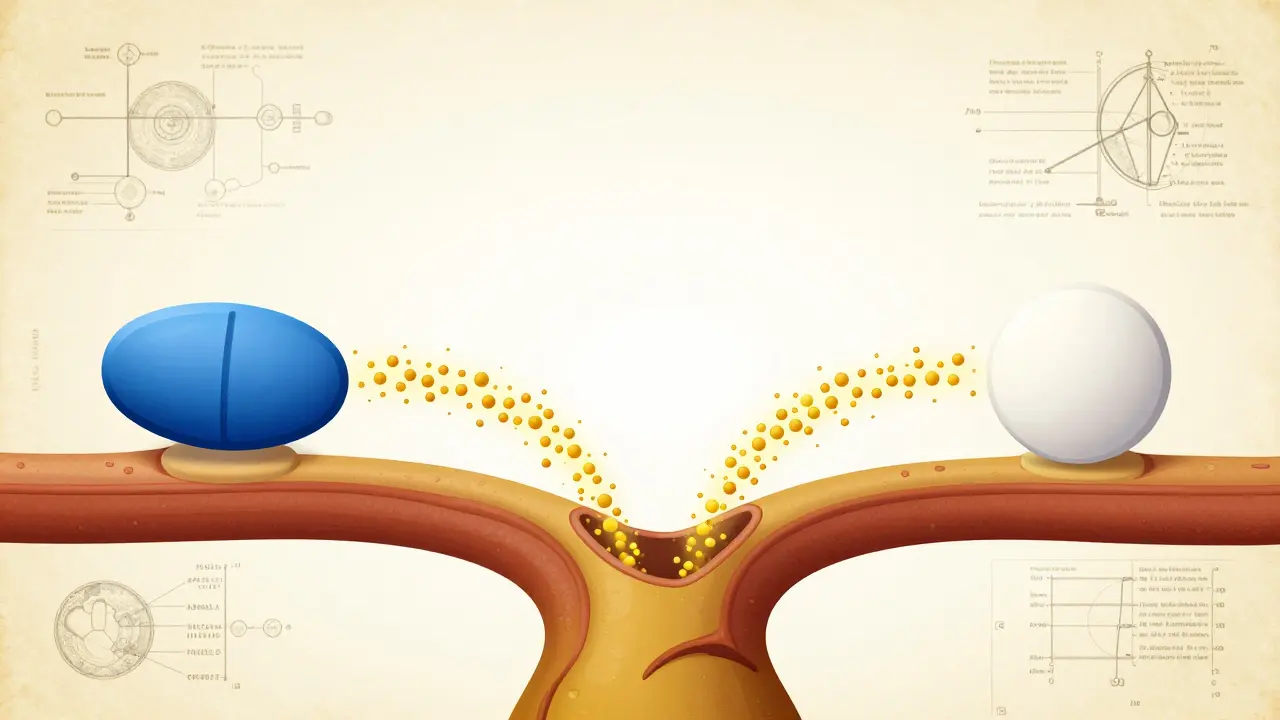
If they are the same, why does the generic pill look like a tiny white circle while the brand name is an oval blue pill? This is where the distinction between active and inactive ingredients comes in. The active ingredient-the part that actually treats your condition-must be identical in strength and dosage.
However, inactive ingredients are the "fillers" used to bind the pill together or give it a specific color and flavor. These can differ. One drug might use lactose as a filler, while the other uses sucrose. For 99% of people, this makes no difference. But if you have a severe allergy to a specific dye or a filler, these inactive ingredients can matter. This is the primary reason some people feel a difference when switching; they aren't reacting to a "weaker" drug, but to a different filler.
| Feature | Brand-Name Medication | Generic Medication |
|---|---|---|
| Active Ingredient | Identical | Identical |
| Strength & Dosage | Same | Same |
| Inactive Ingredients | Specific to brand | May vary by manufacturer |
| Appearance | Trademarked look | Different (cannot copy brand) |
| Average Cost | High (approx. $685 avg) | Low (approx. $15 avg) |
When You Might Actually Need the Brand Name
Is there ever a time when the generic isn't the best choice? Yes, but it's rare. Experts point to Narrow Therapeutic Index (NTI) drugs. These are medications where a tiny change in the dose or the way the body absorbs it can lead to a huge change in effect-either the drug stops working or it becomes toxic.
Common examples include warfarin (a blood thinner) or levothyroxine (for thyroid issues). For these, the FDA enforces even tighter bioequivalence limits (between 90% and 111%). Even so, some specialists, like endocrinologists, note that a small percentage of patients-maybe 5-10%-are simply too sensitive to formulation changes and do better staying on one specific brand for the rest of their lives to keep their levels stable.
The Psychology of the "Placebo Effect" in Reverse
You'll often see people online claiming generics don't work. Interestingly, a massive 2019 study in JAMA Internal Medicine analyzed 3.5 million patients across 13 different health areas (like diabetes and depression) and found no significant difference in outcomes between generics and brands. In some Austrian data, generics actually showed *better* survival rates, though researchers think this was likely due to other health factors rather than the drug itself.
So why the complaints? It's often a psychological phenomenon. When we pay more for something, we perceive it as higher quality. When we switch to a cheaper version, we become hyper-aware of our symptoms. This can lead to a "nocebo effect," where the belief that a drug is inferior actually causes the patient to experience more side effects or feel the drug isn't working, even when the chemistry in their blood is identical.
Tips for Switching Safely and Saving Money
If you're looking to cut your medication costs, a few practical steps can ensure the transition is smooth:
- Stick to one pharmacy: Different pharmacies use different generic manufacturers. If you jump between stores, you might be taking Generic A from Walgreens and Generic B from CVS. While both are approved, switching manufacturers frequently can cause minor fluctuations in some people.
- Talk to your doctor about NTI drugs: If you're taking medication for seizures or thyroid issues, ask your doctor if you're a candidate for a generic or if you should stick with the brand to avoid instability.
- Use identification tools: If your pill suddenly changes color or shape, don't panic. Use the FDA's Drugs@FDA database or a pill ID app to confirm it's the correct medication.
- Check your insurance tiers: Many insurance plans use "tiered formularies," meaning they'll charge you a $5 copay for a generic but $100 for the brand. Switching can save you thousands of dollars a year.
Are generic drugs made in countries with lower standards?
While many active pharmaceutical ingredients come from India and China, any facility selling drugs in the U.S. must meet FDA quality standards. The FDA conducts regular inspections of these overseas plants to ensure they follow Current Good Manufacturing Practice (CGMP) regulations. If a plant fails, the FDA can block their imports.
Why are generics so much cheaper if they are the same?
The brand-name company spent millions on research, development, and clinical trials to prove the drug was safe and effective. They were granted a patent to recover those costs. Once the patent expires, generic companies can enter the market. Since they don't have to redo the research, their only costs are manufacturing and distribution, which they pass on as savings to you.
Can I switch from brand to generic at any time?
In most cases, yes. However, you should always consult your doctor first, especially if you are on a high-risk medication. Some doctors prefer to transition patients slowly or monitor their blood levels more closely during the first few weeks after a switch to ensure stability.
What is a biosimilar, and is it the same as a generic?
Not exactly. Generics are copies of simple chemical drugs. Biosimilars are copies of "biologics," which are complex medicines made from living cells. Because biologics are so complex, they can't be made into an identical copy. Biosimilars are "highly similar" and have no clinically meaningful difference in safety or effectiveness, but they aren't identical in the way a generic pill is.
What should I do if I feel a generic isn't working?
First, keep a log of your symptoms. Then, talk to your pharmacist and doctor. It could be a rare reaction to an inactive filler, or it could be an issue with the specific manufacturer's batch. Your doctor can help you decide if you need to switch back to the brand name or try a different generic manufacturer.
Next Steps for Your Health Budget
If you're currently paying high copays, start by reviewing your medication list. Identify which ones are brands and ask your doctor, "Is there a therapeutically equivalent generic for this?" For those who absolutely need brand-name versions of NTI drugs, look into manufacturer assistance programs or coupons to bridge the price gap. The goal is always a balance: getting the most effective treatment for your specific body while keeping your healthcare costs sustainable.