
Feverfew and Anticoagulants: Understanding the Bleeding Risk
Feverfew-Anticoagulant Risk Checker
Assess Your Risk Level
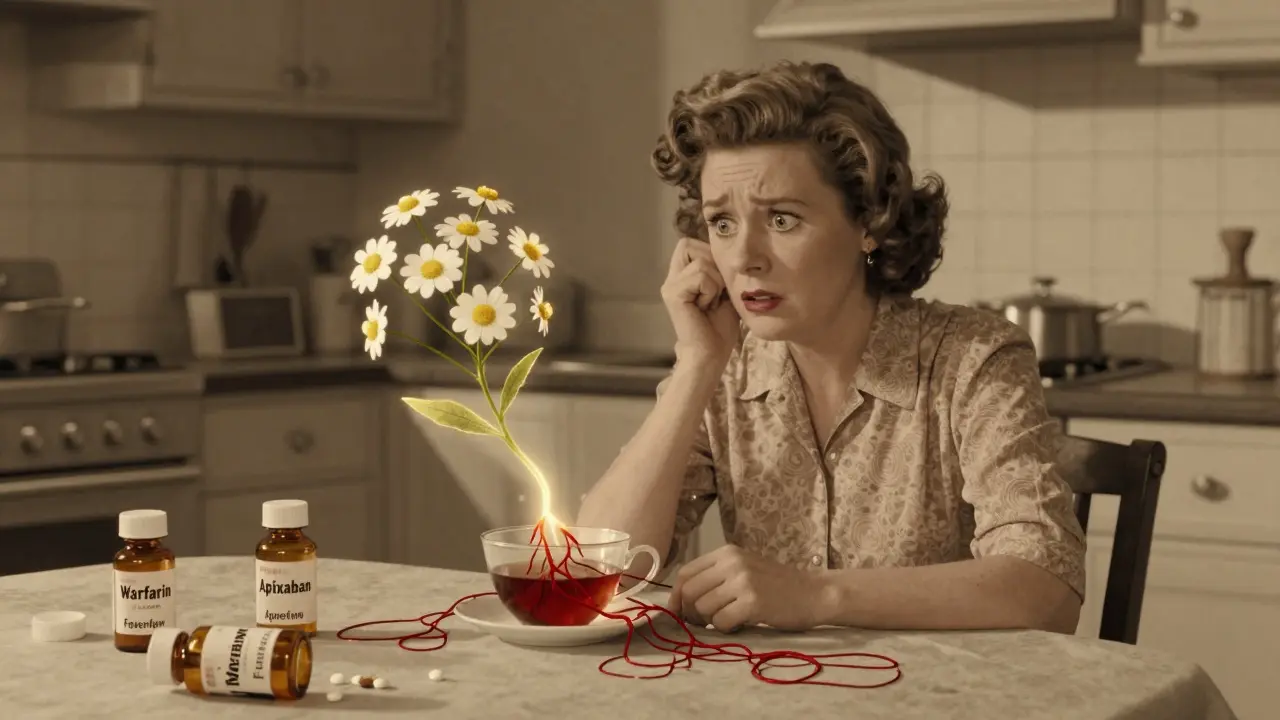
When you’re taking blood thinners like warfarin, apixaban, or rivaroxaban, even small changes in your daily routine can affect how well they work. One of the most overlooked risks comes from something many people think is harmless: feverfew. This herb, often used for migraine prevention, can quietly increase your chance of bleeding - sometimes with serious consequences.
What Feverfew Actually Does in Your Body
Feverfew (Tanacetum parthenium) is a daisy-like plant that’s been used for centuries to treat headaches and inflammation. Today, it’s sold in capsules, liquids, and even as dried leaves for tea. The main active ingredient, parthenolide, works by blocking serotonin’s effect on platelets - the blood cells that help clots form. This sounds helpful for reducing migraine triggers, but it’s exactly why it becomes dangerous when paired with anticoagulants.
Unlike aspirin, which broadly affects platelet function, feverfew targets a specific pathway. That might sound safer, but it doesn’t mean it’s harmless. Studies show it can prolong clotting times even at standard doses. One documented case in 2021 involved a 36-year-old woman taking feverfew daily. Her prothrombin time (PT) jumped to 27.3 seconds - well above the normal range of 11-16 seconds. Her hemoglobin dropped to 10 g/dL, signaling internal bleeding. After stopping feverfew for four months, her numbers returned to normal.
Why This Interaction Is Worse Than You Think
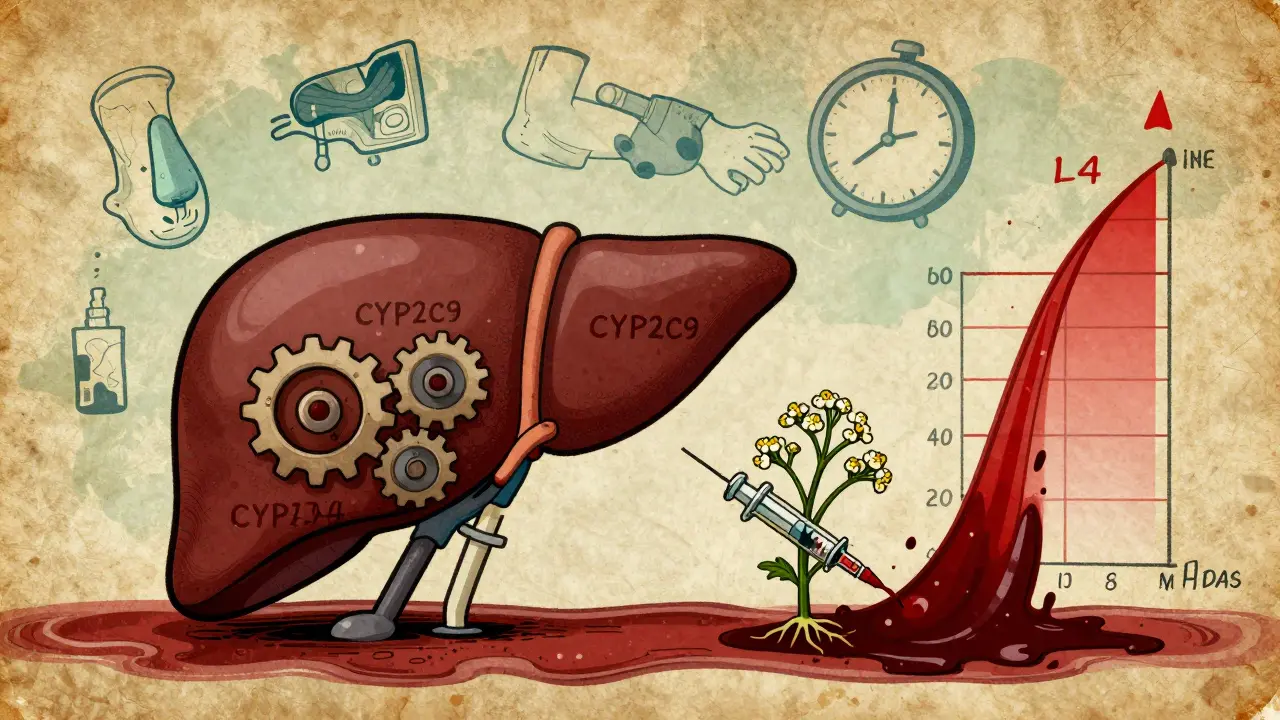
Feverfew doesn’t just interfere with platelets. It also messes with your liver’s ability to break down anticoagulants. It inhibits several CYP450 enzymes - especially CYP2C9 and CYP3A4 - the same ones that metabolize warfarin. In lab studies, this inhibition can raise warfarin levels in the blood by 18-22%. That’s not a small bump. A 20% increase in warfarin concentration can push your INR into dangerous territory, especially if you’re already on a low dose.
And here’s the catch: most people don’t realize they’re at risk. Feverfew is sold as a “natural remedy,” often without warning labels. A 2023 survey of herbal supplement users found that 68% of people taking feverfew for migraines didn’t tell their doctor. When you combine that with the fact that many anticoagulant patients are older and managing multiple medications, the potential for harm grows quickly.
How Feverfew Compares to Other Herbal Risks
You’ve probably heard of ginkgo, garlic, or ginger as bleeding risks. But feverfew is different. Ginkgo has more documented cases - 12 reported incidents of elevated INR between 2000 and 2015. Garlic and ginger clear from your system in about three days. Feverfew? It lingers. And it doesn’t just affect clotting - it can trigger withdrawal symptoms if you stop suddenly.
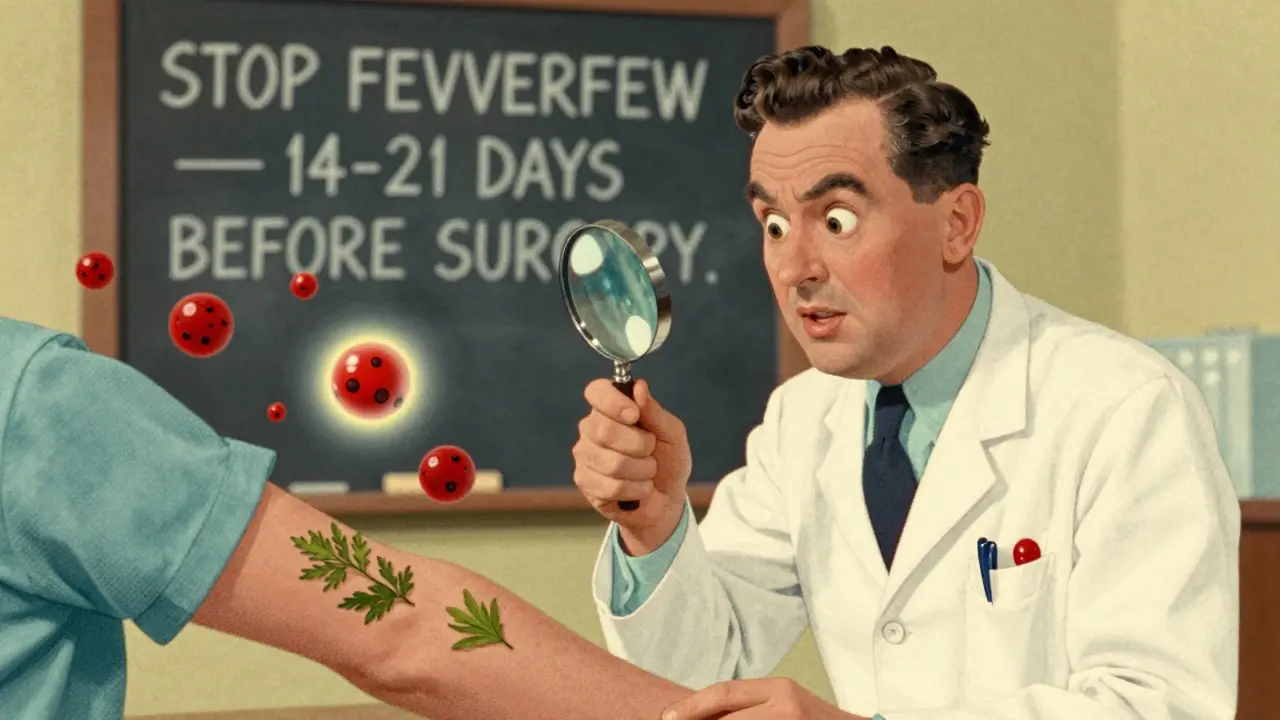
That’s called “post-feverfew syndrome.” About 41% of people who stop taking it after months or years get severe headaches. Others report insomnia, joint pain, or nervousness. This makes it harder to manage. You can’t just quit feverfew the day before surgery like you might with ginger. Experts recommend stopping it at least two weeks before any procedure - and for high-risk surgeries, up to three weeks. The 2021 NIH case report even noted that patients needed 2-3 weeks of tapering to avoid withdrawal, not just abrupt cessation.
Real-World Signs You Might Be at Risk
You don’t need a lab test to suspect a problem. Watch for these signs if you’re on anticoagulants and taking feverfew:
- Easy bruising - especially large, unexplained bruises on your arms or legs
- Nosebleeds lasting longer than 15 minutes
- Bleeding gums when brushing or flossing
- Unusually heavy or prolonged menstrual periods
- Dark, tarry stools or blood in urine
A 2023 review of user reports on Healthline found that 41% of people on anticoagulants who used feverfew reported increased bruising. That’s more than triple the rate seen in non-users. One Reddit user shared that after combining feverfew with low-dose aspirin, he had nosebleeds lasting 40 minutes - something he’d never experienced before, even with aspirin alone.
What Doctors Are Doing About It
Leading medical centers are starting to take this seriously. Memorial Sloan Kettering now includes feverfew in their “Few Gs” list - a mnemonic for herbs with bleeding risk: Feverfew, Ginger, Ginkgo, Garlic, and Ginseng. It’s taught in 78% of U.S. medical schools. The American College of Chest Physicians recommends screening for feverfew use in patients with unexplained coagulopathy, especially women of reproductive age - because one documented case involved abnormal vaginal bleeding.
Protocols are clear: Before starting feverfew, get baseline blood tests - PT, PTT, and INR. Then retest every two weeks for the first month. If you’re scheduled for surgery, stop feverfew 14-21 days ahead, depending on the procedure. For minor surgeries, 14 days is enough. For major procedures like spinal taps or joint replacements, go with 21 days. And don’t just quit cold turkey - taper slowly to avoid withdrawal symptoms.
What You Should Do Right Now
If you’re taking an anticoagulant and using feverfew:
- Stop taking it immediately - don’t wait for symptoms.
- Contact your doctor or pharmacist. Tell them exactly how long you’ve been taking it and what dose.
- Ask for a coagulation panel (PT/INR/PTT) to check your current clotting status.
- If you’ve been on it for more than six months, plan a taper. Cut your dose in half for a week, then stop completely.
- Don’t switch to another herbal remedy without checking its interaction profile. Dong quai, for example, contains coumarin - a compound that directly thins blood and is even riskier.
If you’re not on anticoagulants but use feverfew for migraines, be honest with your provider. Many people don’t realize their headache treatment could be a hidden risk - especially if they later need surgery or start a blood thinner for atrial fibrillation or a blood clot.
What’s Coming Next
Research is accelerating. A 2023 clinical trial (NCT05567891) is testing how feverfew affects apixaban in 120 healthy volunteers. Results are expected in mid-2024. The NIH has tripled its funding for this research since 2020, signaling growing concern. Experts predict that within five years, feverfew products may be standardized to contain less than 0.2% parthenolide for users on anticoagulants. There are even talks of developing a point-of-care test to measure parthenolide levels - similar to how we monitor warfarin with INR tests.
For now, the message is simple: Just because something is natural doesn’t mean it’s safe with your medication. Feverfew isn’t the biggest risk out there - but it’s one of the quietest. And that’s what makes it dangerous.
Can I take feverfew if I’m on warfarin?
No. Even small amounts of feverfew can raise your INR and increase bleeding risk. The interaction is well-documented in case reports and lab studies. If you’re on warfarin, avoid feverfew completely. There are safer alternatives for migraine prevention, like riboflavin or magnesium, that don’t interfere with blood thinners.
How long does feverfew stay in your system?
Feverfew’s active compound, parthenolide, can remain in your body for up to two weeks after you stop taking it. This is why experts recommend stopping it at least 14 days before surgery. Unlike garlic or ginger, which clear in 72 hours, feverfew lingers - and its effects on platelets and liver enzymes don’t disappear overnight.
Is it safe to chew fresh feverfew leaves?
No. Chewing fresh leaves causes mouth sores in about 11% of users, and some develop lasting oral inflammation. Even if you’re not on blood thinners, this is a real risk. Encapsulated forms are safer, but still not recommended if you’re taking anticoagulants. The delivery method doesn’t change the systemic effect - parthenolide still enters your bloodstream.
What are the withdrawal symptoms of stopping feverfew?
Up to 41% of long-term users experience rebound headaches after stopping. Other symptoms include insomnia (32%), joint pain (27%), nervousness (24%), and muscle stiffness (87%). These can last 3-14 days. That’s why tapering - not sudden stopping - is critical. Cut your dose in half for a week, then stop. This reduces withdrawal severity and gives your body time to adjust.
Are there any safe herbal alternatives to feverfew for migraines?
Yes. Magnesium (400 mg daily), riboflavin (vitamin B2, 400 mg daily), and coenzyme Q10 have strong evidence for migraine prevention without bleeding risk. Unlike feverfew, they don’t affect platelets or liver enzymes. Talk to your doctor about switching - these are proven, safe options that won’t interfere with your anticoagulant therapy.


8 Comments
Dean Jones
March 1, 2026 at 11:35
Feverfew is one of those substances that sneaks up on you like a quiet ghost in the pharmacological closet. It's not flashy like warfarin, it doesn't scream danger like heparin - it just sits there, in your medicine cabinet, labeled "natural remedy for migraines," while quietly turning your coagulation cascade into a chaotic jazz improvisation. The fact that it inhibits CYP2C9 and CYP3A4 isn't some obscure biochemistry footnote - it's a ticking time bomb wrapped in organic packaging. And yet, people take it because it's "herbal," as if nature somehow suspended the laws of pharmacokinetics. I've seen patients come in with INRs over 8, bleeding into their retroperitoneum, and when I ask about supplements, they look at me like I just asked if they've tried praying to the moon. This isn't about fearmongering. It's about respecting the complexity of human physiology - and recognizing that "natural" doesn't mean "innocent."
And don't get me started on the withdrawal syndrome. 41% of long-term users get rebound headaches? That's not a side effect - that's a dependency trap disguised as preventive care. We treat caffeine withdrawal like a joke, but we don't talk about feverfew withdrawal because it doesn't fit the narrative of "herbs are gentle." But they're not. They're pharmacologically active compounds. And if you're on an anticoagulant, you're already walking a razor's edge. Adding feverfew is like tightening the rope before you jump.
The NIH funding increase is a good sign. We need standardized parthenolide levels, mandatory labeling, and mandatory screening in anticoagulation clinics. This isn't a niche issue. It's a systemic blind spot in how we educate patients about supplements. We need to stop treating herbal products like tea and start treating them like drugs - because that's what they are.
And for the love of all that's measurable, stop saying "I've been taking it for years and nothing happened." That's not proof of safety. That's survivorship bias. We don't hear from the ones who bled out silently at 3 a.m. because no one was there to notice.
Stop. Stop. Stop. Just stop. And talk to your pharmacist. Not your yoga instructor. Not your Instagram herbalist. Your pharmacist.
Richard Elric5111
March 2, 2026 at 01:59
While I appreciate the clinical rigor of this exposition, I must posit a metaphysical counterpoint: the very notion that pharmaceutical intervention is inherently superior to botanical governance of physiological equilibrium is a relic of mechanistic reductionism. Feverfew, as a phytochemical entity, does not "interfere" - it participates. It is not an intruder, but a dialogue partner in the body's self-regulatory symphony. To label it a "risk" is to impose a binary framework upon a system that is inherently non-binary. The human organism, when allowed to adapt with dignity, does not succumb to the tyranny of pharmacological dogma. The case study cited - a 36-year-old woman - may reflect an idiosyncratic vulnerability, not a universal peril. Perhaps the pathology lies not in feverfew, but in the rigid, quantified model of health that demands constant surveillance and control. Is it not possible that the true danger is not the herb, but the fear of nature's autonomy?
Betsy Silverman
March 2, 2026 at 03:01
I’ve been on warfarin for six years due to a clotting disorder, and I started taking feverfew for migraines after my acupuncturist swore by it. I didn’t tell my doctor because I thought it was "just a herb." I had a nosebleed that lasted 25 minutes last winter - I thought I was just getting old. Turns out, my INR was 6.8. I stopped feverfew cold turkey and had the worst headache of my life for 10 days. I didn’t know about tapering. I wish someone had told me. Now I take magnesium and riboflavin. No more drama. My INR’s stable. My head doesn’t kill me. And I talk to my pharmacist every time I think about trying something new. Just because it’s in a bottle with leaves on it doesn’t mean it’s harmless. I’m alive because I listened. Please, if you’re reading this and you’re on blood thinners - don’t wait for a nosebleed to be your wake-up call.
Also, the part about mouth sores from chewing leaves? YES. I tried it once. My gums felt like I’d licked a battery. Never again.
Justin Rodriguez
March 2, 2026 at 20:34
Just want to add: the 2023 Healthline survey mentioned in the post? I was one of those 68%. Didn’t think it mattered. My neurologist didn’t ask. My pharmacist didn’t ask. I didn’t think to mention it. Now I know better. I’ve switched to butterbur extract (PA-free) and it’s been fine. No bleeding. No headaches. No drama. The key is communication. If your provider doesn’t ask about supplements, ask them. Bring a list. Write it down. Even if it seems silly. You’re not being paranoid - you’re being smart. And if they brush you off? Find a new provider. Your life isn’t a guessing game.
Raman Kapri
March 4, 2026 at 15:34
This article is alarmist nonsense. You cite a single case report as if it's epidemiological evidence. Where are the large-scale RCTs? Where is the meta-analysis? You mention "studies" but provide no citations beyond anecdotal Reddit posts and a 2023 survey - which is not clinical data. The CYP450 inhibition claims are theoretical, based on in vitro models, not human pharmacokinetics. Meanwhile, aspirin, which is actually a proven anticoagulant, is prescribed by the billions with far less scrutiny. Why is feverfew demonized while NSAIDs are not? This is fearmongering disguised as science. The real risk is not feverfew - it's the over-medicalization of natural substances. If you're afraid of herbs, don't take them. But don't scare people with cherry-picked anecdotes. I've taken feverfew for 12 years with warfarin. My INR is stable. Your narrative is flawed.
Megan Nayak
March 5, 2026 at 07:07
Oh, so now we're adding "herbal villain" to the list of things that will kill you? Next they'll ban sunlight because it increases vitamin D and somehow makes your blood thinner? This whole article reads like a pharmaceutical industry marketing pamphlet disguised as public health advice. Feverfew? A plant? With leaves? That’s the threat? Meanwhile, the real killers - processed foods, sedentary lifestyles, corporate pharmaceutical greed - are ignored. You want to save lives? Start by regulating sugar and statin pricing. But no, let’s focus on the poor woman who took a daisy to stop her headache. How convenient. Let’s make people afraid of nature so they buy more pills. The fact that you’re not acknowledging the profit motive behind this fear is the real danger. I’m not taking feverfew. But I’m not taking your narrative either.
Ivan Viktor
March 6, 2026 at 21:38
So let me get this straight - we’re told to avoid a plant because it might make your blood too thin… but we’re also told to take aspirin, which is literally a plant derivative? The irony is thicker than the blood in this article. I’ve been on rivaroxaban for 3 years. I chew feverfew leaves like they’re gum. No nosebleeds. No bruises. No drama. My doctor didn’t even blink when I mentioned it. Maybe the real issue isn’t feverfew - it’s that people are scared of everything that doesn’t come in a patent. I’m not saying it’s safe. I’m saying maybe the risk is overstated. Or maybe I’m just lucky. Either way, I’m not stopping. And I’m not apologizing for it.
Zacharia Reda
March 8, 2026 at 04:56
Look - I get why this post exists. It’s necessary. But let’s be real: most people don’t read this far. They see "feverfew" and think "migraine cure" and keep scrolling. The real problem isn’t the herb - it’s the communication gap. Doctors don’t ask. Pharmacists don’t remind. Patients don’t know to tell. We need a simple, standardized warning on every supplement bottle that says: "If you take blood thinners, DO NOT use this without consulting your provider." Not a footnote. Not a tiny font. A bold, red block. And we need pharmacists to flag it at checkout - like they do with alcohol and antibiotics. This isn’t about scaring people. It’s about making safety obvious. Because right now? It’s not. And people are getting hurt. Let’s fix the system, not just the herb.