
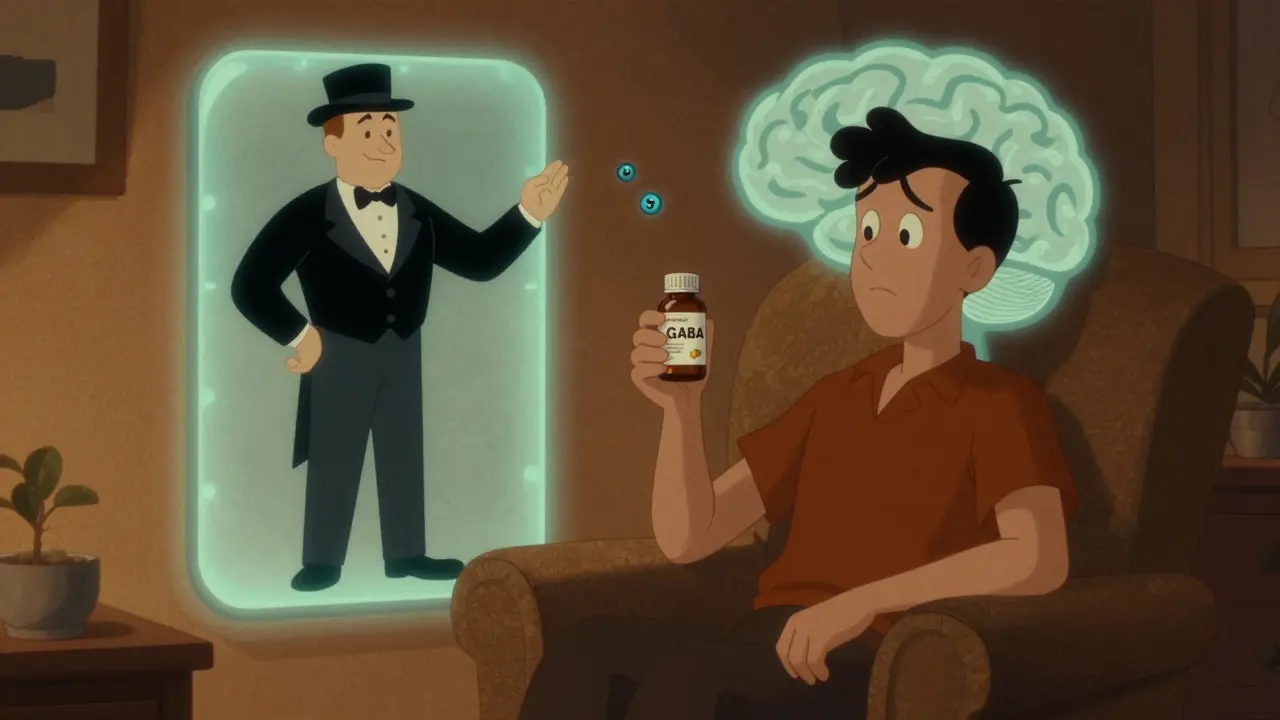
GABA Supplements and Sedatives: What You Need to Know About CNS Depression Risk
When you’re taking a prescription sedative like Xanax or Valium, you know to avoid alcohol. But what about that GABA supplement you’re popping for better sleep or reduced anxiety? Could it be making your sedative stronger-maybe dangerously so?
What GABA Actually Does in Your Body
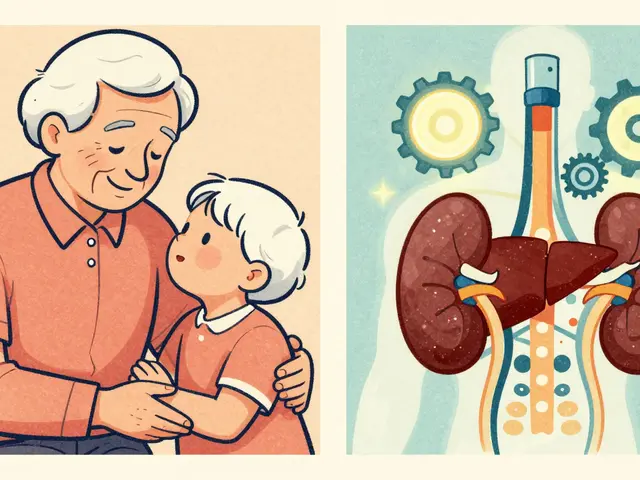
Gamma-aminobutyric acid, or GABA, is your brain’s main calming neurotransmitter. It works by slowing down overactive nerve signals, which helps reduce anxiety, promote relaxation, and encourage sleep. That’s why drugs like benzodiazepines and barbiturates target GABA receptors-they boost its effects to create sedation.
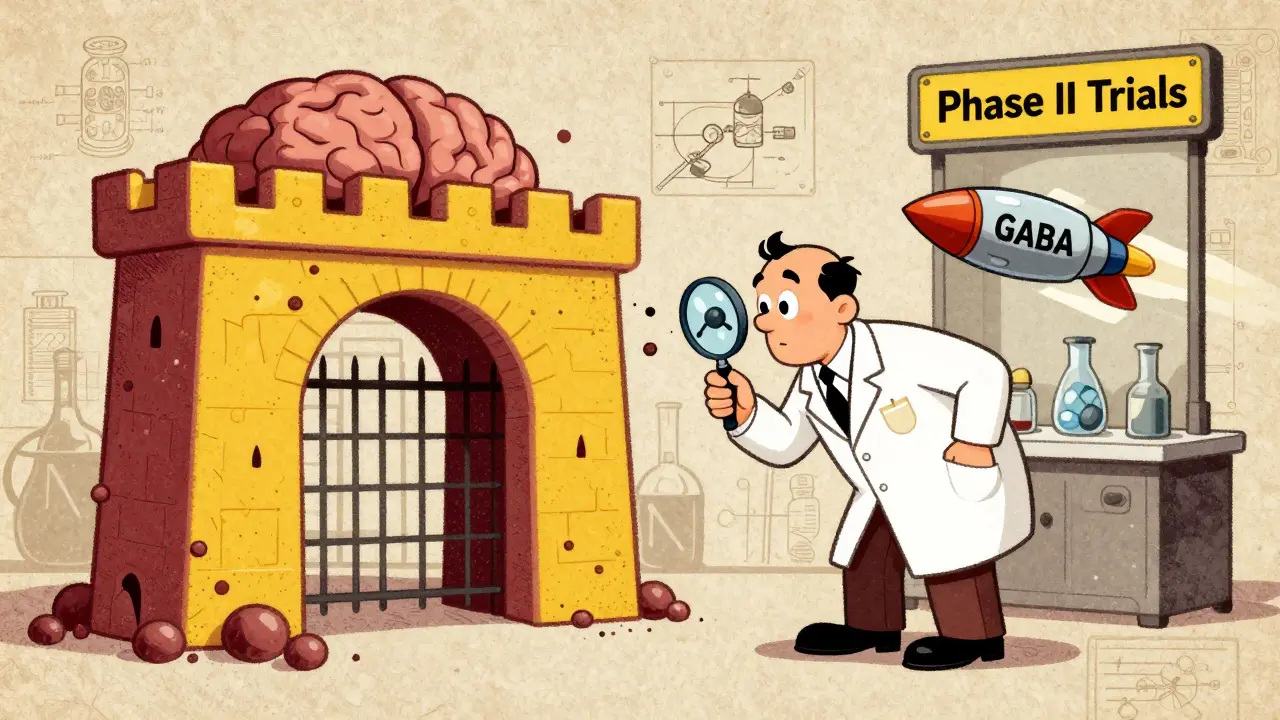
But here’s the catch: when you swallow a GABA supplement, almost none of it reaches your brain. GABA is a water-soluble molecule, and your blood-brain barrier acts like a bouncer at a club-it won’t let it in. Studies show less than 0.03% of oral GABA crosses into the central nervous system. That means even a 750 mg dose, which sounds like a lot, barely makes a dent in your brain’s natural GABA levels, which are thousands of times higher.
Why Sedatives Are a Different Story
Prescription sedatives don’t rely on bringing GABA into your brain. They work directly on GABA receptors. Benzodiazepines like alprazolam bind to specific spots on those receptors and make GABA work 200-300% more effectively. Barbiturates do something similar, but even more powerfully. Alcohol? It does both-boosts GABA and blocks excitatory signals at the same time.
These drugs are designed to cross the blood-brain barrier quickly. Diazepam (Valium) hits peak brain levels in under 90 minutes. GABA supplements? They barely register in your bloodstream, let alone your brain. That’s why the theoretical risk of combining them doesn’t match the reality.
The Real Risk: It’s Not GABA-It’s the Other Supplements
If you’re worried about additive CNS depression, you’re looking in the wrong place. The real danger comes from herbal supplements that actually change how GABA behaves in your brain.
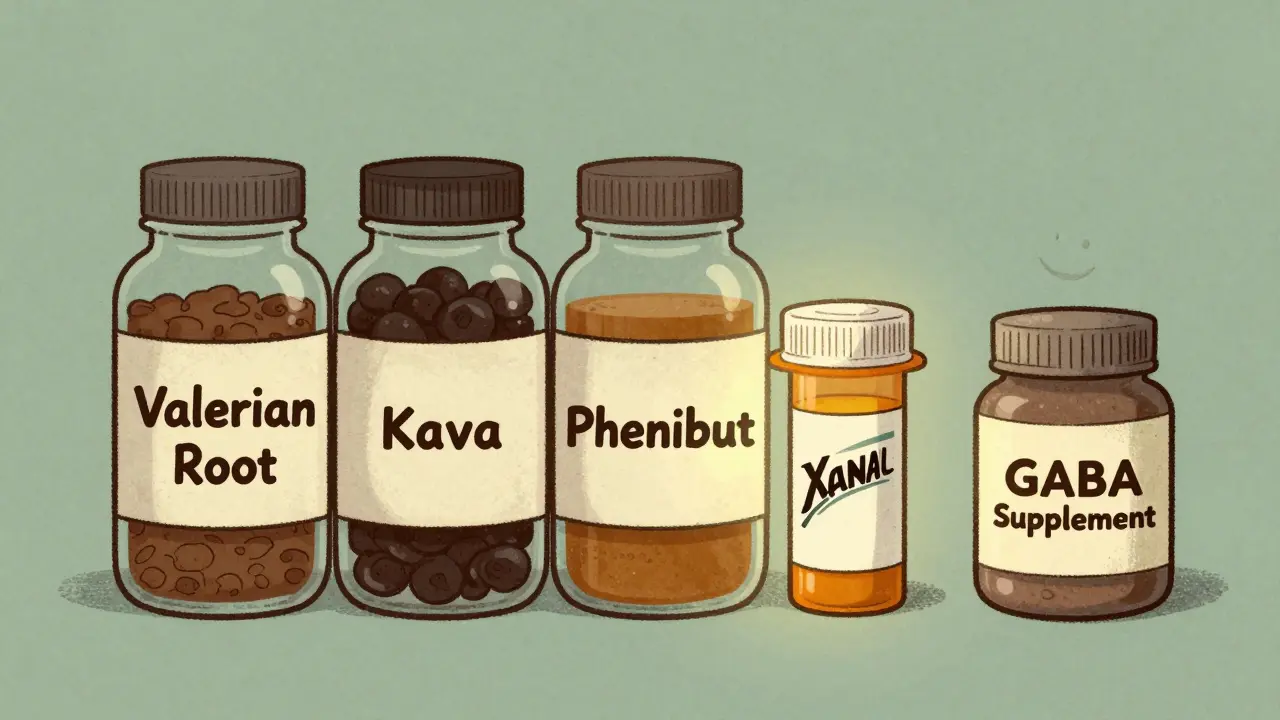
Valerian root? It increases GABA release. Kava? It blocks GABA reuptake. Phenibut? It’s a synthetic GABA analog that crosses the blood-brain barrier easily. These substances have documented interactions with sedatives. One 2020 review found that combining kava with zolpidem (Ambien) increased sedation by 37%. That’s not theoretical-it’s clinical.
Meanwhile, pure GABA supplements show no meaningful interaction in human studies. A 2018 meta-analysis of over 1,200 people found no difference in sedation levels between those taking GABA and those taking a placebo-when both groups were also on benzodiazepines. The FDA hasn’t issued any warnings about GABA supplements interacting with sedatives, unlike the black box warnings they put on opioid-benzodiazepine combinations.
What the Data Says About Safety
Let’s look at real-world evidence. The FDA’s adverse event database from 2010 to 2022 recorded only three possible cases where GABA supplements were linked to sedative reactions. None met the standard criteria for a confirmed adverse drug reaction. Compare that to over 12,800 documented cases of dangerous interactions between opioids and benzodiazepines during the same period.
On Reddit, users who combined GABA with alcohol or prescription sedatives mostly reported no effect. Of 147 comments analyzed, 62% said they felt nothing different. Only 23% noticed slightly more drowsiness-enough to feel sleepy, but not enough to require medical help. Amazon reviews of top-selling GABA products show a 4.1 out of 5 rating. The most common complaint? “Didn’t work.” Not “made me pass out.”
What Experts Are Saying
Dr. Adrienne Heinz from Stanford says it plainly: “There’s virtually no clinical evidence that oral GABA supplements significantly enhance CNS depressant effects.”
The American Academy of Neurology’s 2022 position paper concluded GABA supplements are “unlikely to contribute meaningfully to CNS depression.” Even Dr. David Eagleman, a leading neuroscientist, wrote in his book that “99.97% of orally consumed GABA is filtered out by the blood-brain barrier.”
That said, not everyone is fully convinced. Dr. Charles P. O’Brien raised a quieter concern: what about GABA made in your gut? Could it be influencing your vagus nerve and indirectly affecting brain activity? It’s a plausible theory-but so far, there’s no proof it matters in real people taking normal doses.
What You Should Actually Do
If you’re on a sedative and thinking about adding GABA:
- Don’t panic. The science says the risk is extremely low.
- Don’t assume it works. Most people don’t feel any effect from GABA supplements at all.
- Avoid alcohol. That’s the real combo to worry about-alcohol with sedatives increases CNS depression risk by 45%.
- Check your other supplements. If you’re taking valerian, kava, melatonin, or phenibut, talk to your doctor. Those are the ones with actual interaction risks.
- Start low if you try it. If you still want to experiment, begin with 100-200 mg. Monitor for drowsiness. If you feel overly sleepy, stop.
The American Academy of Family Physicians recommends always talking to your doctor before adding any supplement-especially if you’re on medication. That’s not because GABA is dangerous. It’s because you deserve to make informed choices.
What’s Coming Next
Researchers are working on ways to get GABA into the brain. A new compound called GABA-C12, currently in phase II trials, is designed to sneak past the blood-brain barrier. Early animal studies show it’s over 12 times more effective at reaching the brain than regular GABA.
If this works in humans, everything changes. That’s when additive CNS depression might become a real concern. But right now? That’s science fiction. The GABA you can buy at the store? It’s just not strong enough to matter.
Bottom Line
You can take GABA supplements while on sedatives without worrying about dangerous interactions. The science is clear: GABA doesn’t reach your brain in meaningful amounts. The risk of additive CNS depression is theoretical, not practical.
But that doesn’t mean you should be careless. Avoid alcohol with sedatives. Watch out for other herbal supplements like kava or phenibut. And if you’re unsure, ask your doctor. It’s not about GABA being dangerous-it’s about making sure you’re not accidentally combining things that actually are.
For now, GABA supplements are mostly harmless-and mostly ineffective. Treat them like a vitamin you take because you hope it helps. Not like a drug you need to fear.


8 Comments
Aditya Kumar
December 16, 2025 at 09:05
Been taking GABA with my Xanax for months. Zero difference. Just wasted money.
Wish I’d read this sooner.
Billy Poling
December 16, 2025 at 10:07
It is imperative to recognize, from a pharmacological and neurophysiological standpoint, that the blood-brain barrier constitutes a highly selective semipermeable border that effectively excludes hydrophilic molecules such as gamma-aminobutyric acid, thereby rendering oral supplementation biologically inert with respect to central nervous system modulation. This is not merely anecdotal speculation but is grounded in peer-reviewed neuropharmacological literature dating back to the 1970s, wherein the permeability coefficient of GABA across the BBB was quantified at less than 0.03%, a figure that remains statistically indistinguishable from placebo in controlled trials. Consequently, the notion that dietary GABA augments sedative effects is a persistent myth propagated by supplement marketers who exploit cognitive biases in health-conscious populations.
Furthermore, the conflation of GABA supplements with clinically active GABAergic agents such as phenibut or kava represents a dangerous category error-one that could lead to inappropriate risk assessment and potentially hazardous self-medication practices. The real threat lies not in GABA, but in the unregulated, poorly characterized herbal extracts that are often co-consumed without medical oversight.
Randolph Rickman
December 17, 2025 at 21:19
This is such a needed post. So many people are scared to take GABA because they think it’s like adding more Xanax to their system. It’s not. It’s like pouring water into a locked vault-doesn’t matter how much you pour, the vault stays empty.
And honestly? If you’re taking kava or phenibut with sedatives, that’s where you need to pause. Talk to your doctor. Don’t just Google it and hope for the best.
Also-huge shoutout to the author for calling out alcohol. That’s the real silent killer here. GABA? Just a sleepy placebo with a nice label.
sue spark
December 18, 2025 at 13:15
I’ve tried GABA three times. Felt nothing. Not sleepy not calm just… there.
Worthless for me but at least not dangerous. Good to know the science backs that up.
Still gonna avoid kava though. Heard too many stories.
Tiffany Machelski
December 20, 2025 at 06:13
thank you for this so clear and helpful i had no idea gaba didnt even get to the brain wow
im gonna stop wasting money on it and check my other supps instead
SHAMSHEER SHAIKH
December 21, 2025 at 09:21
Esteemed colleagues, I extend my profound gratitude to the author for this meticulously researched, scientifically rigorous exposition on the pharmacokinetic limitations of oral gamma-aminobutyric acid supplementation.
It is both enlightening and deeply reassuring to observe that empirical data-drawn from meta-analyses, FDA adverse event reporting, and neurochemical studies-consistently refute the speculative dangers propagated by wellness influencers.
Let us not forget: the human body is a marvel of evolutionary engineering, and the blood-brain barrier is not a suggestion-it is a fortress. GABA, in its supplemental form, is but a humble traveler at the gates, denied entry by nature’s own design.
However, we must remain vigilant against the allure of synthetic analogs-phenibut, in particular-whose deceptive molecular mimicry permits passage into the CNS, thereby creating genuine clinical risk.
Let this post serve as a beacon for the confused, a shield for the anxious, and a clarion call to prioritize evidence over anecdote.
With respect and scientific integrity,
Dr. Shamsheer Shaikh, M.D. (Ret.)
Dave Alponvyr
December 22, 2025 at 11:04
So you’re telling me I’ve been paying $20 a bottle for placebo water?
Wow. I feel smart.
And also kinda dumb.
Thanks for the save.
Kim Hines
December 22, 2025 at 11:54
My mom takes GABA and Valium. She says she feels a little more relaxed, but she also drinks chamomile tea and naps after lunch. Hard to say what’s doing what.
Still, I’m glad to know it’s probably not dangerous. I’ll tell her to stop buying the expensive stuff though. The cheap one’s just as good.