
How Generic Combination Drugs Save Money Compared to Individual Generics
When you fill a prescription for a generic drug, you expect to save money. But sometimes, the generic version costs more than another generic you could have taken instead. That’s not a mistake-it’s the reality of today’s generic drug market. Many patients and insurers are paying way more than they need to because they’re not comparing the right options. The biggest savings often come not from switching from brand to generic, but from swapping one generic for another-especially when you look at combination products versus taking two separate generics.
Why Some Generics Cost More Than Others
Not all generics are created equal. Two pills with the exact same active ingredients can have wildly different prices. A 2022 study from JAMA Network Open looked at the top 1,000 generic drugs in Colorado and found 45 that were priced way higher than their clinical equivalents. These high-cost generics weren’t better. They didn’t work faster. They didn’t have fewer side effects. They just cost more-sometimes over 15 times more. Take a common example: a generic version of a blood pressure pill might cost $80 for a 30-day supply. But another generic with the same active ingredient, same dose, and same manufacturer just in a different pill shape or packaging? It might cost $8. That’s a 90% drop in price for the exact same medicine. The difference? Market competition. When only one company makes a certain generic version, they can charge more. When five companies make it, prices crash. The study found that 62% of these overpriced generics could have been replaced with lower-cost versions of the same drug-just in a different strength or form. That’s not switching drugs. That’s just switching the version of the same drug. And the savings? On average, 95% off for different dosage forms, and 77% off for different strengths.Combination Drugs: One Pill, Big Savings
Combination drugs-pills that pack two or more active ingredients into one tablet-are where the real savings shine. Instead of buying two separate generics and taking them at different times, you get them together in one pill. Sounds simple, right? But here’s the catch: brand-name combination drugs used to be expensive. Then generics came in. Take Advair Diskus, a brand-name inhaler for asthma and COPD. Before generics hit the market in 2019, it cost about $334 per inhaler. By early 2020, the generic version, Wixela Inhub, hit shelves at $115. That’s a 65% drop in price per unit. Across the U.S., that single switch saved patients and insurers nearly $1 billion in one year. That’s not a small number. That’s enough to cover thousands of other prescriptions. The same pattern happened with other combination drugs. In rheumatology, generic versions of combination treatments for arthritis replaced expensive brand-name combos and saved an estimated $925 million in 2016 alone. These aren’t theoretical savings. These are real dollars taken out of patients’ pockets and insurance bills.Who’s Saving the Most?
Not everyone benefits equally. A 2023 study in JAMA Health Forum analyzed over 843 million prescription fills and found that uninsured patients saw the biggest savings-on average, $6.08 per prescription. That’s because they were paying full retail price before, and generics brought them down to near wholesale rates. People with private insurance saved about $3.69 per script. Medicare patients saved $4.64. Medicaid patients? Almost nothing. Why? Because Medicaid already had low prices built in. For them, the gap between brand and generic was already closed. The real winners? People who didn’t have insurance or had high deductibles. For them, switching to a cheaper generic combination-or even just a different version of the same generic-could mean the difference between filling a prescription or skipping it.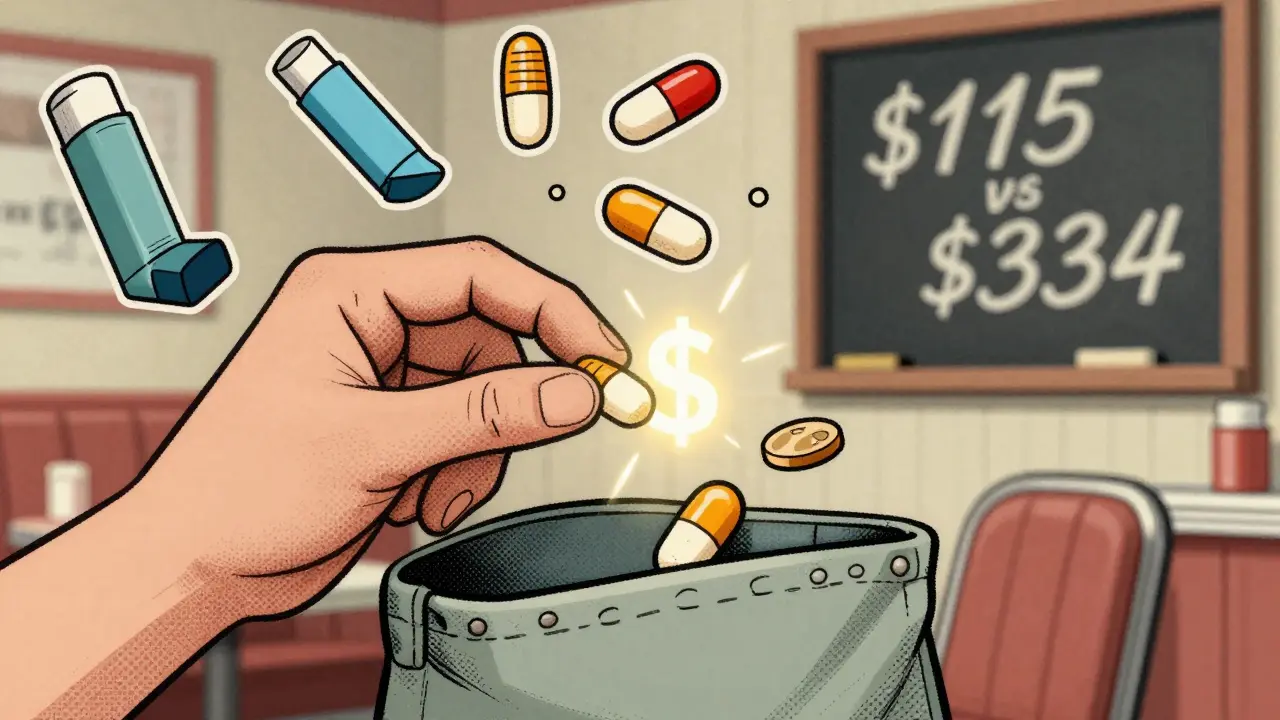
How to Find the Cheapest Option
You don’t need a pharmacy degree to save money on generics. Here’s how to do it:- Ask your pharmacist: “Is there a lower-cost version of this generic?” They know which manufacturers make the cheapest versions.
- Check if your drug is a combination product. If you’re taking two separate pills, ask if there’s a combo version. It might be cheaper than buying both individually.
- Use tools like GoodRx or SingleCare. They show real-time prices at nearby pharmacies. Sometimes the same generic costs $12 at Walmart and $48 at CVS.
- Look up the drug in the FDA’s Orange Book. If it has an “A” rating, it’s considered therapeutically equivalent to the brand and other generics. That means you can swap safely.
Why Don’t More People Switch?
You’d think this would be common sense. But barriers exist. Some doctors don’t know about cheaper alternatives. Some pharmacies don’t stock them because they’re not on the formulary. Some insurance plans don’t cover certain generics unless you get prior authorization. Also, there’s a psychological hurdle. Patients think “if it’s generic, it’s cheap”-so they don’t question it. But as we’ve seen, some generics are expensive by design. Manufacturers know that once a patient is on a specific version, they’re locked in. Switching requires a new prescription, a new refill, and a conversation. Most people don’t have the time or energy. That’s why plan sponsors-like employers and insurers-need to audit their drug lists. They should be looking for high-cost generics that have cheaper, equivalent options. A quarterly review can cut generic spending by tens of millions without changing patient outcomes.
The Bigger Picture: Competition Drives Prices Down
The reason generic drugs are so cheap isn’t because they’re low quality. It’s because there’s competition. When only one company makes a generic, prices stay high. When five or six companies enter the market, prices collapse. That’s how Crestor’s generic went from $5.78 per pill to $0.08. That’s how Prilosec dropped from $3.31 to $0.05. The FDA says the sweet spot is around three competitors. After that, prices drop fast. But here’s the problem: the generic market is getting more concentrated. The top 10 manufacturers now control about 40% of the $70 billion U.S. generic market. That means less competition, fewer price drops, and more risk of shortages. That’s why recent FDA efforts to speed up generic approvals matter. In 2017, they approved 843 new generic applications-the highest ever. Since then, approvals have dropped. Fewer new players mean less pressure on prices. If we want to keep saving billions, we need more companies making generics.What You Can Do Today
You don’t need to wait for policy changes or insurance reforms. Right now, you can save money:- Ask your pharmacist for the lowest-priced generic version of your medication.
- If you’re on two separate generics, ask if a combination pill exists.
- Use a price comparison app before you pay at the counter.
- Don’t assume your current prescription is the cheapest option.
Are generic combination drugs as effective as brand-name ones?
Yes. The FDA requires generic combination drugs to have the same active ingredients, strength, dosage form, and route of administration as the brand-name version. They must also prove they work the same way in the body. The only differences allowed are in inactive ingredients like color or filler-none of which affect how the drug works.
Why is one generic version more expensive than another?
It’s usually about competition. If only one company makes a specific generic version, they can charge more. If five companies make it, prices drop. Other factors include packaging, marketing, and which pharmacy chain is selling it. Some generics are priced higher simply because no one’s challenged the price yet.
Can I ask my doctor to switch me to a cheaper generic?
Absolutely. Doctors expect this question. If your prescription is for a high-cost generic, your doctor can often prescribe a lower-cost alternative with the same therapeutic effect. Just bring up the cost and ask if there’s a more affordable option that’s just as effective.
Do Medicare or Medicaid patients benefit from switching generics?
Medicare patients often do, especially if they’re in the coverage gap (donut hole) or have a high deductible. Medicaid patients usually see less savings because Medicaid already negotiates very low prices. But even Medicaid users can benefit if they’re on a brand-name drug or a high-cost generic that has a cheaper equivalent.
How do I know if a generic is therapeutically equivalent?
Look up the drug in the FDA’s Orange Book. If it has an “A” rating, it’s approved as interchangeable with the brand and other generics. You can also ask your pharmacist-they have access to this database and can tell you if a generic is rated as equivalent.


16 Comments
Meina Taiwo
December 22, 2025 at 05:27
Just asked my pharmacist about my blood pressure med-switched from the $45 version to the $7 one. Same active ingredients. Same results. Saved $400 a year. Why didn’t I know this sooner?
Brian Furnell
December 23, 2025 at 14:33
This is a critical but grossly under-discussed issue in pharmaceutical economics. The market fragmentation of generic APIs, coupled with patent evergreening via dosage form manipulation, creates artificial monopolies that exploit regulatory loopholes. The FDA’s Orange Book A-rating system is the only reliable heuristic, yet pharmacists are rarely incentivized to educate patients on therapeutic substitution. We need mandatory price transparency at point-of-sale, and formulary audits should be legally mandated for all PBMs. The 95% price differential for identical bioequivalent generics isn’t a market anomaly-it’s a systemic failure.
Southern NH Pagan Pride
December 25, 2025 at 11:20
They don't want you to know this. Big Pharma owns the FDA. They let the cheap generics in just enough to look good, but the real money is in the 'special' versions that cost 10x. You think that's coincidence? No. It's a scheme. They want you dependent on the expensive one so they can upsell you on the 'premium' generic. And don't get me started on how the pharmacies are in on it too-$48 at CVS? That's not pricing. That's extortion.
Orlando Marquez Jr
December 27, 2025 at 07:56
It is both a testament to the efficacy of market-based competition and a sobering indictment of the structural inefficiencies inherent in the U.S. pharmaceutical supply chain. The empirical data presented, particularly regarding the 62% of overpriced generics that are therapeutically interchangeable, underscores the necessity for policy intervention to incentivize transparency and promote generic substitution at the point of dispensing. One is compelled to question the ethical obligations of prescribers who fail to consider cost-effectiveness as a component of clinical decision-making.
Jackie Be
December 27, 2025 at 21:36
OMG I JUST SWITCHED MY DIABETES MEDS TO THE CHEAP GENERIC AND MY BILL DROPPED FROM $180 TO $12 I CRIED IN THE PHARMACY LINE I WAS SO HAPPY WHY DOESNT EVERYONE KNOW THIS
John Hay
December 28, 2025 at 12:22
People need to stop assuming their doctor picked the best option. Doctors are busy. They don’t track which generic version costs what. You have to be your own advocate. Ask for the cheapest A-rated version. It’s not rude-it’s smart. And if your pharmacy doesn’t have it, they can order it. It’s not magic. It’s just knowledge.
Ben Warren
December 29, 2025 at 23:12
It is not merely a matter of cost-efficiency; it is a moral failing of the American healthcare apparatus that patients are routinely overcharged for therapeutically identical medications. The fact that manufacturers can exploit packaging and formulation differences to maintain monopolistic pricing structures-while the FDA permits such practices under the guise of therapeutic equivalence-is an abomination. The absence of mandatory price disclosure at the prescriber level, combined with the perverse incentives of pharmacy benefit managers, constitutes a systemic corruption that disproportionately harms the uninsured, the elderly, and the working poor. Until we dismantle the PBM cartel and enforce true price transparency, this exploitation will continue unabated.
Teya Derksen Friesen
December 30, 2025 at 07:04
It’s fascinating how the market dynamics of generics mirror those of consumer electronics-early adopters pay more, latecomers get the bargain. The real tragedy is that patients are treated like passive recipients rather than informed consumers. If we treated medication like we treat smartphones-comparing models, reading reviews, shopping around-we’d save billions. But we don’t. We trust the system. And the system is rigged.
Sarah Williams
December 31, 2025 at 20:07
Just told my mom to check GoodRx before her next refill. She’s on Medicare and thought she was already getting the best deal. Turned out she was paying $35 for a pill that costs $5 elsewhere. She’s so relieved. This info changes lives.
Dan Adkins
January 2, 2026 at 06:16
One must acknowledge the structural impediments to pharmaceutical equity. The concentration of manufacturing capacity among the top ten firms, as noted in the study, is not a coincidence but rather the outcome of regulatory capture and capital-intensive barriers to entry. The FDA’s approval backlog, while reduced in 2017, has since regressed due to bureaucratic inertia. The implication is clear: without aggressive antitrust enforcement and subsidy-driven entry incentives, generic markets will continue to ossify, rendering the promise of affordable medicine a rhetorical artifact.
Grace Rehman
January 2, 2026 at 13:46
So we’re supposed to be grateful that a pill that costs $80 is now $8? That’s not progress. That’s just the system finally admitting it was stealing from us all along. And now we’re supposed to pat ourselves on the back for ‘finding the deal’? What kind of world are we living in where the bare minimum is a miracle?
Jerry Peterson
January 3, 2026 at 00:57
My buddy in Canada pays $2 for the same generic combo pill we pay $45 for. He doesn’t even know how lucky he is. We’re literally paying more for the same medicine because our system is broken. And no one talks about it.
Siobhan K.
January 4, 2026 at 16:02
My pharmacist told me this last month. I didn’t believe her until I saw the price difference. Then I checked the Orange Book. Same rating. Same everything. I felt stupid for not asking sooner. But honestly? I’m not mad. I’m just glad I found out before I got hit with another $200 bill.
Adrian Thompson
January 6, 2026 at 06:27
They want you to think this is about savings. It’s not. It’s about control. The government lets these cheap generics in so you think they’re helping. But then they make sure the real drugs-the ones you actually need-are still expensive. They’re playing a game. And we’re the pawns.
Jon Paramore
January 7, 2026 at 17:16
Combination generics are the unsung heroes of cost containment. A single-pill regimen improves adherence, reduces pill burden, and often cuts costs by 50–80% compared to two separate generics. The real barrier isn’t clinical-it’s administrative. Formularies lag, EHRs don’t auto-suggest alternatives, and prescribers lack real-time pricing data. Fix the tech, fix the incentives, and we can eliminate unnecessary spending overnight.
Meina Taiwo
January 8, 2026 at 03:35
That’s what I said. I switched my combo med to the generic version and saved $120/month. No side effects. No issues. Just cheaper.