
How to Store Inhalers and Nebulizer Medications Safely: Temperature, Humidity, and Common Mistakes
It’s December 2025, and the temperature in Austin just hit 89°F. Your inhaler’s been sitting in your car all morning. You reach for it during your morning coughing fit - but nothing comes out. Or worse, it spits out a weak puff. That’s not just frustrating. It’s dangerous. Every year, inhaler storage mistakes lead to preventable emergency visits, especially during heatwaves. The truth? Most people have no idea how to store their asthma or COPD meds correctly - and it’s killing more people than they realize.
Why Storage Matters More Than You Think
Your inhaler isn’t just a plastic tube with a metal canister. Inside is a precise dose of medicine - often albuterol, salmeterol, or budesonide - suspended in a propellant or dried into fine powder. These compounds are fragile. Too much heat? They break down. Too much moisture? The powder clumps or the capsule cracks. A study from the University of North Carolina found that inhalers stored in a 95°F car for just 24 hours delivered up to 40% less medication than they should. That’s not a small drop. That’s the difference between breathing and suffocating during an attack.
The FDA and the American Lung Association agree: improperly stored inhalers contribute to about 12% of all asthma emergency visits. That’s not a myth. That’s data from a 2022 patient safety study. And it’s not just inhalers. Nebulizer solutions like Pulmicort Respules degrade even faster. One 2022 study in the Journal of Aerosol Medicine showed that exposing albuterol ampules to 104°F for just 30 minutes ruined the drug completely. No second chances. No backup. If your medicine fails, you’re on your own.
What’s the Right Temperature? (It’s Not What You Think)
Most people assume “room temperature” means whatever the house feels like. It doesn’t. For most inhalers, the sweet spot is 68°F to 77°F (20°C to 25°C). That’s not your bathroom. That’s not your car. That’s not your gym bag.
Here’s the breakdown by type:
- Pressurized metered-dose inhalers (pMDIs) like ProAir HFA, Ventolin HFA: Keep between 59°F and 77°F. Don’t let them go above 86°F. The aluminum canister can explode if heated past 120°F.
- Dry powder inhalers (DPIs) like Spiriva HandiHaler, Advair Diskus: Moisture is the enemy. Humidity above 60% makes the powder clump. Above 65%, the capsules become brittle and crack. Store these in a dry drawer, not a humid bathroom.
- Breath-actuated inhalers (BAIs) like Proventil RespiClick: More sensitive than pMDIs. Stick to 68°F-77°F. Cold or heat changes how the medicine releases.
- Nebulizer solutions like albuterol ampules or Pulmicort Respules: Refrigerate unopened (36°F-46°F). Once opened, they’re good for only 7 days at room temperature. After that, the concentration drops - fast.
There’s confusion about refrigeration. The European Respiratory Society says it’s okay to briefly chill Symbicort during extreme heat. The American Thoracic Society says never refrigerate multi-dose inhalers. Stick to the manufacturer’s label. If it says “do not refrigerate,” don’t. If it says “store in fridge until first use,” do it.
Where NOT to Store Your Inhaler
Here are the top 5 places you’re probably keeping your inhaler - and why they’re disasters:
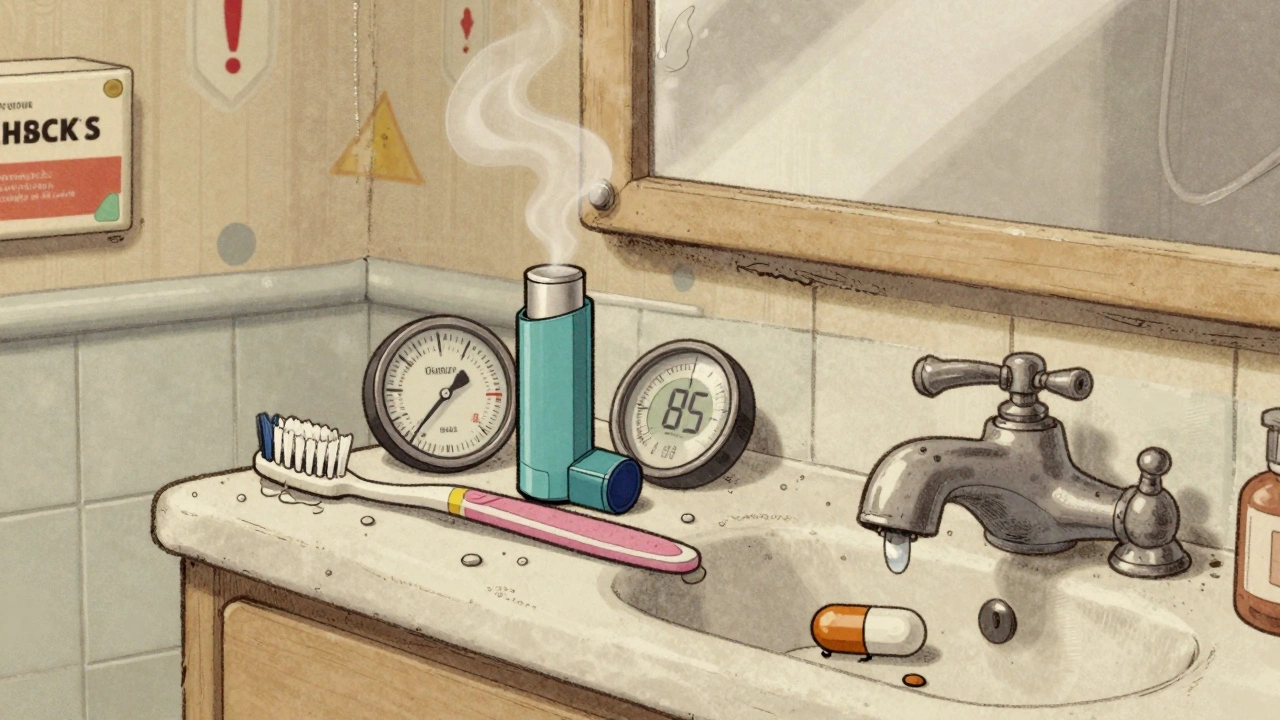
- Bathroom cabinet: Steam from showers raises humidity to 70-90%. St. Jude Children’s Research Hospital found this reduces albuterol concentration by 35% in just 14 days.
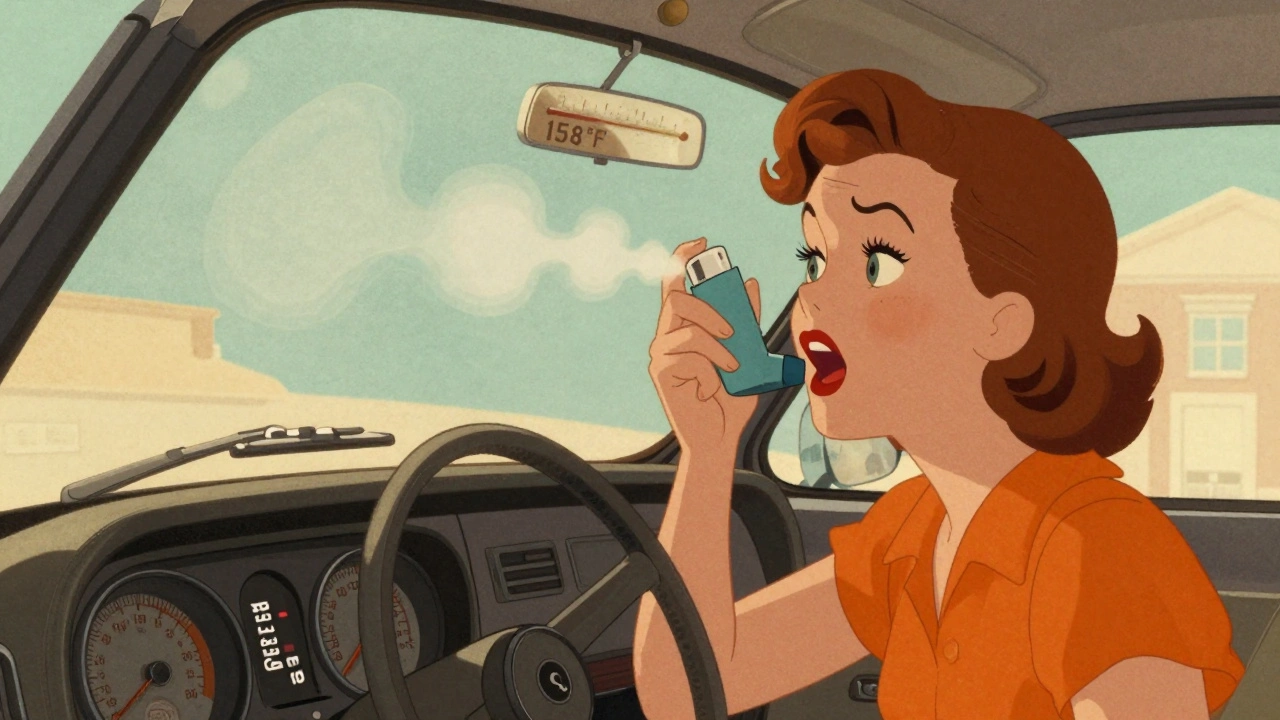
- Car dashboard: On a 90°F day, your car can hit 158°F inside 30 minutes. The NIH tested this. Medication denatures. Full stop.
- Gym bag or purse: Left in a hot car or under direct sun? You’re risking degradation. One Reddit user, ‘AsthmaWarrior87’, said their inhaler failed during an attack - it had been in a gym bag that hit 110°F in the car.
- Windowsill or near heating vents: Direct sunlight and heat sources cause rapid breakdown. Even a radiator 3 feet away can push the temp past 86°F.
- With other inhalers: Mixing DPIs with pMDIs is a hidden risk. Moisture from the pMDI’s propellant can leak and ruin the dry powder. Keep them separated.
How to Store Inhalers and Nebulizer Meds the Right Way
Follow this simple system:
- Use the original packaging. The box blocks light and helps stabilize temperature.
- Store in an opaque, dry container. A small plastic box with a lid, kept in a bedroom drawer or closet, works better than any fancy case.
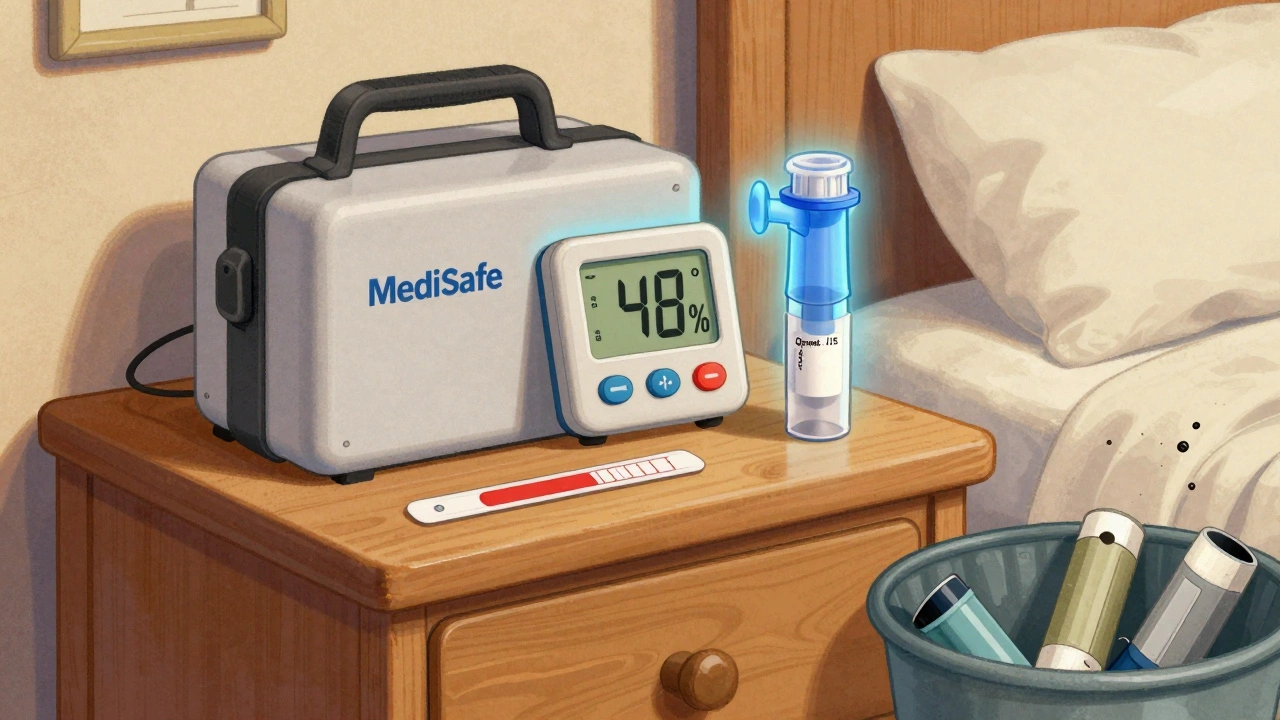
- Check humidity. Buy a $10 digital hygrometer. If the room is above 60% humidity, move your meds. Ideal range: 40-50%.
- Use a temperature strip. Timestrip or similar stickers change color if the med was exposed to unsafe temps. Stick one on the box. You’ll know instantly if it’s been compromised.
- Keep nebulizer solutions refrigerated until opened. Once opened, write the date on the ampule. Toss it after 7 days, even if it looks fine.
For travel, use the “Rule of 15”: no more than 15 minutes outside a temperature-controlled space. Insulated cases like the MediSafe case (tested by the Asthma and Allergy Foundation of America) can keep meds stable for up to 15 hours. They’re $15 on Amazon. Worth every penny.
What About Schools and Workplaces?
One of the biggest hidden dangers? Schools. In 2022, 63% of school-related asthma emergencies involved inhalers stored in nurse’s offices that were too hot - often near windows or HVAC vents. The CDC says this is preventable.
Leading schools are now installing “Cool Cubby” systems - small, temperature-monitored lockers that maintain 72°F ±2°F. St. Jude Children’s Research Hospital reduced inhaler failures by 89% with this system. If your child’s school doesn’t have one, ask for it. It’s not luxury - it’s safety.
At work, don’t leave your inhaler on your desk near the window. Keep it in a drawer or a small insulated pouch. If you’re in a warehouse, factory, or outdoor job, talk to HR about a climate-controlled storage option. You’re not asking for special treatment. You’re asking to stay alive.
What’s New in 2025? (And What’s Coming)
The industry is changing. In 2023, the FDA cleared the first Bluetooth-enabled inhaler case: SmartInhale. It tracks temperature and humidity, sends alerts to your phone if your meds are at risk, and logs data for your doctor. GlaxoSmithKline also rolled out humidity-indicating packaging for Ellipta inhalers - the box turns color if moisture got in.
By 2026, the FDA plans to require all rescue inhalers to have built-in environmental sensors. That’s not science fiction. It’s coming. Until then, you’re still the first line of defense.
And climate change is making this harder. A 2023 study in The Lancet Planetary Health predicts that by 2030, 32% of the U.S. population will face more than 60 days a year above 86°F. That’s 100 million people. If your storage habits don’t adapt, your medicine won’t work.
Common Mistakes and Real Stories
Here’s what patients actually do - and what happens:
- “I kept it in my purse all summer.” → 42% of asthma patients do this. 28% say their inhaler felt weaker. The CDC says that’s not in their head.
- “I didn’t realize the expiration date was wrong.” → 35% of negative Drugs.com reviews blame “medication stopped working before expiration.” Storage is the culprit, not the date.
- “I stored my DPI next to my pMDI.” → Johns Hopkins found this caused 22% of DPI failures. Moisture transfer is real.
One mother in Florida told her story on a patient forum: “I bought the MediSafe case after my son had two ER visits. Used it for 18 months. Zero issues. No more panic when we travel.” That’s the difference.
What to Do If Your Inhaler Fails
If you’ve stored it wrong - or you’re not sure - don’t risk it.
- Use a backup inhaler if you have one.
- If you’re having trouble breathing and your inhaler doesn’t work, call 911. Don’t wait. Don’t try to “power through.”
- Replace it immediately. Even if it’s not expired, if it was left in a hot car or bathroom, it’s unreliable.
- Report it to the manufacturer. They track these failures. Your report helps improve future packaging.
And never, ever throw an inhaler in the trash or burn it. The propellant is pressurized. It can explode in a landfill or incinerator. Return it to a pharmacy with a take-back program.
Can I store my inhaler in the fridge?
Only if the label says so. Nebulizer solutions like Pulmicort Respules must be refrigerated until opened. But most inhalers - especially multi-dose ones like Symbicort or Advair - should not be refrigerated. Condensation can form inside, ruining the medicine. Always check the manufacturer’s instructions.
How long do nebulizer solutions last after opening?
Most liquid nebulizer solutions, like albuterol or budesonide, are good for only 7 days after opening - even if the bottle says “expires in 2026.” After that, the concentration drops and the medicine becomes ineffective. Write the opening date on the ampule and toss it after a week.
Is it safe to leave my inhaler in my car during winter?
No. Freezing temperatures can also damage inhalers. Cold can cause the propellant to thicken or the valve to stick. If it drops below 59°F for long periods, the dose may not deliver correctly. Keep your inhaler inside your coat pocket or in your bag - never on the seat or in the glovebox.
What’s the best way to carry an inhaler while traveling?
Use an insulated case like the MediSafe or SmartInhale. These are designed to keep meds between 68°F-77°F for up to 15 hours. Keep it in your carry-on, not checked luggage. Never leave it in a hot airport terminal or rental car. Follow the Rule of 15: no more than 15 minutes outside temperature control.
Do I need to clean my inhaler? How often?
Yes. For pMDIs, rinse the mouthpiece with warm water once a week and let it air-dry. Never use soap or put it in the dishwasher. For DPIs, wipe the mouthpiece with a dry cloth - never wet it. Moisture ruins the powder. Always follow the cleaning instructions on your specific device’s label.
How do I know if my inhaler is still working?
Test it monthly: remove the cap, shake well, and spray into the air away from your face. You should hear a clear puff and see a fine mist. If it’s weak, sputters, or looks like spray paint, it’s degraded. Replace it. Don’t wait for an emergency.
Next Steps: Protect Your Life
Right now, check where your inhaler is. Is it in the bathroom? In your car? On the windowsill? Move it. Buy a $10 hygrometer. Get a temperature strip. Use an insulated case if you travel. Talk to your pharmacist - ask them to verify your storage habits. You wouldn’t leave insulin in the sun. Don’t treat your inhaler any differently.
Proper storage isn’t a suggestion. It’s a survival skill. And in 2025, with temperatures rising and asthma cases growing, it’s more important than ever. Your life depends on it.



8 Comments
Jennifer Patrician
December 5, 2025 at 06:36
So let me get this straight - the FDA is letting Big Pharma sell inhalers that break down in heat, but they won’t regulate the damn temperature in school nurse’s offices? This isn’t about storage, it’s about corporate negligence. They know 12% of ER visits are preventable, yet they’re pushing ‘SmartInhale’ gadgets at $50 a pop instead of fixing the infrastructure. Climate change? Nah, it’s just a profit opportunity for tech startups. You think your $15 MediSafe case is saving lives? It’s a Band-Aid on a hemorrhage.
Mellissa Landrum
December 6, 2025 at 00:55
lol u guys are so gullible. the real reason inhalers fail? They’re laced with tracking chips. The gov’t wants to monitor who’s using asthma meds so they can flag ‘high-risk’ citizens. That’s why they push ‘humidity sensors’ and ‘Bluetooth cases’ - it’s all surveillance. I keep my inhaler wrapped in aluminum foil in my sock drawer. No signal. No tracking. No death by corporate drone.
luke newton
December 6, 2025 at 21:47
You people are treating your life like a convenience. You leave your medication in a hot car like it’s a bag of chips. You don’t check the humidity because ‘it’s too much work.’ You’d rather blame the system than take responsibility. This isn’t a conspiracy - it’s basic human laziness. Your child’s life isn’t a suggestion. If you can’t be bothered to store your inhaler properly, you don’t deserve to breathe.
Ali Bradshaw
December 6, 2025 at 22:07
Just wanted to say - I’ve been using a cheap plastic container from the dollar store with a silica gel pack inside. Keeps my DPI dry, no fancy tech needed. Been doing it for 3 years. No issues. Also, I write the opening date on my nebulizer ampules with a sharpie - simple, but it works. You don’t need a $50 gadget to stay alive. Just a little consistency.
an mo
December 8, 2025 at 15:31
Let’s deconstruct the data: 40% reduction in drug delivery under thermal stress isn’t degradation - it’s pharmacokinetic failure. The propellant’s vapor pressure curve is non-linear above 86°F, leading to suboptimal aerosolization kinetics. The FDA’s 2022 safety report is underpowered - n=1,200 patients, no control for baseline lung function. Also, ‘Rule of 15’ is anecdotal. Where’s the peer-reviewed validation? This is risk communication masquerading as science.
aditya dixit
December 9, 2025 at 11:27
It’s funny how we think of medicine as something we just ‘use’ - like a tool. But it’s not. It’s a living thing, in a way. It responds to heat like a plant to sunlight, to moisture like bread to humidity. We forget that our bodies are delicate ecosystems. If we treat our inhalers like we treat our phones - tossed in bags, left in sun, ignored until it breaks - then of course it fails. Maybe the real problem isn’t storage. It’s how little we respect the things that keep us alive.
Lynette Myles
December 11, 2025 at 08:54
SmartInhale is a scam. The sensors are fake. They don’t even measure real-time temp. It’s just a timer with a light.
Annie Grajewski
December 13, 2025 at 06:31
Oh wow, so the solution to climate change-induced asthma emergencies is… buying another gadget? Like, I get it, the MediSafe case is cute. But you’re telling me the answer to 100 million people facing 60+ days over 86°F is… $15 plastic boxes? Meanwhile, the government’s busy subsidizing oil pipelines. We’re treating symptoms like they’re the disease. Also, I stored mine in my bra for a week. It worked. Just saying.