

Equipment Maintenance: Calibration and Validation Requirements for Manufacturing Quality
Why Calibration Isn’t Just a Checklist Item
Think of a thermometer in a hospital lab that reads 99.5°F when the real temperature is 101°F. That half-degree error might seem small-but in a manufacturing setting, it could mean a batch of sterile injectables gets rejected, a patient gets the wrong dosage, or a medical device fails in surgery. This isn’t hypothetical. In 2023, 37.2% of FDA warning letters cited inadequate calibration procedures. Calibration isn’t about following rules-it’s about preventing real-world harm.
Calibration means comparing your instrument’s reading to a known standard-something traceable back to the International System of Units (SI). If your micrometer says a part is 5.00 mm, but the reference standard says it’s actually 5.03 mm, your machine is off by 0.03 mm. That’s enough to make a valve leak or a surgical implant misfit. ISO 13485:2016, the global standard for medical device quality, requires this traceability. And it’s not optional. Every piece of measuring equipment used in production, inspection, or testing must be calibrated at defined intervals or before use.
What ISO 13485:2016 Actually Demands
ISO 13485:2016 doesn’t just say “calibrate your tools.” It spells out exactly how. Clause 7.6 requires three things: traceability, documentation, and control. Traceability means your calibration standard must link back to NIST (in the U.S.) or BIPM (in Europe) through an unbroken chain. No shortcuts. No “we’ve always used this gauge.”
Documentation isn’t a folder you file away. It’s a living record. Every calibration must include:
- The unique ID of the equipment
- The date and next due date
- The environmental conditions during calibration (usually 20°C ±2°C and 40% RH ±10%)
- The uncertainty of the measurement
- Who performed it and who approved it
And records? You must keep them for at least the product’s lifecycle plus two years. If you make a pacemaker with a 15-year lifespan, you’re storing calibration records for 17 years. That’s not a burden-it’s legal insurance.
Calibration Intervals: How Often Is Enough?
There’s no universal answer. A micrometer in an aerospace plant might need calibration every 3 months. A basic digital scale in a food packaging line might be fine every 12 months. The key is risk-based scheduling.
ISO 9001:2015 lets you set your own intervals based on data. Many companies start with the manufacturer’s recommendation, then adjust. A 2024 Reddit thread from quality engineers showed 63% of users extended intervals after proving their equipment stayed within tolerance for 18+ months. One lab saved $18,500 a year by switching from quarterly to biannual calibration on electronic scales-after collecting 18 months of stability data.
But don’t assume stability. Environmental factors kill accuracy. NIST found 57.8% of out-of-tolerance incidents happened in places where temperature swung more than ±5°C from calibration conditions. A lab in Texas with no AC in summer? Your pH meter will drift. A warehouse in Wisconsin with winter drafts? Your torque wrench will lie.
Use the Method 5 approach from SAE AS9100D:2016: combine manufacturer guidelines, historical performance, and risk. If a device has never gone out of tolerance in 3 years? Extend the interval. If it’s used in a dirty, vibrating, humid environment? Shorten it. Don’t guess. Measure.
Validation: When Calibration Isn’t Enough
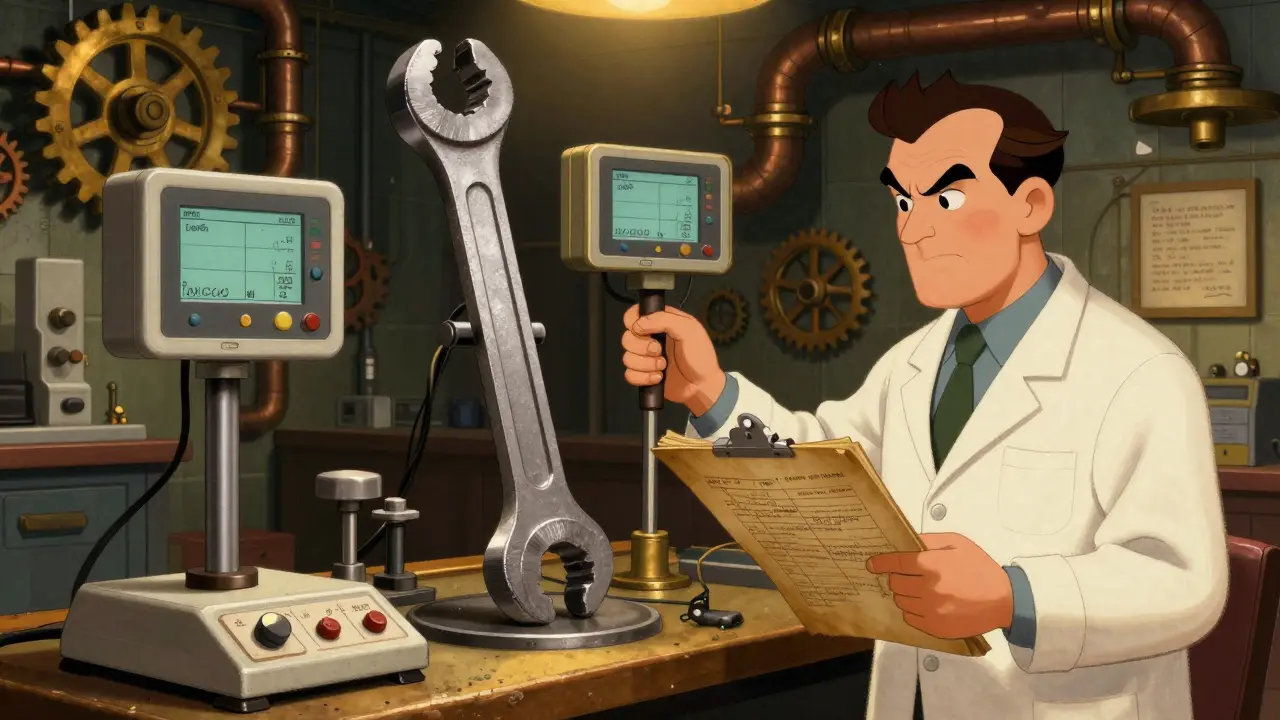
Calibration tells you your instrument is accurate. Validation tells you it works right in your process.
Imagine you install a new automated filling machine. You calibrate its flow sensor to 10 mL ±0.1 mL. But does it fill 10,000 bottles a day without clogging? Does it handle different viscosities? Does it stop cleanly when the bottle is full? That’s validation.
Validation follows GAMP 5 guidelines: Installation Qualification (IQ), Operational Qualification (OQ), and Performance Qualification (PQ). IQ checks the machine was installed correctly. OQ tests it under extreme conditions-max speed, min flow, power surges. PQ proves it consistently produces acceptable product over time.
For medical devices, validation can cost $25,000 to $500,000 per system. It takes 18-24 months. But skipping it? That’s how you get a Class III recall. In 2022, a company skipped PQ on a sterilizer. The autoclave met calibration specs-but didn’t kill spores in dense packs. 1,200 devices were recalled. The cost: $14 million.
Regulatory Differences That Trip Up Companies
Not all standards are the same. ISO 13485 demands full traceability to SI units. CLIA, which governs clinical labs, allows some devices to skip calibration if they’re manufacturer-calibrated and verified daily. Point-of-care glucose meters fall here. They’re pre-calibrated. You just check them with control solutions.
That’s a 23.5% reduction in workload for waived tests-but only if you follow the verification rules. Miss a daily control test? You’re non-compliant.
Then there’s the EU vs. U.S. divide. EU MDR 2017/745 requires traceability to BIPM. FDA accepts NIST. Multinational companies now run dual calibration systems. One for Europe, one for the U.S. That adds 18.7% to compliance costs.
And China? Manufacturers there often calibrate 30% more frequently than global norms, due to past quality issues. But as CNAS accreditation grows, that’s starting to change.
Common Pitfalls and How to Avoid Them
Here’s what goes wrong-and how to fix it:
- Pitfall: Using outdated calibration certificates. Solution: Use software that auto-flags expiring certs. GageList and Trescal do this well.
- Pitfall: Calibration done in the wrong environment. Solution: Install ISO Class 5 environmental chambers if humidity or temp swings exceed ±5°C. Cost: $85K-$120K. Worth it.
- Pitfall: No one knows who’s responsible. Solution: Assign a Calibration Coordinator. Not an afterthought. A role with authority.
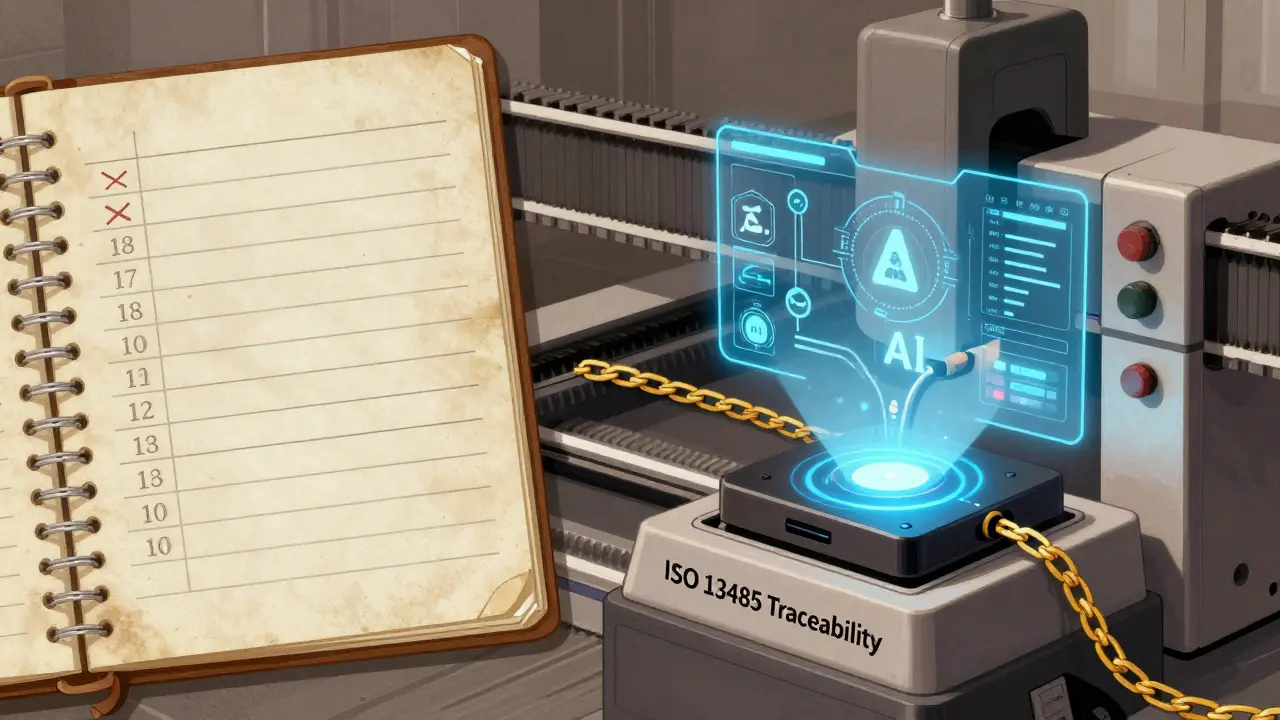
- Pitfall: Manual logs. Solution: 89 manufacturers using calibration software cut audit prep time from 84 to 31 hours per week.
And don’t forget the human factor. 83.6% of calibration labs report technician shortages. If you can’t hire a certified expert, train someone. ASQ’s Certified Calibration Technician (CCT) credential is the gold standard. Holders earn 22.5% more than non-certified peers.
The Future: AI, IoT, and Continuous Verification
Calibration is shifting from scheduled events to continuous monitoring. IoT sensors on equipment now track vibration, temperature, and usage in real time. If a CNC machine starts vibrating outside normal range, the system flags it for calibration-not because it’s due, but because it’s behaving differently.
Pfizer’s pilot program used AI to schedule calibrations. Result? 31.7% cost reduction. No missed dates. No over-calibration.
But there’s a catch. NIST found 44.2% of automated systems fail to document the chain of custody for reference standards. If you can’t prove your standard was handled correctly, your whole calibration is invalid.
And now, ISO 13485:2016 Amendment 1 (March 2024) requires calibration of AI/ML systems. If your quality system uses machine learning to predict defects, you must validate its algorithm isn’t drifting. That’s new. That’s critical.
By 2026, FDA will require all Class II/III device manufacturers to use electronic records. Paper logs are dead. The shift is coming fast.
What You Need to Do Today
- Inventory everything: List every measuring device. From micrometers to thermocouples. If it measures, it needs calibration.
- Classify by risk: High-risk (medical implants, sterile fillers) = quarterly or continuous. Low-risk (basic scales, tape measures) = annually.
- Set intervals using data: Don’t guess. Use Method 5: manufacturer + history + risk.
- Document everything: ID, date, standard used, environment, technician, result, uncertainty. No exceptions.
- Automate: Invest in calibration software. It saves time, reduces errors, and passes audits.
- Train your team: Even a 40-hour NCSL MET-101 course changes how your team sees calibration-from chore to control.
Calibration and validation aren’t costs. They’re insurance. The cost of one recall? Often 100x the price of a year’s calibration program. Get it right, and you don’t just comply-you protect lives and your reputation.
What’s the difference between calibration and validation?
Calibration checks if a measuring device reads accurately against a known standard. Validation confirms that a piece of equipment performs correctly in its actual use-like filling syringes, sterilizing tools, or inspecting parts. Calibration is about accuracy. Validation is about performance.
How often should I calibrate my equipment?
There’s no universal answer. Start with the manufacturer’s recommendation, then adjust based on usage, environment, and historical data. High-precision tools in harsh conditions may need quarterly calibration. Stable tools in controlled environments can go 12-24 months. Use risk-based scheduling-like Method 5-to reduce unnecessary calibrations without compromising safety.
Does ISO 13485 require traceability to NIST?
Yes. ISO 13485:2016 requires calibration traceability to SI units through an unbroken chain. In the U.S., that means NIST-traceable standards. In Europe, it’s BIPM. You must document each step in the chain. No “as-is” calibrations from vendors unless they provide full traceability documentation.
Can I use manufacturer-provided calibration certificates?
Only if they include full traceability to SI units, environmental conditions, measurement uncertainty, and are signed by an accredited lab. Many factory certificates lack this. If you can’t verify the chain, you must re-calibrate in-house or through an accredited lab before putting the equipment into production.
What happens if I don’t calibrate my equipment?
You risk non-conforming products, regulatory action, and patient harm. In 2023, 37.2% of FDA warning letters cited calibration failures. This can lead to product recalls, production shutdowns, fines, or loss of ISO 13485 certification. For medical device makers, that’s often the end of the business.
Is calibration software worth the investment?
Yes, especially if you manage 50+ devices. Companies using software like GageList or Trescal cut audit prep time by 63%, reduce human error, and auto-flag expiring calibrations. Small manufacturers report saving 15+ hours per week on documentation. The ROI is clear: faster audits, fewer errors, and less stress.


11 Comments
Diana Dougan
January 31, 2026 at 00:24
lol so now we need AI to calibrate our calibrators? next they'll be calibrating the calibration software with a quantum calibrator. can i get a certificate for that? 🤡
Bobbi Van Riet
January 31, 2026 at 19:36
I've seen too many labs cut corners on this. One place I worked had a micrometer that hadn't been calibrated in 4 years because 'it's always been accurate'. Then one day it was off by 0.15mm and 1200 parts got scrapped. The real cost isn't the calibration-it's the panic, the audit, the lost trust. Training your team to see this as part of quality culture, not a chore, changes everything. Start small: label every tool, log every date, and make it someone's actual job-not an afterthought at the end of the quarter.
Holly Robin
February 1, 2026 at 16:52
THEY'RE LYING TO YOU. NIST doesn't even exist as a real standard anymore. It's all controlled by the same contractors who sell you the calibration software. You think your 'traceable' certificate is legit? Look at the fine print. It's signed by a guy in a basement in Ohio who got his 'accreditation' from a website that costs $99/year. This whole system is a racket. And don't get me started on ISO-they're just a tax collection agency with a fancy logo. They want you broke so you buy their 'compliance packages'. Wake up.
Shubham Dixit
February 2, 2026 at 05:35
In India, we used to think calibration was a western obsession. But after our pharma exports got rejected three times in a row because of 'traceability gaps', we realized: this isn't about politics, it's about survival. We trained 47 technicians in NCSL courses, bought a temperature-controlled chamber, and now our exports are accepted in 14 countries. You don't compete on price anymore-you compete on trust. And trust is built one calibrated micrometer at a time.
KATHRYN JOHNSON
February 3, 2026 at 08:51
This post is accurate. The data is correct. The compliance requirements are non-negotiable. Failure to adhere is not negligence-it is criminal recklessness. You are not protecting equipment. You are protecting lives. There is no middle ground.
Blair Kelly
February 3, 2026 at 16:51
I used to think calibration was boring. Then my company got slapped with a Class II recall because someone forgot to log a torque wrench. 14 months of audits. 3 million in fines. My boss got fired. I quit. Now I work for a company that uses IoT sensors that auto-flag drift. No paperwork. No panic. Just real-time data. If you're still using Excel sheets, you're not just behind-you're a liability.
Rohit Kumar
February 4, 2026 at 00:39
There is a deeper truth here: calibration is not about tools. It is about humility. To calibrate is to admit that your instrument, your judgment, your assumptions-even your own senses-are imperfect. In a world that glorifies certainty, this is radical. The most dangerous tool is not the one that is broken-it is the one that we believe is working because we want it to. The real validation is not in the certificate. It is in the quiet moment when you pause, question, and re-check.
Gaurav Meena
February 5, 2026 at 17:51
To anyone new to this: don't panic. Start with your top 5 high-risk tools. Get them calibrated. Document everything. Then move to the next 5. You don't need to fix everything today. But you need to start today. I've mentored 3 small shops in India to go from zero documentation to FDA-ready in 9 months. It's not about money-it's about consistency. And yes, software helps-but your team's mindset matters more. You got this. 💪
Jodi Olson
February 6, 2026 at 14:19
The future is continuous verification but the foundation remains unchanged: traceability documentation and accountability. If you cannot prove the chain you have no calibration. Period.
calanha nevin
February 8, 2026 at 03:10
I've been in this field for 22 years. I've seen companies go under because they skipped validation. I've seen patients harmed because someone assumed a gauge was fine. I've trained hundreds of technicians. The ones who succeed aren't the ones with the fanciest software-they're the ones who treat every calibration like someone's life depends on it. Because it does. Don't wait for a recall to wake up.
Sidhanth SY
February 8, 2026 at 06:38
I appreciate how this breaks it down. One thing I'd add: don't forget the people. Calibration isn't just about tools-it's about culture. If your team feels like this is just another box to check, it will fail. But if you make it part of their pride in their work? That's when real quality happens. Start by thanking the tech who logs the data. That matters more than any software.