
How to Talk to Your Doctor About Generic vs. Brand-Name Medications
Why Your Doctor Might Suggest a Generic Drug
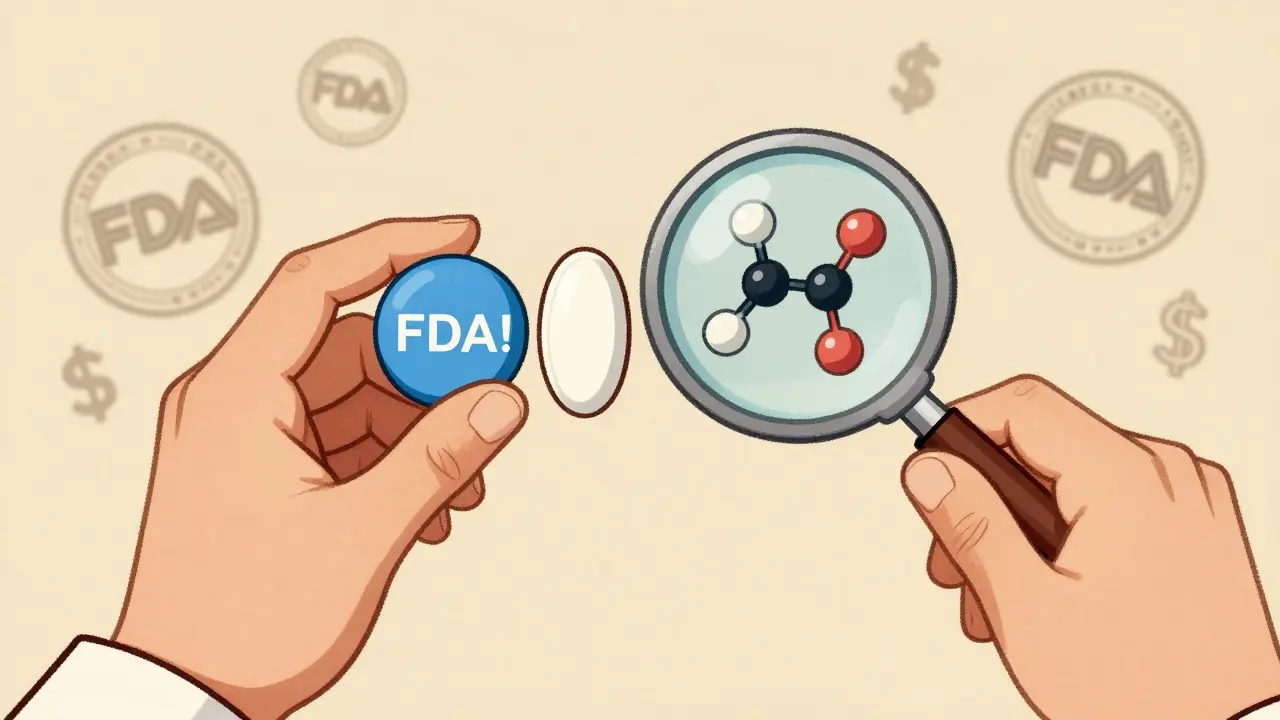
You walk into the pharmacy to pick up your prescription and see a different pill than what you’ve been taking. Same name, different color, cheaper price. You might wonder: Is this the same thing? The answer is yes - most of the time. Generic medications are not second-rate copies. They’re exact chemical twins to brand-name drugs, approved by the FDA to work the same way, in the same amount of time, with the same risks and benefits.
But here’s the catch: your doctor doesn’t always bring this up first. Maybe you’ve never asked. Maybe you assumed brand-name meant better. The truth? Nine out of every 10 prescriptions filled in the U.S. are for generics. And they’ve saved Americans over $1.6 trillion in the last 15 years. That’s not just a number - it’s someone skipping a copay, filling a refill they couldn’t afford before, or not choosing between medicine and groceries.
What Makes a Generic Drug Really a Generic?
The FDA doesn’t let just anyone slap a label on a pill and call it generic. To get approval, a generic drug must:
- Contain the exact same active ingredient as the brand-name version
- Work the same way in your body
- Have the same strength, dosage form, and route of administration
- Meet the same strict standards for purity, quality, and safety
It’s not a copycat. It’s a clone - legally required to be bioequivalent. That means the amount of medicine your body absorbs is within 80% to 125% of the brand-name version. The FDA’s acceptable range is up to 20%, so even the worst-case generic is still well within safe, effective limits. Studies show the average difference in absorption is just 3.5%.
So why do they look different? U.S. trademark laws forbid generics from copying the shape, color, or logo of brand-name pills. That’s why your blue round pill became a white oval. It’s not a change in effectiveness - just packaging. Inactive ingredients like fillers, dyes, or flavorings can vary, but they don’t affect how the medicine works.
When Brand-Name Might Still Be the Better Choice
For most people, generics are just as good. But there are exceptions. Some medications have a narrow therapeutic index - meaning even tiny changes in dosage can cause problems. Think blood thinners like warfarin, seizure drugs like phenytoin, or thyroid meds like levothyroxine.
Here’s the reality: the FDA says approved generics are safe for these drugs too. But some doctors, especially those treating complex cases, still prefer brand-name for consistency. Why? Because if you’ve been stable on one version for years, switching between different generic manufacturers - even if all are FDA-approved - might cause slight fluctuations in blood levels. It’s rare, and often not clinically meaningful, but it happens.
One 2016 study in the New England Journal of Medicine found a few patients on warfarin had minor changes in INR levels after switching generic brands. But follow-up studies haven’t consistently replicated this. Most experts agree: if you’re doing well on a generic, don’t switch. If you’re switching and notice something off - like new dizziness, mood changes, or unstable lab results - tell your doctor. Don’t assume it’s all in your head.
Cost Isn’t Just a Number - It’s a Health Decision
Let’s be real: price drives behavior. A 2022 Consumer Reports survey found that 89% of patients saw no difference in effectiveness when switching from brand to generic. But 17% felt anxious at first - not because the drug didn’t work, but because it looked different. That’s the power of perception.
And cost? Generics cost 80% to 85% less. That’s not a small savings. It’s $45 less per prescription on average. For someone on five meds a month? That’s $225 saved. That’s a full tank of gas. Or groceries. Or skipping a deductible.
Dr. Niteesh Choudhry from Harvard Medical School puts it bluntly: “Brand-name medications are not always better. Many of them are highly expensive.” And when people can’t afford their meds, they skip doses. They cut pills in half. They stop taking them altogether. That’s when health gets worse - not because the drug failed, but because the person couldn’t access it.
What to Say to Your Doctor (And What to Ask)
You don’t need to be a pharmacist to have this conversation. Here’s how to start:
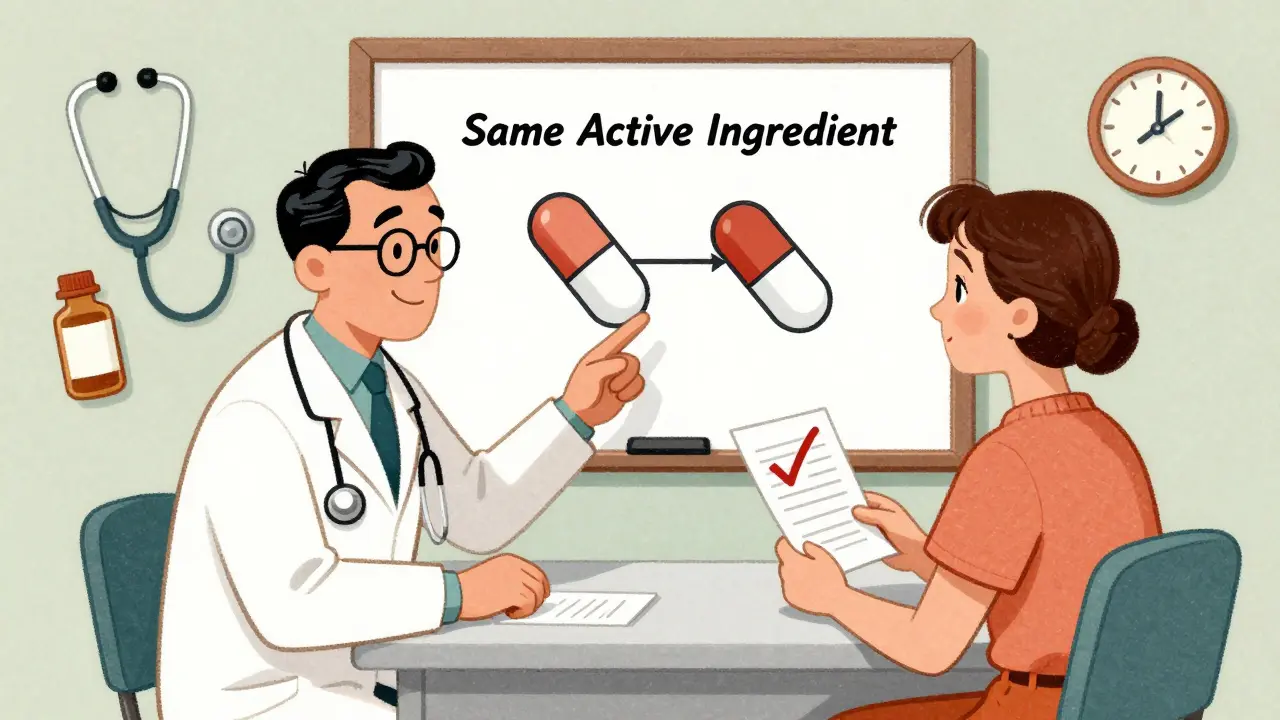
- “Is there a generic version of this medication?”
- “Will it work just as well for my condition?”
- “Are there any reasons I should stick with the brand-name?”
- “If I switch, what should I watch for?”
If your doctor says no to a generic, ask why. Is it because of your specific condition? Past reactions? Insurance rules? Don’t take “because that’s what we’ve always done” as an answer. You have a right to know.
Also, remember: your pharmacist is your ally. If you get a different-looking pill and feel unsure, call them. A 2022 American Pharmacists Association study found that 78% of patient concerns about generics were cleared up in a quick conversation with a pharmacist. They know the ins and outs of what’s in each pill - and they’re trained to explain it in plain language.
What Happens If You Don’t Ask?
In most states, pharmacists are required by law to substitute a generic unless your doctor writes “dispense as written” on the prescription. That means if you don’t speak up, you might get switched without even knowing it.
That’s fine - if you’re okay with it. But if you’ve had bad reactions before, or if you’re on a sensitive medication, you need to be in control of that decision. Don’t assume the pharmacy or your doctor is watching out for you. You’re the one taking the pill. You’re the one who knows how your body feels.
Keep a list of all your meds - brand or generic - and note any side effects, changes in energy, sleep, or mood. Bring that list to every appointment. If your pill changes color and you feel off, say it. That’s not being difficult. That’s being smart.
Real Talk: The Myths About Generics
Let’s clear up some noise:
- Myth: Generics are made in cheaper, lower-quality factories.
Truth: The same companies that make brand-name drugs often make the generics - sometimes in the same facility. The FDA inspects all of them equally. - Myth: Generics take longer to work.
Truth: They absorb at the same rate. If you feel a delay, it’s psychological - not pharmacological. - Myth: Only poor people take generics.
Truth: Everyone takes them. Medicare, Medicaid, private insurers - they all push generics because they work and they save money. You’re not getting the “discount version.” You’re getting the standard version.
Even if you’re insured, your copay might still be high. Generics can cut that in half - or more. That’s not charity. That’s science.
What About Biologics and Biosimilars?
Not all drugs have generics. Biologics - like insulin, rheumatoid arthritis drugs, or cancer treatments - are made from living cells, not chemicals. You can’t just copy them like a pill. Instead, you get biosimilars: highly similar versions, approved under different rules.
Biosimilars aren’t generics. They’re a different category. But they’re still cheaper than the original brand-name biologic. And yes, they’re backed by the FDA. If you’re on one of these drugs, ask your doctor: “Is there a biosimilar available?” The answer might surprise you.
Final Thought: Your Health, Your Voice
Medicine isn’t a one-size-fits-all system. What works for your neighbor might not work for you. But what works for you shouldn’t be determined by price tags or appearances.
Generic drugs are safe. They’re effective. They’re regulated harder than most people realize. And they’re the reason millions of Americans can afford to stay healthy.
Next time you get a prescription, don’t just take it. Ask. Listen. Speak up. Your doctor isn’t trying to upsell you. They’re trying to help you live better. And sometimes, that means choosing the cheaper pill that works just as well.
Are generic medications really as effective as brand-name drugs?
Yes. The FDA requires generic drugs to have the same active ingredient, strength, dosage form, and route of administration as the brand-name version. They must also prove bioequivalence - meaning they work the same way in your body. Studies show generics are just as effective for nearly all conditions, with 89% of patients reporting no difference in results after switching.
Why do generic pills look different from brand-name ones?
U.S. trademark laws prevent generic manufacturers from copying the exact shape, color, or logo of brand-name pills. That’s why your blue pill became white or oval. These differences are only in appearance - not in how the medicine works. The active ingredient and dosage are identical.
Can switching to a generic cause side effects?
For most people, no. But a small number of patients on narrow therapeutic index drugs - like warfarin, phenytoin, or levothyroxine - may notice slight changes when switching between generic manufacturers. This isn’t because generics are unsafe - it’s because even tiny shifts in absorption can matter for these medications. If you feel different after a switch, tell your doctor and pharmacist.
Does my insurance force me to take generics?
In most cases, yes - but only if your doctor doesn’t say otherwise. State laws require pharmacies to dispense the generic version unless your prescription says “dispense as written” or “no substitution.” If you prefer the brand-name, you need to ask your doctor to write that note. Otherwise, the pharmacy will fill the cheaper option.
Are generic drugs made in lower-quality factories?
No. The FDA inspects all manufacturing facilities - brand-name and generic - using the same standards. In fact, many brand-name companies also produce generic versions of their own drugs. The difference isn’t in quality - it’s in price. Generics cost less because they don’t have to repeat expensive clinical trials.




13 Comments
Hussien SLeiman
December 20, 2025 at 20:36
Look, I get it - generics are cheaper, but let’s not pretend the FDA is some infallible oracle. I worked in pharma compliance for 12 years, and I’ve seen the paperwork. The bioequivalence range? 80-125%? That’s a 45% swing. That’s not ‘exact same.’ That’s ‘close enough for government work.’ And don’t even get me started on the inactive ingredients - dyes, fillers, binders - those aren’t inert. They trigger reactions in people with sensitivities, and no one tracks that. You think your body doesn’t notice the switch from a blue pill to a white one? It does. It just doesn’t scream about it until you’re in the ER.
And yes, the same companies make both. But they don’t use the same lines. The generic line runs faster, cheaper, with less QA oversight. You think they’re inspecting every batch the same way? Please. Budgets are tight. Targets are high. They’re not cutting corners on safety - they’re cutting corners on scrutiny. And you’re the guinea pig.
I’m not anti-generic. I’m anti-blind trust. If you’re on warfarin, thyroid meds, or anything with a narrow therapeutic window? Stick with brand. Don’t let the pharmacist decide for you. You’re not saving money if you end up in the hospital because your INR spiked.
And don’t tell me ‘everyone takes them.’ That’s not an argument. It’s herd mentality dressed up as science. I’ve seen people switch and get depressed, dizzy, nauseous - and their doctors shrug it off as ‘psychosomatic.’ It’s not. It’s pharmacology. And if you’re not asking the right questions, you’re not protecting yourself.
So yeah. Generics are fine for ibuprofen. Fine for Zyrtec. Fine for your average statin. But when your life depends on a precise chemical balance? Don’t gamble. Ask. Push back. Demand the brand. You’ve got the right to.
Janelle Moore
December 22, 2025 at 08:14
They’re not even real drugs. I heard a guy on YouTube who works at the FDA - he said generics are made in China in factories that don’t even have running water. They use dust from old pills and mix it with chalk and call it medicine. I got my blood pressure meds switched and I started seeing shadows in the corners of my room. That’s not anxiety. That’s poison. They’re testing on us. The government lets them do it because they don’t care if you die. I’m not taking it anymore. I’m paying out of pocket now. Even if it costs $500 a month. I’d rather be broke than dead.
Henry Marcus
December 24, 2025 at 05:58
Okay, so let me get this straight - the FDA says generics are ‘bioequivalent’… but the same companies that make the brand-name versions also make the generics? And they’re in the same facility? Then why the hell do they charge 85% less?!! There’s a conspiracy here. A. Big. One. They’re not saving money on production - they’re saving it on marketing. And the real profit? It’s in the refill cycle. You think they want you to be healthy? No. They want you to be dependent. Brand-name keeps you docile. Generic? That’s the gateway drug to noncompliance. You switch, you forget, you skip doses, you get sicker - and then they upsell you the ‘premium’ version again. It’s a loop. A beautiful, sinister loop. And you’re all just playing along.
And don’t even get me started on the ‘inactive ingredients.’ That’s the real poison. The dyes? The fillers? They’re not inert - they’re designed to trigger mild side effects so you’ll come back for ‘better’ versions. That’s how they make their money. You think that’s a coincidence? Nah. It’s business. And you’re the product.
Chris porto
December 24, 2025 at 18:49
I’ve been on generic levothyroxine for six years. No issues. My TSH is stable. I feel fine. But I also know people who switched and had weird fatigue, brain fog, palpitations - and their doctors didn’t listen. So I get both sides. The science says generics are equivalent. The lived experience says sometimes they’re not. Maybe it’s the fillers. Maybe it’s the batch. Maybe it’s the placebo effect - or the nocebo effect. Either way, the system doesn’t account for individual variation enough.
What’s interesting to me is how much we’ve outsourced trust. We assume the pharmacist, the doctor, the FDA - someone else is handling it. But health is personal. Your body isn’t a statistic. It’s a unique system. So I think the real takeaway isn’t ‘use generics’ - it’s ‘know your body, track your changes, and speak up.’ That’s the only safeguard we really have.
And yeah - cost matters. A lot. But not at the cost of your peace of mind. If you’re unsure, ask for the brand. You deserve to feel safe in your treatment.
William Liu
December 25, 2025 at 09:11
This is such an important topic. I used to be scared of generics too - until I switched to a generic statin and saved $180 a month. That money paid for my kid’s braces. I didn’t feel any different. My cholesterol dropped the same. And now I tell everyone: don’t assume brand is better. Ask. It’s your right. And if your doctor says no - ask why. There’s a reason behind every answer. And sometimes, it’s just habit. Not science.
Frank Drewery
December 26, 2025 at 18:46
I’ve been a pharmacist for 18 years. I’ve filled thousands of generic prescriptions. I’ve had patients cry because they thought the pill looked ‘wrong.’ I’ve had people refuse to take them because of the color. I’ve also had people come back months later saying, ‘I didn’t know I was saving so much - I didn’t even notice a difference.’
The truth? Most people never notice. The ones who do? Often have underlying anxiety about their health. Or they’re on a medication where small shifts matter. But that doesn’t mean generics are bad. It means we need better education - not fear.
And yes, pharmacists are your allies. Call us. We’re paid to answer questions. We’re not trying to cut corners. We’re trying to help you stay healthy - and afford it.
benchidelle rivera
December 26, 2025 at 21:14
Let me be clear: if you’re not asking your doctor about generics, you’re not advocating for yourself. Period. You’re letting a system that prioritizes profit over your well-being make decisions for you. The fact that 89% of prescriptions are generic means the system is working - but only if you’re informed. If you’re passive, you’re being exploited. You’re not saving money - you’re being manipulated into silence. And that’s not health care. That’s corporate compliance with a side of false reassurance.
Ask the questions. Demand transparency. Bring your pill list. Note every change. If your doctor brushes you off - find a new one. Your life isn’t a cost-cutting exercise. You deserve to be heard. And you deserve to know what’s in your body.
Isabel Rábago
December 27, 2025 at 00:44
It’s disgusting how people just accept this. You think the government cares about you? They care about budgets. They care about stats. They don’t care if your thyroid flares up because you got a different batch. And don’t tell me ‘the FDA approved it.’ The FDA is run by people who used to work for the drug companies. It’s a revolving door. You think they’re protecting you? They’re protecting the industry. Generics are a loophole - a way to make more money while pretending they’re helping people. You’re not saving money. You’re being sacrificed.
Matt Davies
December 28, 2025 at 19:29
I’m British, and we’ve been using generics for decades - and we call them ‘generic’ because they’re, well, generic. No drama. No conspiracy. Just science. I switched from brand to generic blood pressure meds last year. My BP’s the same. My wallet’s happier. My GP didn’t even blink. We don’t have this weird brand worship here. It’s just medicine. And honestly? It’s a relief. Why are we so scared of a pill that looks different? It’s not magic. It’s chemistry. And chemistry doesn’t care what color the pill is.
Also - the same companies? Yeah. My local pharmacy gets generics made by the same factory that makes the brand. Just different packaging. It’s not a conspiracy. It’s capitalism. And honestly? I’m glad they’re doing it. Because someone’s gotta pay for all these expensive drugs. And if generics let people stay on their meds? That’s a win.
Mike Rengifo
December 29, 2025 at 07:58
I switched to generic Adderall last year. Felt a little off for a week. Thought I was losing it. Turned out the new batch had a different filler. My pharmacist told me to wait a few days. Didn’t change anything. I’m fine now. Just… weird how your brain fixates on the color. Like, I swear the white pill didn’t work as well - until I realized I was just scared of the change. Funny how that works.
Dev Sawner
December 30, 2025 at 23:51
It is a matter of considerable regret that the populace has been misled into believing that pharmaceutical equivalence is synonymous with therapeutic equivalence. The bioequivalence standards, while statistically valid, are grossly inadequate for clinical precision. The 80-125% range permits a 45% variation in systemic exposure - a margin that is entirely inappropriate for drugs with narrow therapeutic indices. Furthermore, the absence of mandatory post-market surveillance for generic substitution renders the entire framework fundamentally flawed. One must consider that the regulatory apparatus is not designed for patient safety, but for economic efficiency. The FDA is a captive institution, beholden to industry lobbying. To assert that generics are universally safe is not merely inaccurate - it is dangerously negligent.
Moses Odumbe
January 1, 2026 at 18:02
Bro. I switched to generic metformin. Looked like a tiny white rock. I was scared. Took it anyway. No issues. My A1C is down. My bank account is up. 😎 Also - the same company that makes the brand makes the generic. Same factory. Same machine. Just a different label. You’re not getting ‘cheap stuff.’ You’re getting the same thing for 80% less. Chill. It’s science, not a cult.
bhushan telavane
January 2, 2026 at 22:26
In India, generics are the backbone of healthcare. We don’t have insurance. We don’t have choice. We take what works. I’ve seen people on generic insulin for 20 years - living, working, raising kids. The science is solid. The fear? It’s from Western marketing. We don’t have the luxury of brand worship. We have the luxury of survival. And guess what? We’re still here.