
Save Money on OTC Medications: Store Brands Are Just as Effective as Name Brands
How much are you spending on over-the-counter (OTC) meds every month? If you're still reaching for the name-brand bottle because you think it works better, you might be throwing away hundreds a year. The truth is simple: store brand OTC medications work just as well as the expensive name brands - and they cost up to 85% less.
Why Store Brands Cost So Much Less
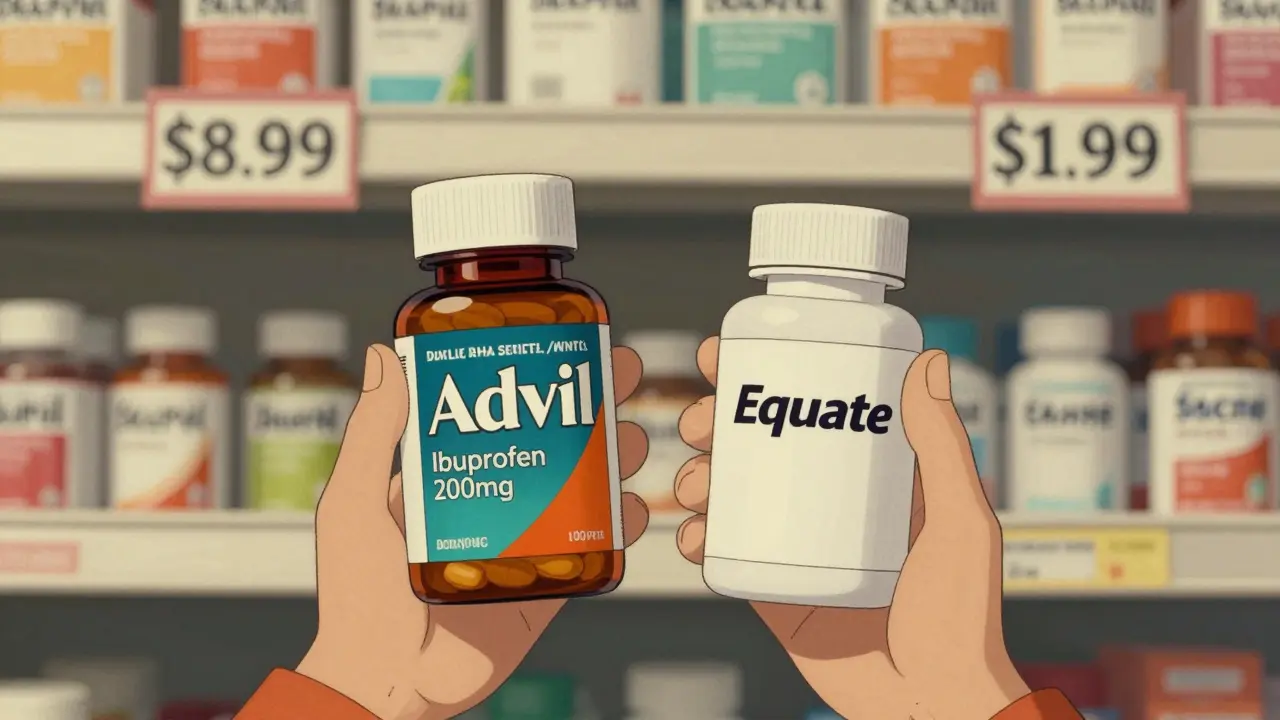
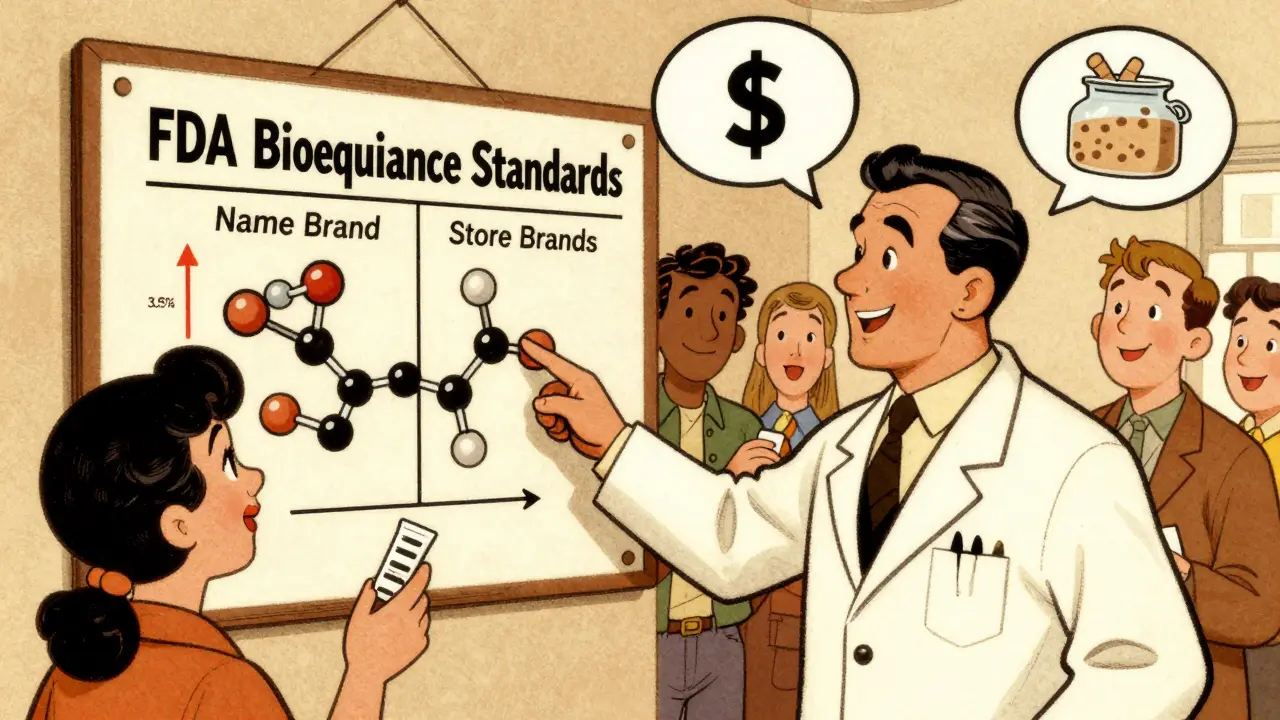
Store brand medications aren’t cheaper because they’re lower quality. They’re cheaper because they don’t spend millions on TV ads, celebrity endorsements, or fancy packaging. When you buy ibuprofen from Walmart’s Equate or CVS’s HealthAid, you’re getting the exact same active ingredient as Advil or Motrin. Same chemical. Same dosage. Same effect. The FDA requires all OTC drugs - whether branded or store brand - to meet the same safety and effectiveness standards. That means every generic pain reliever, allergy pill, or heartburn tablet must prove it delivers the same amount of medicine into your bloodstream at the same speed as the name brand. This isn’t a suggestion - it’s the law. The FDA calls this "bioequivalence," and it’s tested using strict scientific methods. Studies show the difference in how your body absorbs the drug between store brands and name brands is less than 3.5%. That’s less than the natural variation you’d see from taking one pill after eating and another on an empty stomach.What’s Actually Different Between Them
The only real differences between store brand and name brand OTC meds are:- Inactive ingredients: Things like dyes, flavors, fillers, and preservatives. These don’t affect how well the medicine works, but they can sometimes cause minor reactions in people with sensitivities - like a rash from a food dye or stomach upset from a particular binder.
- Packaging: Name brands spend heavily on sleek bottles, childproof caps, and branded labels. Store brands use plain, functional packaging that cuts costs.
- Appearance: A generic ibuprofen tablet might be white instead of blue, or oval instead of round. That’s because trademark laws require them to look different. But the medicine inside? Identical.
Real-World Savings: How Much You’re Really Paying
Let’s break it down with real prices from a typical U.S. pharmacy in early 2026:| Medication | Name Brand (30-count) | Store Brand (30-count) | Savings |
|---|---|---|---|
| Ibuprofen (200mg) | $8.99 | $1.99 | 78% |
| Acetaminophen (500mg) | $7.49 | $1.49 | 80% |
| Loratadine (10mg) | $12.99 | $2.49 | 81% |
| Dextromethorphan (15mg/5mL) | $14.99 | $3.29 | 78% |
| Famotidine (10mg) | $10.99 | $2.99 | 73% |
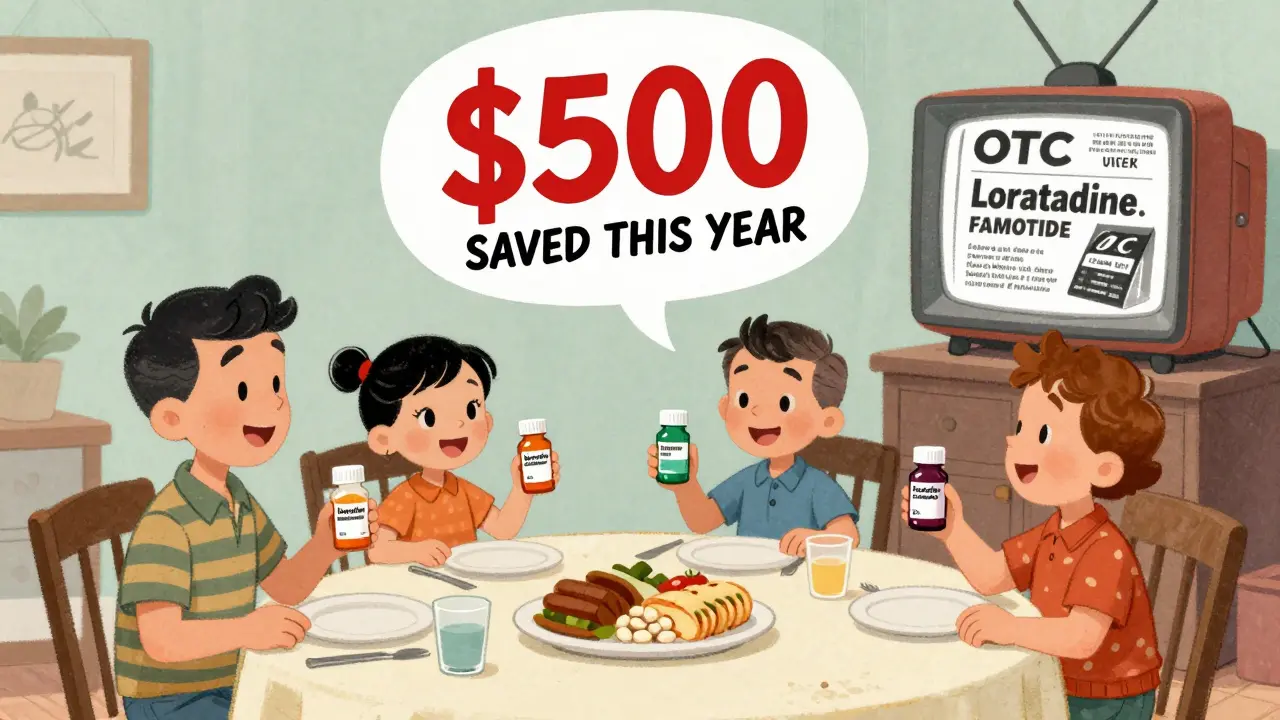
That’s not a typo. You’re paying less than $2 for a month’s supply of medicine that costs over $10 under a famous label. If you take one of these meds weekly, you could save $300-$500 a year just by switching.
What the Experts Say - And Do Themselves
You might think doctors and pharmacists avoid generics. But the opposite is true. A 2023 survey by Pharmacy Times found that 92% of pharmacists confidently recommend store brands to patients. Even more telling: 89% of pharmacists and 82% of physicians use store brand OTC meds for themselves and their families. Dr. Eric D’Agostino, a pharmacist at Brown University Health, says: "Generic medications are just as safe and effective as branded medications and will most likely cost less money out of pocket." He’s not alone. A University of Chicago study found that 78% of consumers chose store brands when they were shown side-by-side evidence that they worked the same. And on Reddit’s r/pharmacy community, 89% of 247 users reported no noticeable difference between store and name brands after years of use.How to Pick the Right Store Brand
Switching is easy - if you know what to look for. Here’s how:- Check the Drug Facts label. The first thing listed is the active ingredient. If it matches the name brand - like "ibuprofen 200mg" - you’re good.
- Compare dosage. Make sure the strength (e.g., 200mg) and form (tablet, capsule, liquid) are the same.
- Read the inactive ingredients. If you have allergies (like to red dye #40 or lactose), check the list. Store brands sometimes use different fillers.
- Don’t double-dose. Many cold and flu products contain acetaminophen. If you’re taking a store brand pain reliever and a store brand cold medicine, you might accidentally overdose. Always check the labels.
When You Might Need the Name Brand
Most people never need to go back. But there are rare cases where switching back makes sense:- You develop a rash, upset stomach, or unusual reaction after switching.
- You’re sensitive to certain dyes, gluten, or artificial flavors - common in some generic liquids.
- You’re giving medication to a child who refuses to take a generic because of taste or texture.
Why Retailers Are Investing Heavily in Store Brands
Walmart’s Equate line now has over 1,200 OTC products. CVS Health’s private label makes up 37% of their OTC sales. Target’s Up & Up offers 950+ items. Why? Because consumers are demanding them. In 2023, store brands made up 67% of all OTC units sold - meaning two out of every three pills bought were generic. Retailers aren’t just selling cheap copies anymore. They’re improving formulations. CVS started putting QR codes on store brand packaging in late 2023 that link to full ingredient lists. Walgreens launched a free pharmacist consultation service for store brand questions in January 2024. These aren’t gimmicks - they’re responses to real consumer concerns.What You Should Do Right Now
Next time you’re at the pharmacy:- Look at the price tag. If it’s more than $5 for a basic pain reliever, you’re overpaying.
- Grab the store brand. Compare the active ingredient on the label.
- Try it for one refill. If it works - and you don’t have side effects - stick with it.
- Ask your pharmacist: "Is this generic the same as [name brand]?" They’ll confirm it in seconds.
Are store brand OTC medications really as effective as name brands?
Yes. The FDA requires store brand OTC medications to have the same active ingredient, strength, dosage form, and bioequivalence as the name brand. Studies show the difference in how your body absorbs the medicine is less than 3.5%, which is within normal variation. Thousands of users report no noticeable difference in effectiveness.
Can store brand medications cause side effects?
Side effects from the active ingredient are the same as name brands. But rare reactions can happen due to inactive ingredients - like dyes, preservatives, or fillers. If you get a rash, stomach upset, or unusual reaction after switching, it’s likely one of these. Switch back to the name brand or ask your pharmacist for a different store brand with different inactive ingredients.
Is it safe to switch between store brands and name brands?
Yes. Since all OTC medications must meet the same FDA standards, switching between store brands and name brands is safe as long as the active ingredient and dosage are the same. Just avoid mixing multiple products with the same active ingredient (like acetaminophen) to prevent accidental overdose.
Why do some people swear by name brands?
Many people believe name brands work better because of advertising, brand loyalty, or placebo effect. Some also prefer the taste or texture of name-brand liquids. But when tested side-by-side, most users can’t tell the difference. A 2023 Consumer Reports survey found taste preferences were the main reason people stuck with name brands - not effectiveness.
Do pharmacists recommend store brands?
Yes. A 2023 Pharmacy Times survey found that 92% of pharmacists confidently recommend store brands to patients. And 89% of pharmacists and 82% of physicians use store brand OTC meds for themselves and their families. They know the science - and they trust it.



8 Comments
Gloria Ricky
February 14, 2026 at 08:25
OMG I just switched to Equate ibuprofen last month and I’m literally saving $50 a month 😭 I used to feel guilty like I was cheaping out, but now I’m like - why am I paying for fancy packaging?? My headache goes away the same way. My cat even judges me less now.
Stacie Willhite
February 15, 2026 at 09:14
I used to be scared to switch too - worried I’d get a weird reaction. But after reading this, I tried CVS Health’s generic allergy pills last spring. Zero issues. My hay fever’s under control and I’ve saved over $200 this year. Honestly? It felt like a tiny win for my mental health too.
Jason Pascoe
February 15, 2026 at 20:49
Interesting breakdown. In Australia, store brands are the norm here - we don’t even think twice about it. My pharmacist once told me the same active ingredient is often manufactured in the same factory, just packaged differently. The branding is pure psychology. Funny how we pay more for trust instead of chemistry.
Sonja Stoces
February 16, 2026 at 02:51
LOL this is sooo naive. 🤡 What about when the generic gives you a migraine? Or when the filler is cornstarch and you’re gluten-sensitive? You think the FDA checks every batch? Pfft. I switched once and got hives. Name brand saved my life. Also, Walmart’s stuff smells weird. Like, literally. 🤢
Annie Joyce
February 16, 2026 at 15:39
Y’all are underestimating how wild this is. The FDA doesn’t just say ‘eh, close enough’ - they run blood tests. Actual pharmacokinetic studies. You know what else has to meet that standard? Prescription drugs. So if you trust your $800/month blood pressure med? You’re already trusting generics. The only difference is the label. It’s like buying a plain white T-shirt instead of one with a logo - same cotton, same weave, different price tag. And if you’re worried about dyes? Read the back. It’s all there. No magic, no conspiracy. Just capitalism trying to sell you a placebo in a fancy box.
Rob Turner
February 17, 2026 at 15:41
It’s funny, isn’t it? We’ll pay £15 for a bottle of aspirin because it’s got a name we recognise since childhood… but if you told us the same pill was made in the same factory as the £3 version, we’d feel silly. I think we’ve confused brand loyalty with efficacy. We’re not just buying medicine - we’re buying reassurance. And that’s expensive.
Luke Trouten
February 18, 2026 at 10:18
The underlying assumption here - that consumers are irrational for preferring name brands - is itself an oversimplification. People don’t just pay for advertising; they pay for consistency. A generic might work 95% of the time, but when it doesn’t, the emotional cost of uncertainty is real. There’s a psychological safety in knowing the pill you’ve trusted for years hasn’t changed. That’s not ignorance - it’s risk aversion. And in healthcare, risk aversion isn’t irrational. It’s human.
Gabriella Adams
February 19, 2026 at 08:58
Let me just say this: I used to be a name-brand snob. I thought store brands were for people who couldn’t afford better. Then I got a job at a pharmacy. Saw the FDA reports. Watched pharmacists grab Equate like it was oxygen. Now I buy generic for everything - even the kids’ liquid cold meds. My daughter hates the taste of the CVS version? We tried a different store brand. Found one with a cherry flavor that’s identical to the name brand. Moral of the story? You’re not saving money by being afraid. You’re saving it by being informed. And honestly? That’s kinda empowering.